
Microsoft AZ-204 Practice Exams
Last updated on Nov 16,2026- Exam Code: AZ-204
- Exam Name: Developing Solutions for Microsoft Azure
- Certification Provider: Microsoft
- Latest update: Nov 16,2026
You ate developing a web application that uses the Microsoft identity platform to authenticate users and resources. The web application calls several REST APIs.
The APIs require an access token from the Microsoft identity platform.
You need to request a token.
Which three properties should you use? Each correct answer presents part of the solution. NOTE: Each correct selection is worth one point.
- A . Application secret
- B . Redirect URI/URL
- C . Application name
- D . Supported account type
- E . Application ID
HOTSPOT
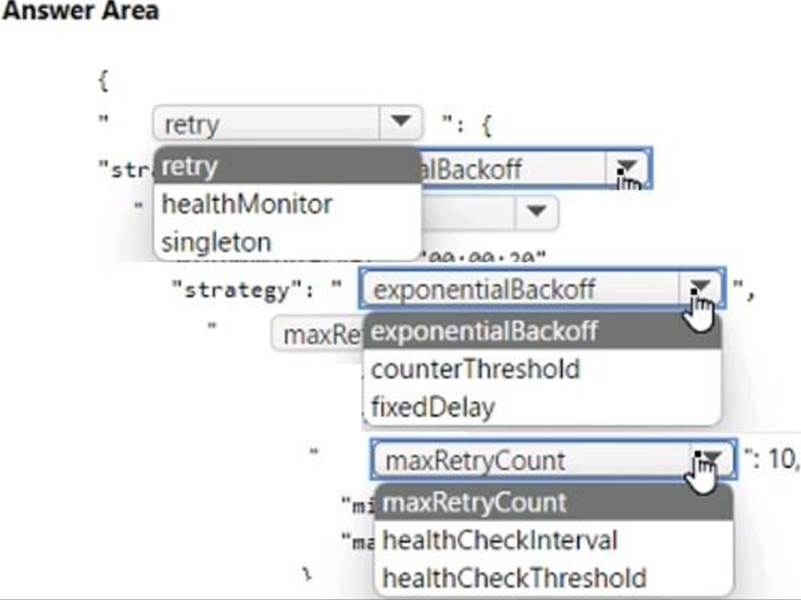
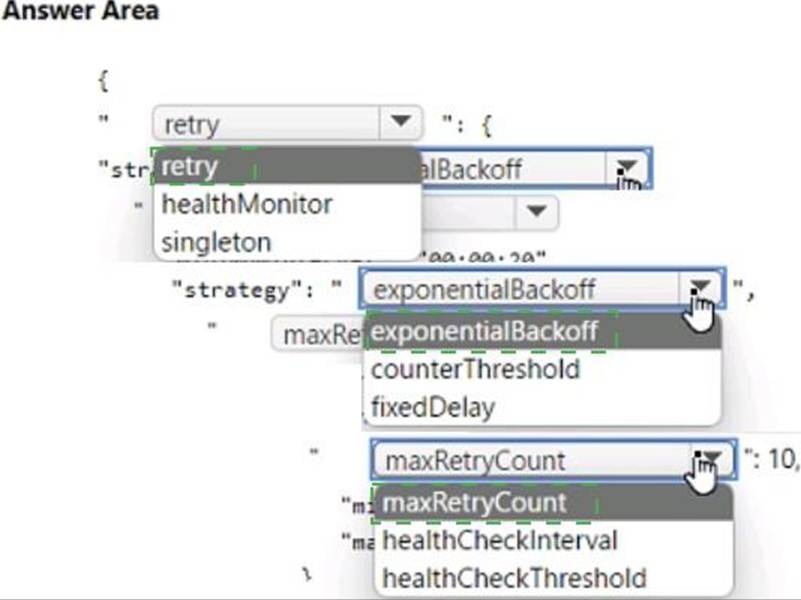
All functions in the app meet the following requirements:
• Run until either a successful run or until 10 run attempts occur.
• Ensure that there are at least 20 seconds between attempts for up to 15 minutes.
You need to configure the hostjson file.
How should you complete the code segment? To answer, select the appropriate options in the answer area. NOTE: Each correct selection is worth one point.
You need to secure the Shipping Logic App.
What should you use?
- A . Azure App Service Environment (ASE)
- B . Azure AD B2B integration
- C . Integration Service Environment (ISE)
- D . VNet service endpoint
C
Explanation:
Scenario: The Shipping Logic App requires secure resources to the corporate VNet and use dedicated storage resources with a fixed costing model.
You can access to Azure Virtual Network resources from Azure Logic Apps by using integration service environments (ISEs).
Sometimes, your logic apps and integration accounts need access to secured resources, such as virtual machines (VMs) and other systems or services, that are inside an Azure virtual network. To set up this access, you can create an integration service environment (ISE) where you can run your logic apps and create your integration accounts.
Reference: https://docs.microsoft.com/en-us/azure/logic-apps/connect-virtual-network-vnet-isolated-environment-overview
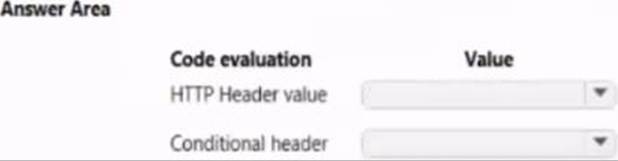
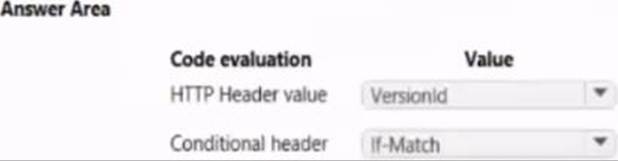
You are developing a web application by using the Azure SDK. The web application accesses data m a zone-redundant BlockBlobStorage storage account
The application must determine whether the data has changed since the application last reao the data. Update operations must use the latest data changes when writing data to the storages………………
You need to implement the update operations.
Which values should you use? To answer, select the appropriate option m the answer area. NOTE Each correct selection is worth one point.
HOTSPOT
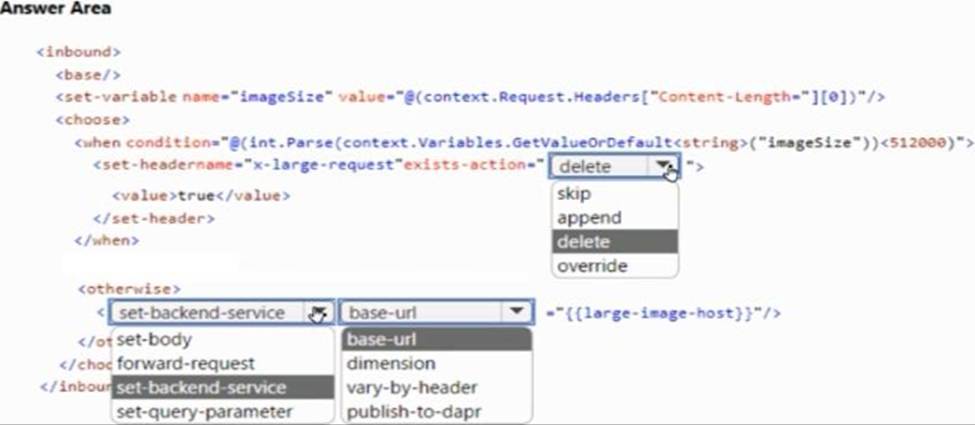
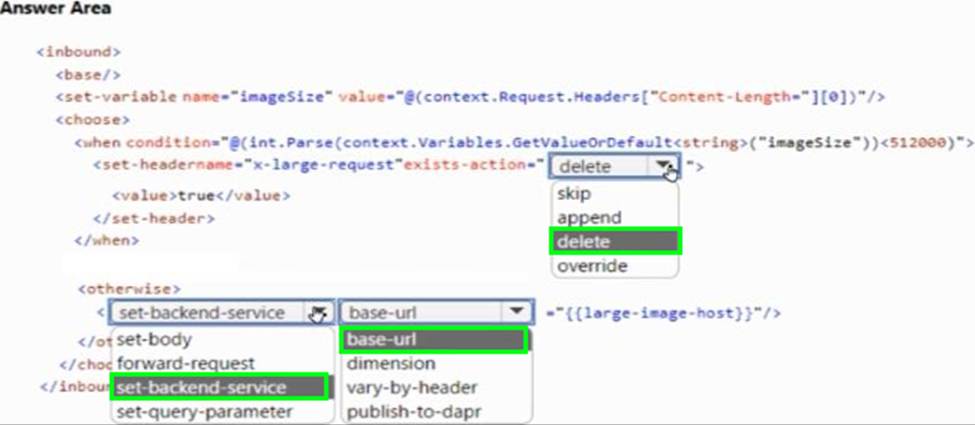
You develop an image upload service that is exposed using Azure API Management. Images are analyzed after upload for automatic tagging.
Images over 500 KB arc processed by a different backend that offers a lower tier of service that costs less money. The lower tier of service is denoted by a header named x-lsrSe-requ«st. Images over 500 KB must never be processed by backends for smaller images and must always be charged the lower price.
You need to implement API Management policies to ensure that images are processed correctly.
How should you complete the API Management inbound policy? To answer, select the appropriate options in the answer area. NOTE: Each correct selection is worth one point.
HOTSPOT
You develop an image upload service that is exposed using Azure API Management. Images are analyzed after upload for automatic tagging.
Images over 500 KB arc processed by a different backend that offers a lower tier of service that costs less money. The lower tier of service is denoted by a header named x-lsrSe-requ«st. Images over 500 KB must never be processed by backends for smaller images and must always be charged the lower price.
You need to implement API Management policies to ensure that images are processed correctly.
How should you complete the API Management inbound policy? To answer, select the appropriate options in the answer area. NOTE: Each correct selection is worth one point.
DRAG DROP
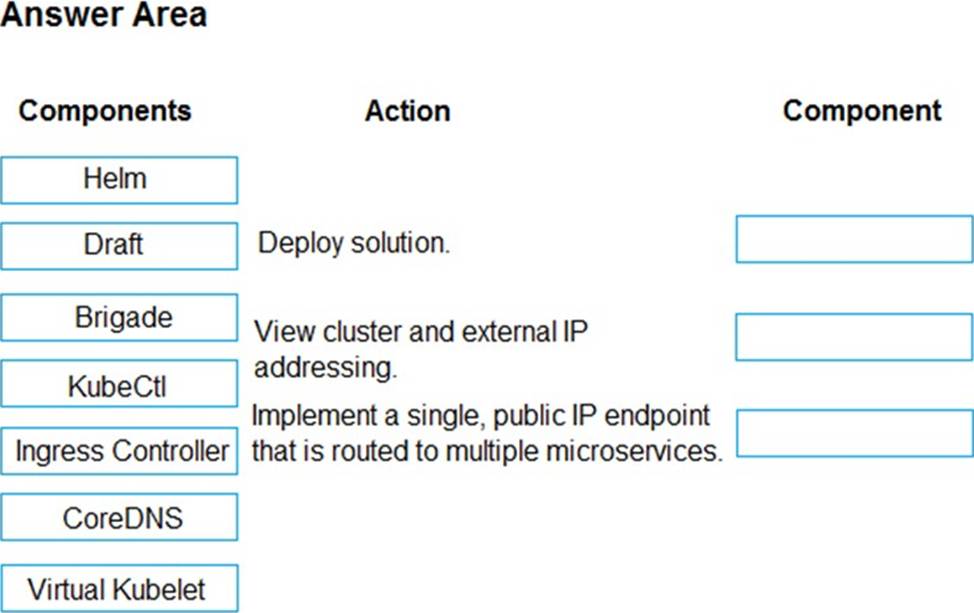
You are developing a microservices solution. You plan to deploy the solution to a multinode Azure Kubernetes Service (AKS) cluster.
You need to deploy a solution that includes the following features:
✑ reverse proxy capabilities
✑ configurable traffic routing
✑ TLS termination with a custom certificate
Which components should you use? To answer, drag the appropriate components to the correct requirements. Each component may be used once, more than once, or not at all. You may need to drag the split bar between panes or scroll to view content. NOTE: Each correct selection is worth one point.
Explanation:
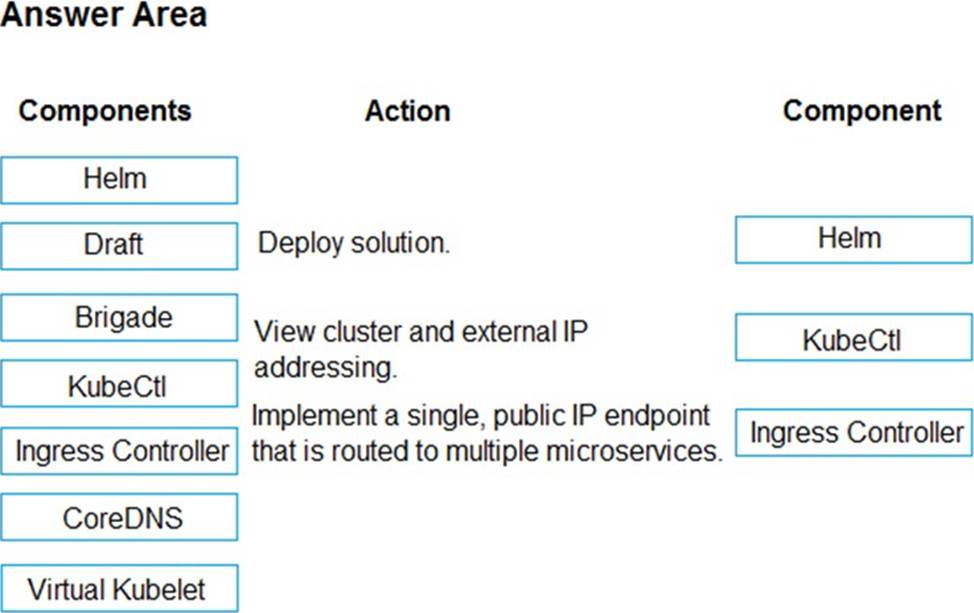
Box 1: Helm
To create the ingress controller, use Helm to install nginx-ingress.
Box 2: kubectl
To find the cluster IP address of a Kubernetes pod, use the kubectl get pod command on your local machine, with the option -o wide.
Box 3: Ingress Controller
An ingress controller is a piece of software that provides reverse proxy, configurable traffic routing, and TLS termination for Kubernetes services. Kubernetes ingress resources are used to configure the ingress rules and routes for individual Kubernetes services.
Incorrect Answers:
Virtual Kubelet: Virtual Kubelet is an open-source Kubernetes kubelet implementation that masquerades as a kubelet. This allows Kubernetes nodes to be backed by Virtual Kubelet providers such as serverless cloud container platforms.
CoreDNS: CoreDNS is a flexible, extensible DNS server that can serve as the Kubernetes cluster DNS.
Like Kubernetes, the CoreDNS project is hosted by the CNCF.
Reference:
https://docs.microsoft.com/bs-cyrl-ba/azure/aks/ingress-basic
https://www.digitalocean.com/community/tutorials/how-to-inspect-kubernetes-networking
You develop Azure solutions.
You must connect to a No-SQL globally-distributed database by using the .NET API. You need to create an object to configure and execute requests in the database.
Which code segment should you use?
- A . new Container(EndpointUri, PrimaryKey);
- B . new Database(Endpoint, PrimaryKey);
- C . new CosmosClient(EndpointUri, PrimaryKey);
C
Explanation:
Example:
// Create a new instance of the Cosmos Client
this.cosmosClient = new CosmosClient(EndpointUri, PrimaryKey)
//ADD THIS PART TO YOUR CODE
await this.CreateDatabaseAsync();
Reference: https://docs.microsoft.com/en-us/azure/cosmos-db/sql-api-get-started