
Microsoft AZ-204 Practice Exams
Last updated on Nov 16,2026- Exam Code: AZ-204
- Exam Name: Developing Solutions for Microsoft Azure
- Certification Provider: Microsoft
- Latest update: Nov 16,2026
Topic 10, Misc. Questions
Note: This question is part of a series of questions that present the same scenario. Each question in the series contains a unique solution that might meet the stated goals. Some question sets might have more than one correct solution, while others might not have a correct solution.
After you answer a question in this section, you will NOT be able to return to it. As a result, these questions will not appear in the review screen.
You develop a software as a service (SaaS) offering to manage photographs. Users upload photos to a web service which then stores the photos in Azure Storage Blob storage. The storage account type is General-purpose V2.
When photos are uploaded, they must be processed to produce and save a mobile-friendly version of the image. The process to produce a mobile-friendly version of the image must start in less than one minute.
You need to design the process that starts the photo processing.
Solution: Convert the Azure Storage account to a BlockBlobStorage storage account.
Does the solution meet the goal?
- A . Yes
- B . No
B
Explanation:
Not necessary to convert the account, instead move photo processing to an Azure Function triggered from the blob upload..
Azure Storage events allow applications to react to events. Common Blob storage event scenarios include image or video processing, search indexing, or any file-oriented workflow.
Note: Only storage accounts of kind StorageV2 (general purpose v2) and BlobStorage support event integration. Storage (general purpose v1) does not support integration with Event Grid.
Reference: https://docs.microsoft.com/en-us/azure/storage/blobs/storage-blob-event-overview
You develop and add several functions to an Azure Function app that uses the latest runtime host. The functions contain several REST API endpoints secured by using SSL. The Azure Function app runs in a Consumption plan.
You must send an alert when any of the function endpoints are unavailable or responding too slowly.
You need to monitor the availability and responsiveness of the functions.
What should you do?
- A . Create a URL ping test.
- B . Create a timer triggered function that calls TrackAvailability() and send the results to Application Insights.
- C . Create a timer triggered function that calls GetMetric("Request Size") and send the results to Application Insights.
- D . Add a new diagnostic setting to the Azure Function app. Enable the FunctionAppLogs and Send to Log Analytics options.
B
Explanation:
You can create an Azure Function with TrackAvailability() that will run periodically according to the configuration given in TimerTrigger function with your own business logic. The results of this test will be sent to your Application Insights resource, where you will be able to query for and alert on the availability results data. This allows you to create customized tests similar to what you can do via Availability Monitoring in the portal.
Customized tests will allow you to write more complex availability tests than is possible using the portal UI, monitor an app inside of your Azure VNET, change the endpoint address, or create an availability test even if this feature is not available in your region.
Reference: https://docs.microsoft.com/en-us/azure/azure-monitor/app/availability-azure-functions
DRAG DROP
You are implementing an order processing system. A point of sale application publishes orders to topics in an Azure Service Bus queue.
The label property for the topic includes the following data:

The system has the following requirements for subscriptions
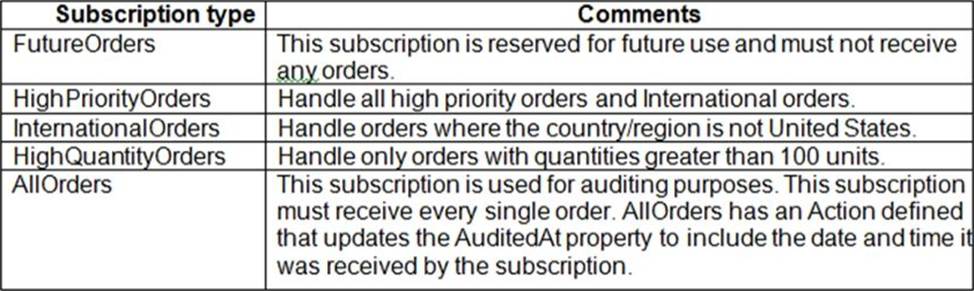
You need to implement filtering and maximize throughput while evaluating filters.
Which filter types should you implement? To answer, drag the appropriate filter types to the correct subscriptions. Each filter type may be used once, more than once, or not at all. You may need to drag the split bar between panes or scroll to view content. NOTE: Each correct selection is worth one point.
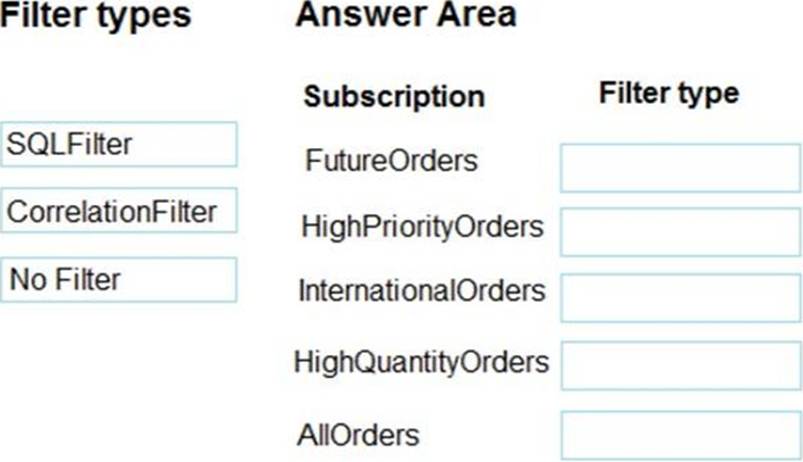
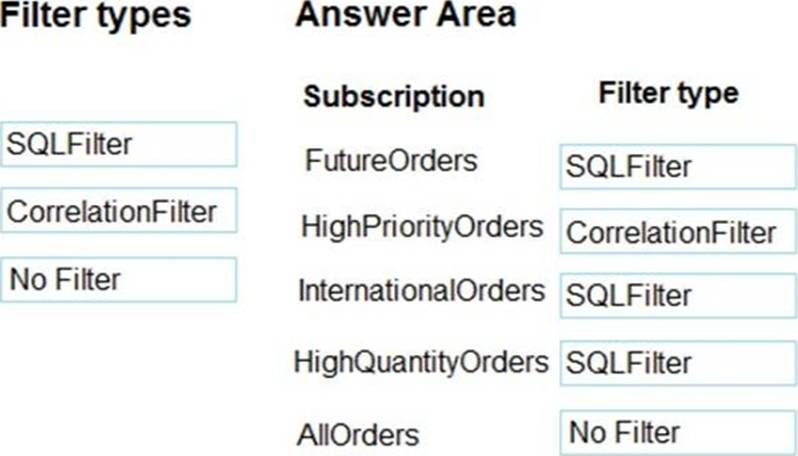
Explanation:
FutureOrders: SQLFilter
HighPriortyOrders: CorrelationFilter
CorrelationID only
InternationalOrders: SQLFilter
Country NOT USA requires an SQL Filter
HighQuantityOrders: SQLFilter
Need to use relational operators so an SQL Filter is needed.
AllOrders: No Filter
SQL Filter: SQL Filters – A SqlFilter holds a SQL-like conditional expression that is evaluated in the broker against the arriving messages’ user-defined properties and system properties. All system properties must be prefixed with sys. in the conditional expression. The SQL-language subset for filter conditions tests for the existence of properties (EXISTS), as well as for null-values (IS NULL), logical NOT/AND/OR, relational operators, simple numeric arithmetic, and simple text pattern matching with LIKE.
Correlation Filters – A CorrelationFilter holds a set of conditions that are matched against one or more of an arriving message’s user and system properties. A common use is to match against the CorrelationId property, but the application can also choose to match against ContentType, Label, MessageId, ReplyTo, ReplyToSessionId, SessionId, To, and any user-defined properties. A match exists when an arriving message’s value for a property is equal to the value specified in the correlation filter. For string expressions, the comparison is case-sensitive. When specifying multiple match properties, the filter combines them as a logical AND condition, meaning for the filter to match, all conditions must match.
Boolean filters – The TrueFilter and FalseFilter either cause all arriving messages (true) or none of the arriving messages (false) to be selected for the subscription.
Reference: https://docs.microsoft.com/en-us/azure/service-bus-messaging/topic-filters
DRAG DROP
You are developing an application to use Azure Blob storage. You have configured Azure Blob storage to include change feeds.
A copy of your storage account must be created in another region. Data must be copied from the current storage account to the new storage account directly between the storage servers.
You need to create a copy of the storage account in another region and copy the data.
In which order should you perform the actions? To answer, move all actions from the list of actions to the answer area and arrange them in the correct order.
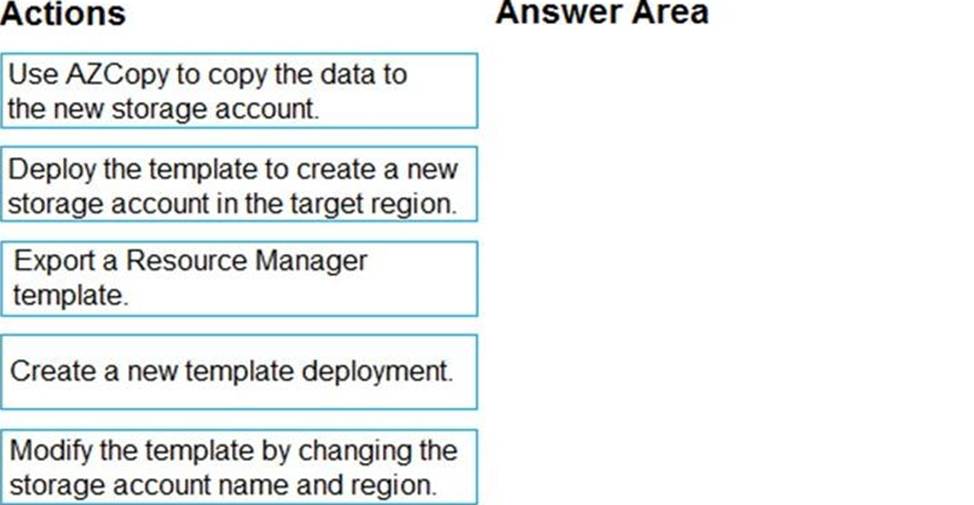
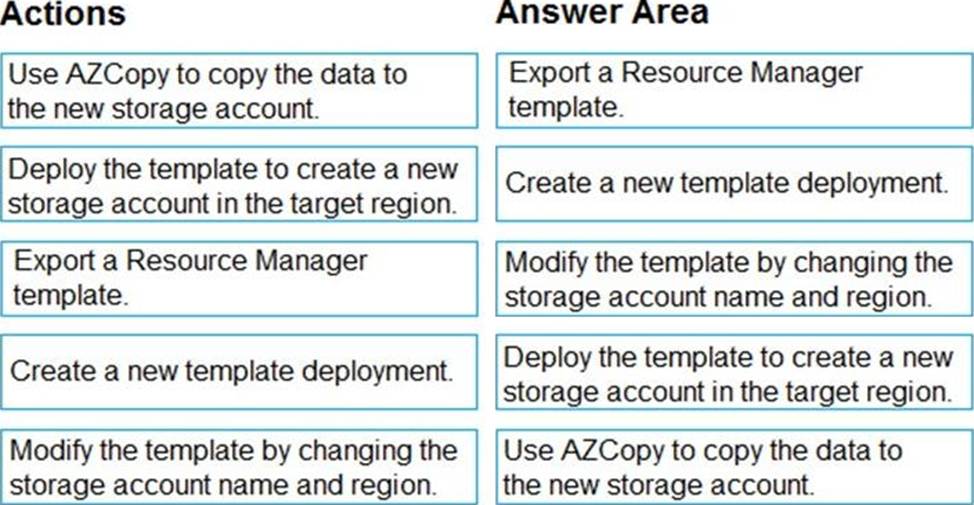
Explanation:
https://docs.microsoft.com/en-us/azure/storage/common/storage-account-move?tabs=azure-portal#modify-the-template
DRAG DROP
You are developing an application to use Azure Blob storage. You have configured Azure Blob storage to include change feeds.
A copy of your storage account must be created in another region. Data must be copied from the current storage account to the new storage account directly between the storage servers.
You need to create a copy of the storage account in another region and copy the data.
In which order should you perform the actions? To answer, move all actions from the list of actions to the answer area and arrange them in the correct order.
Explanation:
https://docs.microsoft.com/en-us/azure/storage/common/storage-account-move?tabs=azure-portal#modify-the-template
You manage a data processing application that receives requests from an Azure Storage queue.
You need to manage access to the queue.
You have the following requirements:
✑ Provide other applications access to the Azure queue.
✑ Ensure that you can revoke access to the queue without having to regenerate the storage account keys.
✑ Specify access at the queue level and not at the storage account level.
Which type of shared access signature (SAS) should you use?
- A . Service SAS with a stored access policy
- B . Account SAS
- C . User Delegation SAS
- D . Service SAS with ad hoc SAS
A
Explanation:
A service SAS is secured with the storage account key. A service SAS delegates access to a resource in only one of the Azure Storage services: Blob storage, Queue storage, Table storage, or Azure Files.
Stored access policies give you the option to revoke permissions for a service SAS without having to regenerate the storage account keys.
Reference: https://docs.microsoft.com/en-us/azure/storage/common/storage-sas-overview
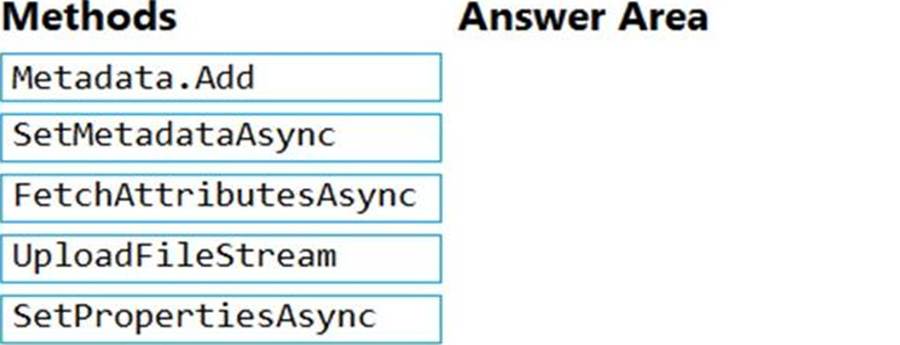
DRAG DROP
You have an application that uses Azure Blob storage.
You need to update the metadata of the blobs.
Which three methods should you use to develop the solution? To answer, move the appropriate methods from the list of methods to the answer area and arrange them in the correct order.
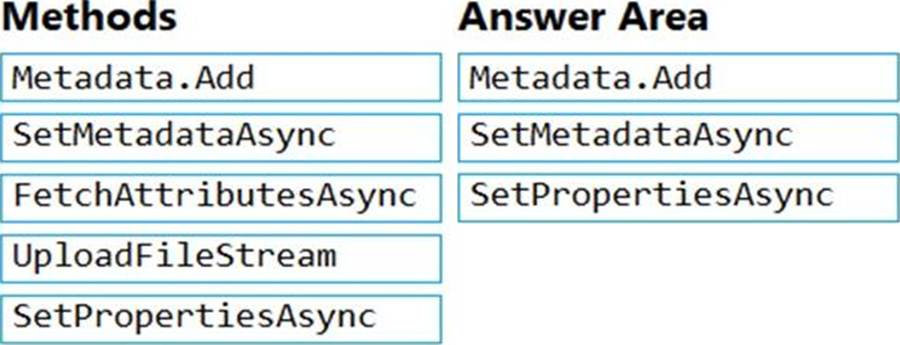
Explanation:
Metadata.Add example:
// Add metadata to the dictionary by calling the Add method metadata.Add("docType", "textDocuments");
SetMetadataAsync example:
// Set the blob’s metadata.
await blob.SetMetadataAsync(metadata);
// Set the blob’s properties. await blob.SetPropertiesAsync();
Reference: https://docs.microsoft.com/en-us/azure/storage/blobs/storage-blob-properties-metadata
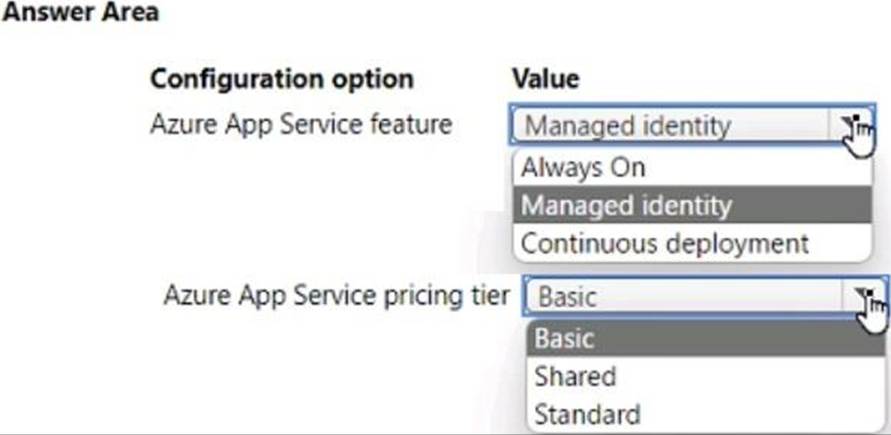
HOTSPOT
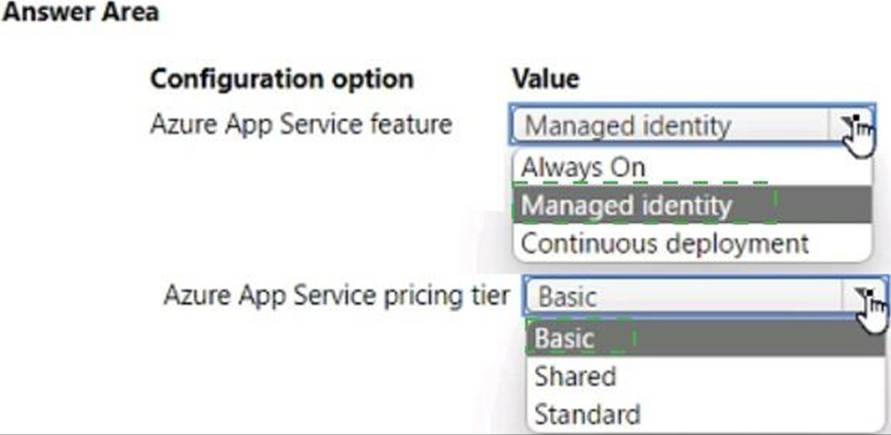
You have an App Service plan named aspl based on the Free pricing tier.
You plan to use aspl to implement an Azure Function app with a queue trigger. Your solution must minimize cost.
You need to identify the configuration options that will meet the requirements.
Which value should you configure? To answer, select the appropriate options in the answer area. NOTE: Each correct selection is worth one point.
HOTSPOT
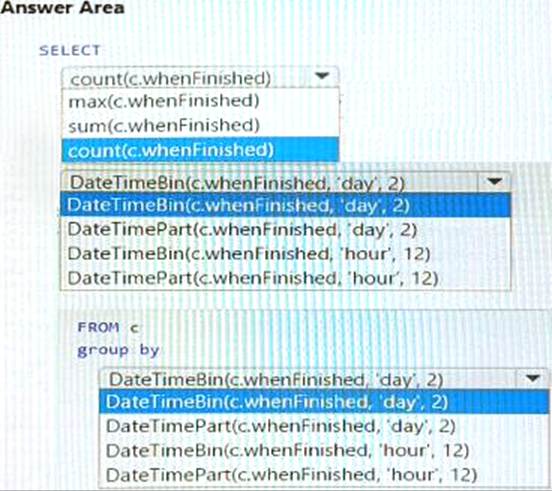
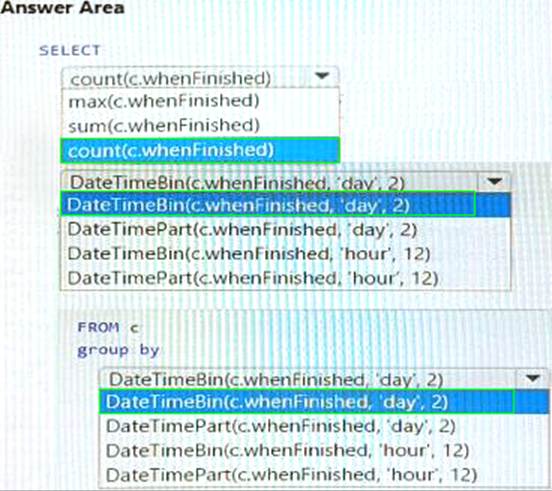
You develop an application that sells Al generated images based on user input. You recently started a marketing campaign that displays unique ads every second day.
Sales data is stored in Azure Cosmos DB with the date of each sale being stored in a property named ‘whenFinished’.
The marketing department requires a view that shows the number of sales for each unique ad.
You need to implement the query for the view.
How should you complete the query? To answer, select the appropriate options in the answer area. NOTE: Each correct selection is worth one point.
Call the Documents.Index method of the SearchIndexClient and pass the IndexBatch.
Does the solution meet the goal?
- A . Yes
- B . No
A
Explanation: