
Microsoft AZ-204 Practice Exams
Last updated on Nov 16,2026- Exam Code: AZ-204
- Exam Name: Developing Solutions for Microsoft Azure
- Certification Provider: Microsoft
- Latest update: Nov 16,2026
You are developing applications for a company. You plan to host the applications on Azure App Services.
The company has the following requirements:
✑ Every five minutes verify that the websites are responsive.
✑ Verify that the websites respond within a specified time threshold.
Dependent requests such as images and JavaScript files must load properly.
✑ Generate alerts if a website is experiencing issues.
✑ If a website fails to load, the system must attempt to reload the site three more times.
You need to implement this process with the least amount of effort.
What should you do?
- A . Create a Selenium web test and configure it to run from your workstation as a scheduled task.
- B . Set up a URL ping test to query the home page.
- C . Create an Azure function to query the home page.
- D . Create a multi-step web test to query the home page.
- E . Create a Custom Track Availability Test to query the home page.
D
Explanation:
You can monitor a recorded sequence of URLs and interactions with a website via multi-step web tests.
Reference: https://docs.microsoft.com/en-us/azure/azure-monitor/app/availability-multistep
You need to audit the retail store sales transactions.
What are two possible ways to achieve the goal? Each correct answer presents a complete solution. NOTE: Each correct selection is worth one point.
- A . Update the retail store location data upload process to include blob index tags. Create an Azure Function to process the blob index tags and filter by store location
- B . Enable blob versioning for the storage account. Use an Azure Function to process a list of the blob versions per day.
- C . Process an Azure Storage blob inventory report by using an Azure Function. Create rule filters on the blob inventory report,
- D . Subscribe to blob storage events by using an Azure Function and Azure Event Grid. Filter the events by store location.
- E . Process the change feed logs of the Azure Blob storage account by using an Azure Function. Specify a time range for the change feed data.
DE
Explanation:
Scenario: Audit store sale transaction information nightly to validate data, process sales financials, and reconcile inventory.
"Process the change feed logs of the Azure Blob storage account by using an Azure Function. Specify a time range for the change feed data": Change feed support is well-suited for scenarios that process data based on objects that have changed. For example, applications can:
Store, audit, and analyze changes to your objects, over any period of time, for security, compliance or intelligence for enterprise data management.
"Subscribe to blob storage events by using an Azure Function and Azure Event Grid. Filter the events by store location": Azure Storage events allow applications to react to events, such as the creation and deletion of blobs. It does so without the need for complicated code or expensive and inefficient polling services. The best part is you only pay for what you use.
Blob storage events are pushed using Azure Event Grid to subscribers such as Azure Functions, Azure Logic Apps, or even to your own http listener. Event Grid provides reliable event delivery to your applications through rich retry policies and dead-lettering.
Reference: https://docs.microsoft.com/en-us/azure/storage/blobs/storage-blob-change-feed
https://docs.microsoft.com/en-us/azure/storage/blobs/storage-blob-event-overview
HOTSPOT
You plan to deploy a new application to a Linux virtual machine (VM) that is hosted in Azure.
The entire VM must be secured at rest by using industry-standard encryption technology to address organizational security and compliance requirements.
You need to configure Azure Disk Encryption for the VM.
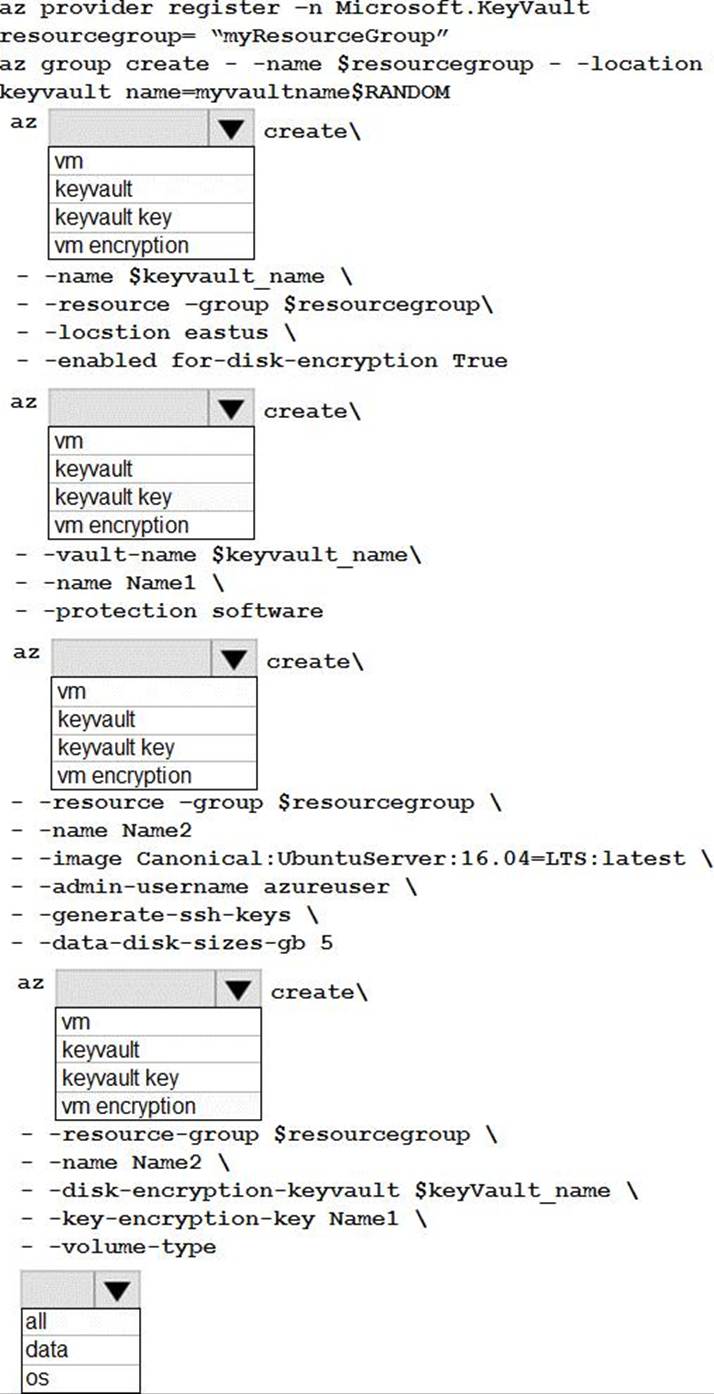
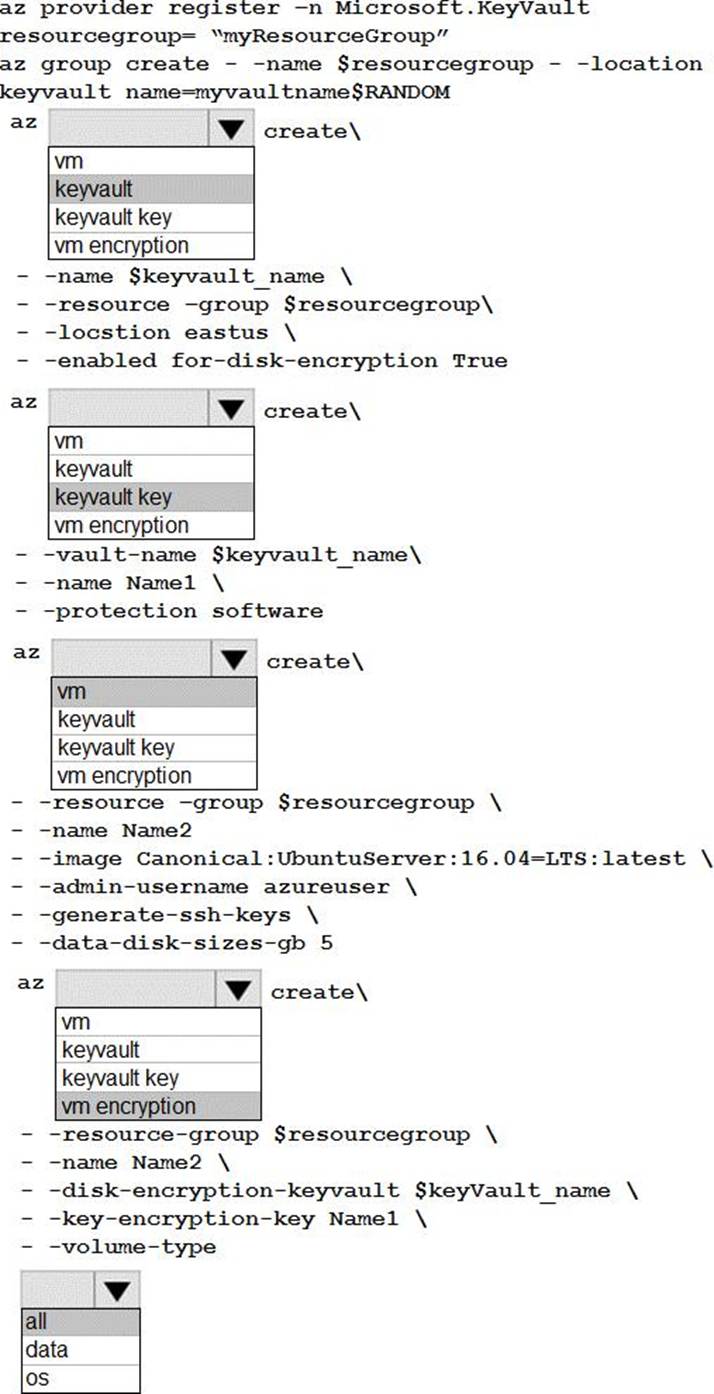
How should you complete the Azure Cli commands? To answer, select the appropriate options in the answer area. NOTE: Each correct selection is worth one point.
Explanation:
Box 1: keyvault
Create an Azure Key Vault with az keyvault create and enable the Key Vault for use with disk encryption. Specify a unique Key Vault name for keyvault_name as follows:
keyvault_name=myvaultname$RANDOM
az keyvault create
–name $keyvault_name
–resource-group $resourcegroup
–location eastus
–enabled-for-disk-encryption True
Box 2: keyvault key
The Azure platform needs to be granted access to request the cryptographic keys when the VM boots to decrypt the virtual disks. Create a cryptographic key in your Key Vault with az keyvault key create. The following example creates a key named myKey:
az keyvault key create
–vault-name $keyvault_name
–name myKey
–protection software
Box 3: vm
Create a VM with az vm create. Only certain marketplace images support disk encryption. The following example creates a VM named myVM using an Ubuntu 16.04 LTS image:
az vm create
–resource-group $resourcegroup
–name myVM
–image Canonical:UbuntuServer:16.04-LTS:latest
–admin-username azureuser
–generate-ssh-keys
Box 4: vm encryption
Encrypt your VM with az vm encryption enable:
az vm encryption enable
–resource-group $resourcegroup
–name myVM
–disk-encryption-keyvault $keyvault_name
–key-encryption-key myKey
–volume-type all
Note: seems to an error in the question. Should have enable instead of create.
Box 5: all
Encrypt both data and operating system.
Reference: https://docs.microsoft.com/bs-latn-ba/azure/virtual-machines/linux/encrypt-disks
You are developing a mobile app that uses an API which stores geospabal data in Azure Cosmos D& The app will be used to find restaurants in a particular area and related information including food types, menu information and the optimal route to a selected restaurant from the user’s current location.
Which Azure Cosmos DB API should you use for the API?
- A . MongoDB
- B . Gremlin
- C . Cassandra
- D . Core
You are building a web application that uses the Microsoft identity platform for user authentication. You are implementing user identification for the web application. You need to retrieve a claim to uniquely identify a user.
Which claim type should you use?
- A . oid
- B . aud
- C . idp
- D . nonce
HOTSPOT
You develop a web app that interacts with Azure Active Directory (Azure AD) groups by using Microsoft Graph.
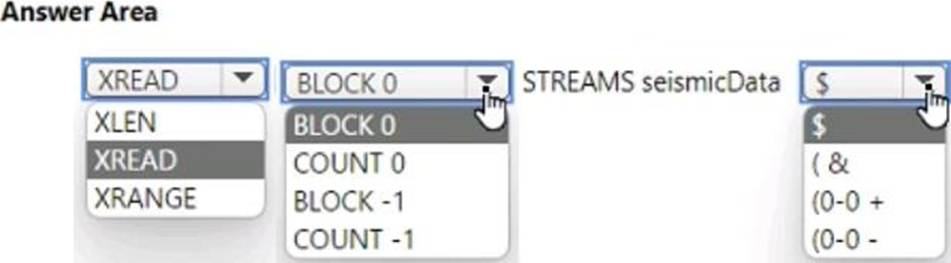
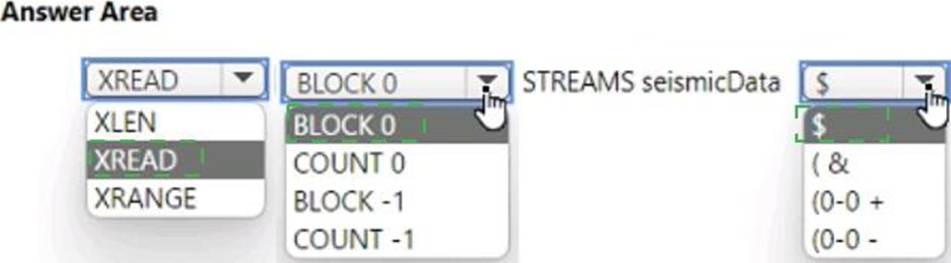
You build a web page that shows all Azure AD groups that are not of the type ‘Unified’.
You need to build the Microsoft Graph query for the page.
How should you complete the query? To answer, select the appropriate options in the answer area. NOTE: Each correct selection is worth one point.
You are a developing a SaaS application that stores data as key value pairs.
You must make multiple editions of the application available. In the lowest cost edition, the performance must be best-effort, and there is no regional failover.
In higher cos! editions customers must be able to select guaranteed performance and support for multiple regions. Azure costs must be minimized.
Which Azure Cosmos OB API should you use for the application?
- A . Core
- B . MongoDB
- C . Cassandra
- D . Table API
DRAG DROP
You are developing a serverless Java application on Azure. You create a new Azure Key Vault to work with secrets from a new Azure Functions application.
The application must meet the following requirements:
✑ Reference the Azure Key Vault without requiring any changes to the Java code.
✑ Dynamically add and remove instances of the Azure Functions host based on the number of incoming application events.
✑ Ensure that instances are perpetually warm to avoid any cold starts.
✑ Connect to a VNet.
✑ Authentication to the Azure Key Vault instance must be removed if the Azure Function application is deleted.
You need to grant the Azure Functions application access to the Azure Key Vault.
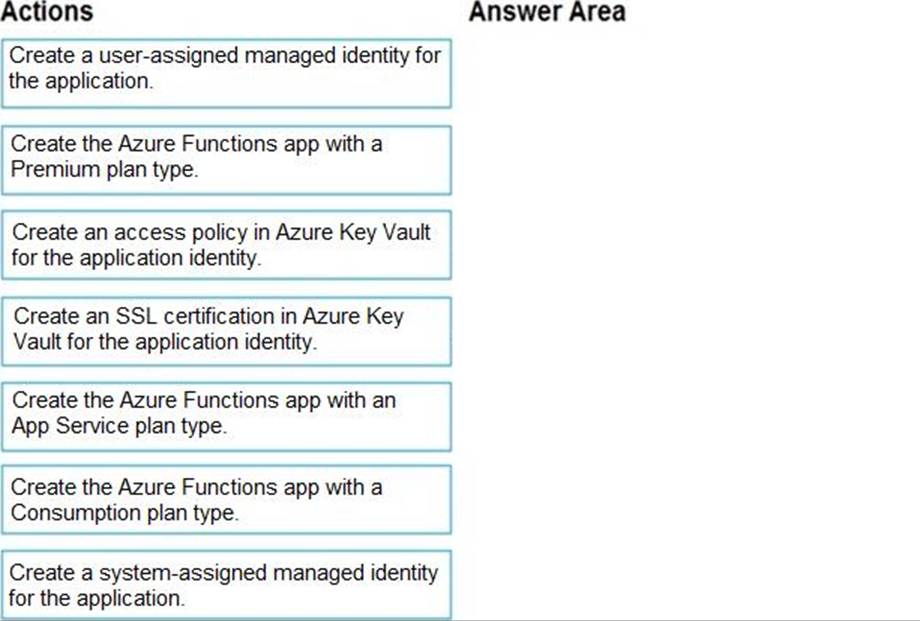
Which three actions should you perform in sequence? To answer, move the appropriate actions from the list of actions to the answer area and arrange them in the correct order.
Explanation:
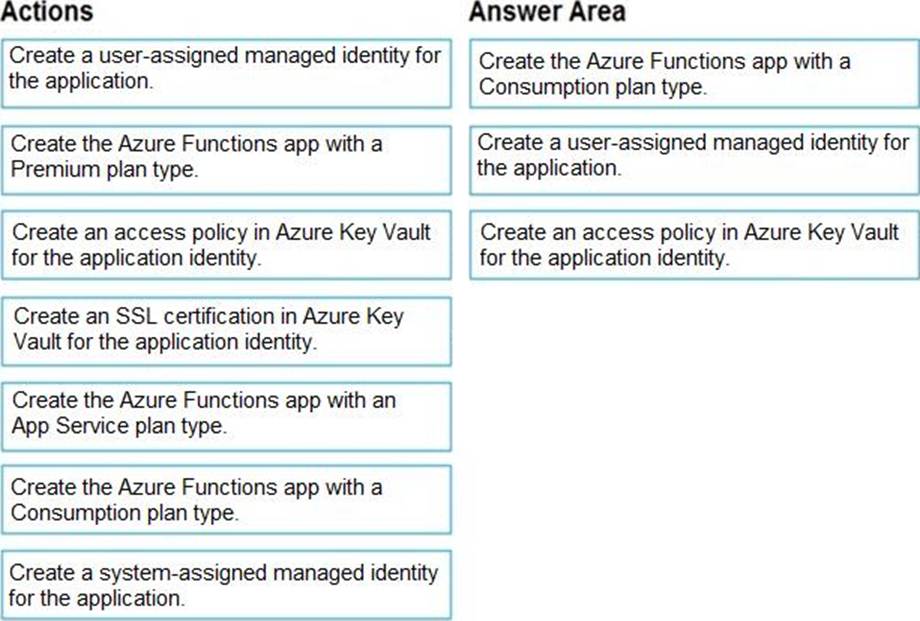
Step 1: Create the Azure Functions app with a Consumption plan type.
Use the Consumption plan for serverless.
Step 2: Create a system-assigned managed identity for the application.
Create a system-assigned managed identity for your application.
Key Vault references currently only support system-assigned managed identities. User-assigned identities cannot be used.
Step 3: Create an access policy in Key Vault for the application identity.
Create an access policy in Key Vault for the application identity you created earlier. Enable the "Get" secret permission on this policy. Do not configure the "authorized application" or applicationId settings, as this is not compatible with a managed identity.
Reference: https://docs.microsoft.com/en-us/azure/app-service/app-service-key-vault-references
You manage an Azure Key Vault named kv1 of Standard SKU.
You plan to programmatically store in kv1 an asymmetric key pair and use the key pair for encryption and decryption.
You must develop an application named app1 that will access the key pair in kv1.
You need to configure an object to retrieve a key pair from kv1.
Which object should you use?
- A . SecretClient
- B . KeyVaultSettingsClient
- C . CertificateClient
- D . KeyClient