Microsoft AZ-204 Practice Exams
Last updated on Nov 16,2026- Exam Code: AZ-204
- Exam Name: Developing Solutions for Microsoft Azure
- Certification Provider: Microsoft
- Latest update: Nov 16,2026
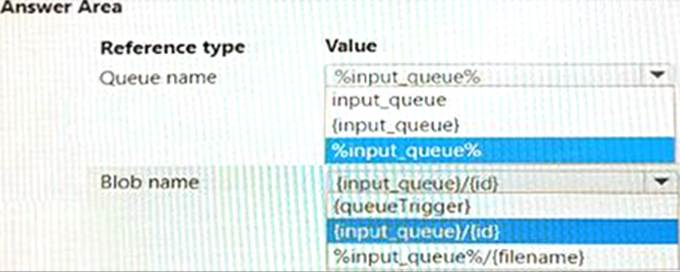
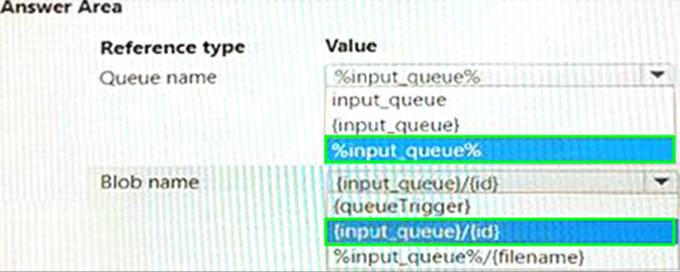
HOTSPOT
You plan to implement an Azure Functions app.
The Azure Functions app has the following requirements:
• Must be triggered by a message placed in an Azure Storage queue.
• Must use the queue name set by an app setting named input-queue.
• Must create an Azure Blob Storage named the same as the content of the message.
You need to identify how to reference the queue and blob name in the function. Just file of the Azure Functions app.
How should you reference the names? To answer, select the appropriate values in the answer area. NOTE: Each correct selection is worth one point.
Note: This question is part of a series of questions that present the same scenario. Each question in the series contains a unique solution that might meet the stated goals. Some question sets might have more than one correct solution, while others might not have a correct solution.
After you answer a question in this section, you will NOT be able to return to it. As a result, these questions will not appear in the review screen.
You are developing a website that will run as an Azure Web App. Users will authenticate by using their Azure Active Directory (Azure AD) credentials.
You plan to assign users one of the following permission levels for the website: admin, normal, and reader. A user’s Azure AD group membership must be used to determine the permission level.
You need to configure authorization.
Solution:
Create a new Azure AD application. In the application’s manifest, define application roles that match the required permission levels for the application.
Assign the appropriate Azure AD group to each role. In the website, use the value of the roles claim from the JWT for the user to determine permissions.
Does the solution meet the goal?
- A . Yes
- B . No
B
Explanation:
To configure Manifest to include Group Claims in Auth Token
Go to Azure Active Directory to configure the Manifest. Click on Azure Active Directory, and go to
App registrations to find your application:
Click on your application (or search for it if you have a lot of apps) and edit the Manifest by clicking on it.
Locate the “groupMembershipClaims” setting. Set its value to either “SecurityGroup” or “All”. To help you decide which:
“SecurityGroup” – groups claim will contain the identifiers of all security groups of which the user is a member.
“All” – groups claim will contain the identifiers of all security groups and all distribution lists of which the user is a member
Now your application will include group claims in your manifest and you can use this fact in your code.
Reference: https://blogs.msdn.microsoft.com/waws/2017/03/13/azure-app-service-authentication-aad-groups/
A development team is creating a new REST API. The API will store data in Azure Blob storage. You plan to deploy the API to Azure App Service.
Developers must access the Azure Blob storage account to develop the API for the next two months. The Azure Blob storage account must not be accessible by the developers after the two-month time period.
You need to grant developers access to the Azure Blob storage account.
What should you do?
- A . Generate a shared access signature (SAS) for the Azure Blob storage account and provide the SAS to all developers.
- B . Create and apply a new lifecycle management policy to include a last accessed date value. Apply the policy to the Azure Blob storage account.
- C . Provide all developers with the access key for the Azure Blob storage account. Update the API to include the Coordinated Universal Time (UTC) timestamp for the request header.
- D . Grant all developers access to the Azure Blob storage account by assigning role-based access control (RBAC) roles.
A
Explanation:
Reference: https://docs.microsoft.com/en-us/azure/storage/common/storage-sas-overview
You develop an Azure web app. You monitor performance of the web app by using Application Insights. You need to ensure the cost for Application Insights does not exceed a preset budget.
What should you do?
- A . Implement ingestion sampling using the Azure portal.
- B . Set a daily cap for the Application Insights instance.
- C . Implement adaptive sampling using the Azure portal.
- D . Implement adaptive sampling using the Application Insights SDK.
- E . Implement ingestion sampling using the Application Insights SDK.
D
Explanation:
Sampling is an effective way to reduce charges and stay within your monthly quota.
You can set sampling manually, either in the portal on the Usage and estimated costs page; or in the ASP.NET SDK in the .config file; or in the Java SDK in the ApplicationInsights.xml file, to also reduce the network traffic.
Adaptive sampling is the default for the ASP.NET SDK. Adaptive sampling automatically adjusts to the volume of telemetry that your app sends. It operates automatically in the SDK in your web app so that telemetry traffic on the network is reduced.
Reference: https://docs.microsoft.com/en-us/azure/azure-monitor/app/sampling
You are creating an app that will use CosmosDB for data storage. The app will process batches of relational data.
You need to select an API for the app.
Which API should you use?
- A . MongoDBAPI
- B . Table API
- C . SQL API
- D . Cassandra API
C
Explanation:
For relational data you will need the SQL API
Reference: https://docs.microsoft.com/en-us/azure/cosmos-db/choose-api
You need to deploy the CheckUserContent Azure function. The solution must meet the security and cost requirements.
Which hosting model should you use?
- A . Consumption plan
- B . Premium plan
- C . App Service plan
You are developing a web app that is protected by Azure Web Application Firewall (WAF). All traffic to the web app is routed through an Azure Application Gateway instance that is used by multiple web apps. The web app address is contoso.azurewebsites.net.
All traffic must be secured with SSL. The Azure Application Gateway instance is used by multiple web apps.
You need to configure the Azure Application Gateway for the app.
Which two actions should you perform? Each correct answer presents part of the solution. NOTE: Each correct selection is worth one point.
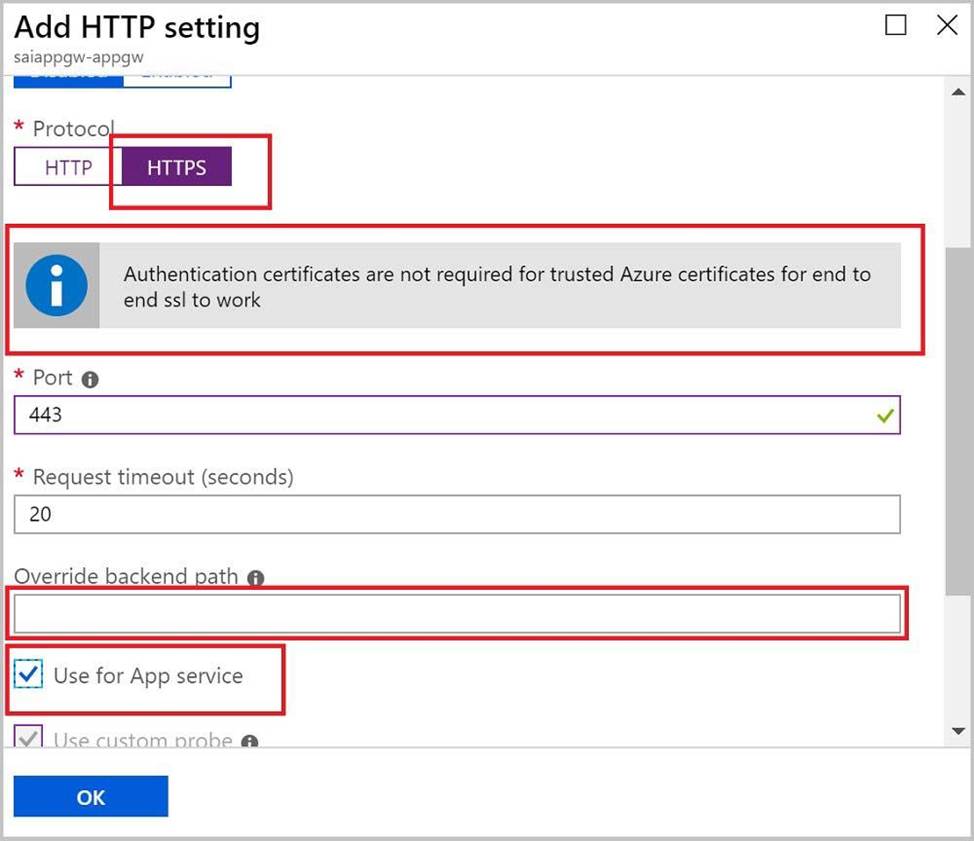
- A . In the Azure Application Gateway’s HTTP setting, enable the Use for App service setting.
- B . Convert the web app to run in an Azure App service environment (ASE).
- C . Add an authentication certificate for contoso.azurewebsites.net to the Azure Application gateway.
- D . In the Azure Application Gateway’s HTTP setting, set the value of the Override backend path option to contoso22.azurewebsites.net.
AD
Explanation:
D: The ability to specify a host override is defined in the HTTP settings and can be applied to any back-end pool during rule creation.
The ability to derive the host name from the IP or FQDN of the back-end pool members. HTTP settings also provide an option to dynamically pick the host name from a back-end pool member’s FQDN if configured with the option to derive host name from an individual back-end pool member.
A (not C): SSL termination and end to end SSL with multi-tenant services.
In case of end to end SSL, trusted Azure services such as Azure App service web apps do not require whitelisting the backends in the application gateway. Therefore, there is no need to add any authentication certificates.
Reference: https://docs.microsoft.com/en-us/azure/application-gateway/application-gateway-web-app-overview
Note: This question is part of a series of questions that present the same scenario. Each question in the series contains a unique solution that might meet the stated goals. Some question sets might have more than one correct solution, while others might not have a correct solution.
After you answer a question in this section, you will NOT be able to return to it. As a result, these questions will not appear in the review screen.
You develop an HTTP triggered Azure Function app to process Azure Storage blob data. The app is triggered using an output binding on the blob.
The app continues to time out after four minutes. The app must process the blob data.
You need to ensure the app does not time out and processes the blob data.
Solution: Pass the HTTP trigger payload into an Azure Service Bus queue to be processed by a queue trigger function and return an immediate HTTP success response.
Does the solution meet the goal?
- A . Yes
- B . No
A
Explanation:
Large, long-running functions can cause unexpected timeout issues. General best practices include:
Whenever possible, refactor large functions into smaller function sets that work together and return responses fast. For example, a webhook or HTTP trigger function might require an acknowledgment response within a certain time limit; it’s common for webhooks to require an immediate response.
You can pass the HTTP trigger payload into a queue to be processed by a queue trigger function. This approach lets you defer the actual work and return an immediate response.
Reference: https://docs.microsoft.com/en-us/azure/azure-functions/functions-best-practices
You need to migrate on-premises shipping data to Azure.
What should you use?
- A . Azure Migrate
- B . Azure Cosmos DB Data Migration tool (dt.exe)
- C . AzCopy
- D . Azure Database Migration service
D
Explanation:
Migrate from on-premises or cloud implementations of MongoDB to Azure Cosmos DB with minimal downtime by using Azure Database Migration Service. Perform resilient migrations of MongoDB data at scale and with high reliability.
Scenario: Data migration from on-premises to Azure must minimize costs and downtime.
The application uses MongoDB JSON document storage database for all container and transport information.
Reference: https://azure.microsoft.com/en-us/updates/mongodb-to-azure-cosmos-db-online-and-offline-migrations-are-now-available/
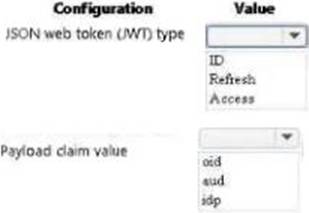
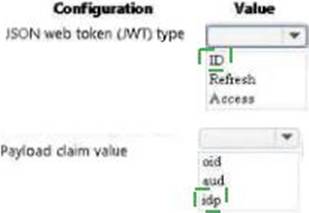
HOTSPOT
YOU need to reliably identify the delivery driver profile information.
How should you configure the system? To answer, select the appropriate options in the answer area.
NOTE Each correct selection is worth one point.