
Microsoft AZ-204 Practice Exams
Last updated on Nov 16,2026- Exam Code: AZ-204
- Exam Name: Developing Solutions for Microsoft Azure
- Certification Provider: Microsoft
- Latest update: Nov 16,2026
HOTSPOT
You are working for a company that designs mobile applications. They maintain a server where player records are assigned to their different games. The tracking system is new and in development.
The application uses Entity Framework to connect to an Azure Database. The database holds a Player table and Game table.
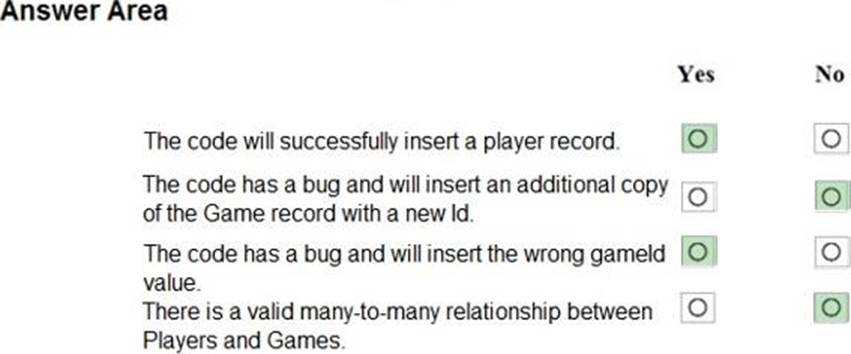
When adding a player, the code should insert a new player record, and add a relationship between an existing game record and the new player record.
The application will call CreatePlayerWithGame with the correct gameIdand the playerId to start the process. (Line numbers are included for reference only.)

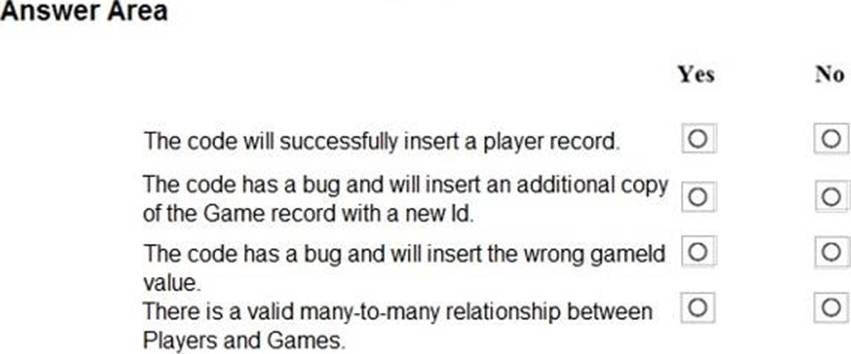
For each of the following statements, select Yes if the statement is true. Otherwise, select No. NOTE: Each correct selection is worth one point.
Explanation:
Many-to-many relationships without an entity class to represent the join table are not yet supported. However, you can represent a many-to-many relationship by including an entity class for the join table and mapping two separate one-to-many relationships.
protected override void OnModelCreating(ModelBuilder modelBuilder)
{
modelBuilder.Entity<PostTag>()
.HasKey(t => new { t.PostId, t.TagId });
modelBuilder.Entity<PostTag>()
.HasOne(pt => pt.Post)
.WithMany(p => p.PostTags)
.HasForeignKey(pt => pt.PostId);
modelBuilder.Entity<PostTag>()
.HasOne(pt => pt.Tag)
.WithMany(t => t.PostTags)
.HasForeignKey(pt => pt.TagId);
}
}
A company is developing a solution that allows smart refrigerators to send temperature information to a central location. You have an existing Service Bus.
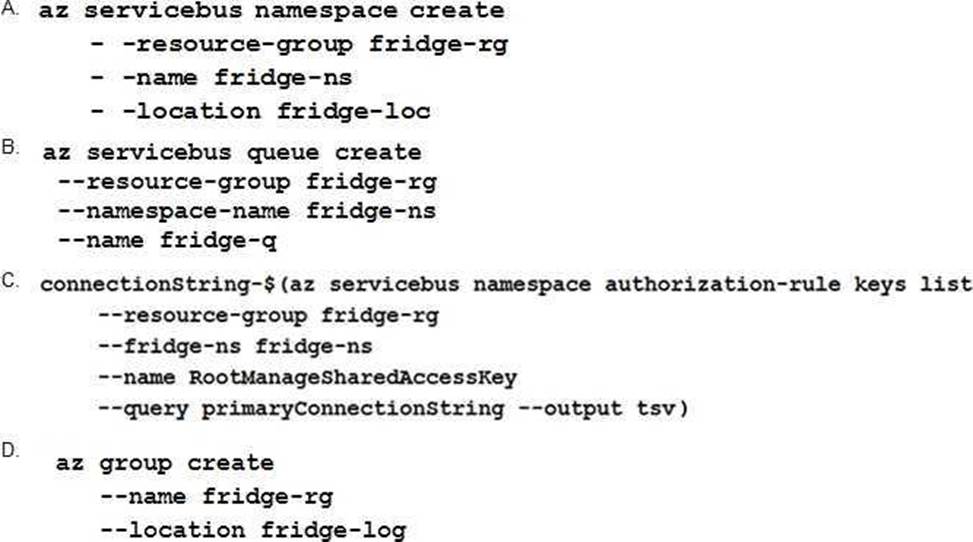
The solution must receive and store messages until they can be processed. You create an Azure Service Bus instance by providing a name, pricing tier, subscription, resource group, and location.
You need to complete the configuration.
Which Azure CLI or PowerShell command should you run?
- A . Option A
- B . Option B
- C . Option C
- D . Option D
B
Explanation:
A service bus instance has already been created (Step 2 below). Next is step 3, Create a Service Bus queue.
Note:
Steps:
Step 1: # Create a resource group
resourceGroupName="myResourceGroup"
az group create –name $resourceGroupName –location eastus
Step 2: # Create a Service Bus messaging namespace with a unique name namespaceName=myNameSpace$RANDOM
az servicebus namespace create –resource-group $resourceGroupName –name $namespaceName — location eastus
Step 3: # Create a Service Bus queue
az servicebus queue create –resource-group $resourceGroupName –namespace-name $namespaceName –name BasicQueue
Step 4: # Get the connection string for the namespace
connectionString=$(az servicebus namespace authorization-rule keys list –resource-group
$resourceGroupName –namespace-name $namespaceName –name RootManageSharedAccessKey – -query primaryConnectionString –output tsv)
Reference: https://docs.microsoft.com/en-us/azure/service-bus-messaging/service-bus-quickstart-cli
HOTSPOT
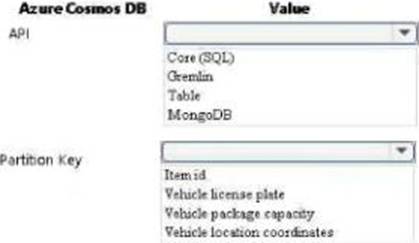
You need to implement the delivery service telemetry data
How should you configure the solution? NOTE: Each correct selection is worth one point.
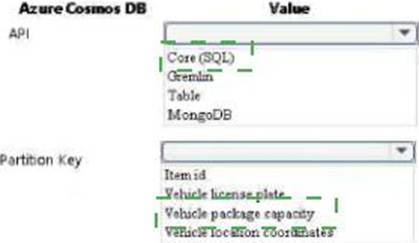
Note: This question is part of a series of questions that present the same scenario. Each question in the series contains a unique solution that might meet the stated goals. Some question sets might have more than one correct solution, while others might not have a correct solution.
After you answer a question in this section, you will NOT be able to return to it. As a result, these questions will not appear in the review screen.
You are developing an Azure solution to collect point-of-sale (POS) device data from 2,000 stores located throughout the world. A single device can produce 2 megabytes (MB) of data every 24 hours. Each store location has one to five devices that send data.
You must store the device data in Azure Blob storage. Device data must be correlated based on a device identifier. Additional stores are expected to open in the future.
You need to implement a solution to receive the device data.
Solution: Provision an Azure Event Grid. Configure event filtering to evaluate the device identifier.
Does the solution meet the goal?
- A . Yes
- B . No
B
Explanation:
Instead use an Azure Service Bus, which is used order processing and financial transactions.
Note: An event is a lightweight notification of a condition or a state change. Event hubs is usually used reacting to status changes.
Reference: https://docs.microsoft.com/en-us/azure/event-grid/compare-messaging-services
DRAG DROP
You are preparing to deploy a medical records application to an Azure virtual machine (VM). The application will be deployed by using a VHD produced by an on-premises build server.
You need to ensure that both the application and related data are encrypted during and after deployment to Azure.
Which three actions should you perform in sequence? To answer, move the appropriate actions from the list of actions to the answer area and arrange them in the correct order.
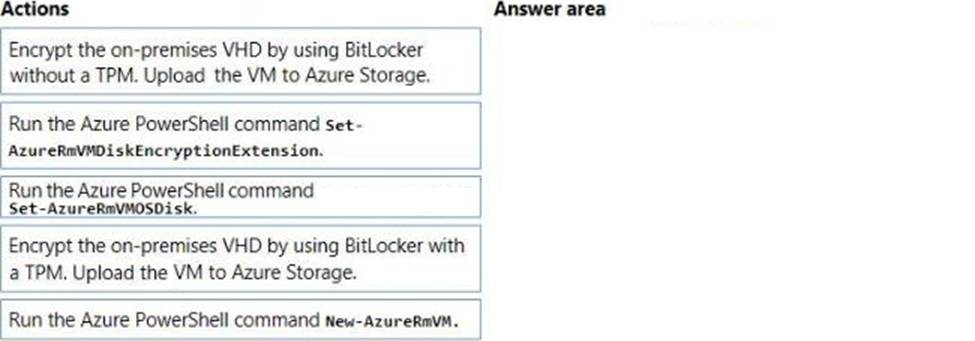
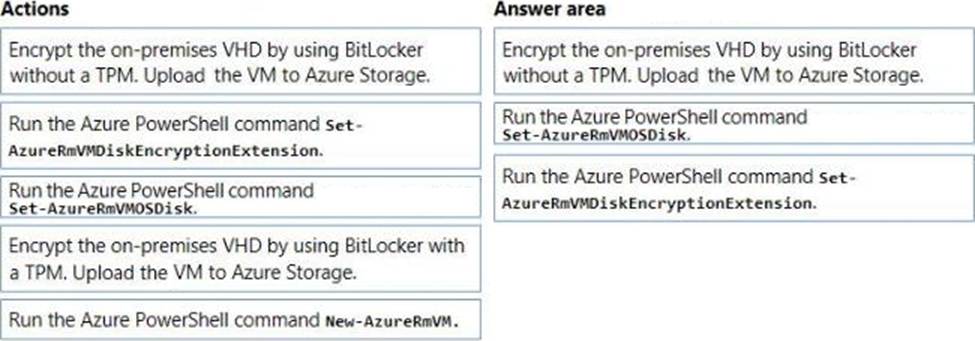
Explanation:
Step 1: Encrypt the on-premises VHD by using BitLocker without a TPM. Upload the VM to Azure Storage
Step 2: Run the Azure PowerShell command Set-AzureRMVMOSDisk
To use an existing disk instead of creating a new disk you can use the Set-AzureRMVMOSDisk command.
Example:
$osDiskName = $vmname+’_osDisk’
$osDiskCaching = ‘ReadWrite’
$osDiskVhdUri = "https://$stoname.blob.core.windows.net/vhds/"+$vmname+"_os.vhd"
$vm = Set-AzureRmVMOSDisk -VM $vm -VhdUri $osDiskVhdUri -name $osDiskName -Create
Step 3: Run the Azure PowerShell command Set-AzureRmVMDiskEncryptionExtension
Use the Set-AzVMDiskEncryptionExtension cmdlet to enable encryption on a running IaaS virtual machine in Azure.
Incorrect:
Not TPM: BitLocker can work with or without a TPM. A TPM is a tamper resistant security chip on the system board that will hold the keys for encryption and check the integrity of the boot sequence and allows the most secure BitLocker implementation. A VM does not have a TPM.
Reference: https://www.itprotoday.com/iaaspaas/use-existing-vhd-azurerm-vm
You are developing a web application that uses Azure Cache for Redis. You anticipate that the cache will frequently fill and that you will need to evict keys.
You must configure Azure Cache for Redis based on the following predicted usage pattern: A small subset of elements will be accessed much more often than the rest.
You need to configure the Azure Cache for Redis to optimize performance for the predicted usage pattern.
Which two eviction policies will achieve the goal? NOTE: Each correct selection is worth one point.
- A . noeviction
- B . allkeys-lru
- C . volatile-lru
- D . allkeys-random
- E . volatile-ttl
- F . volatile-random
B, C
Explanation:
B: The allkeys-lru policy evict keys by trying to remove the less recently used (LRU) keys first, in order to make space for the new data added. Use the allkeys-lru policy when you expect a power-law distribution in the popularity of your requests, that is, you expect that a subset of elements will be accessed far more often than the rest.
C: volatile-lru: evict keys by trying to remove the less recently used (LRU) keys first, but only among keys that have an expire set, in order to make space for the new data added.
Note: The allkeys-lru policy is more memory efficient since there is no need to set an expire for the key to be evicted under memory pressure.
Reference: https://redis.io/topics/lru-cache
Note: This question is part of a series of questions that present the same scenario. Each question in the series contains a unique solution that might meet the stated goals. Some question sets might have more than one correct solution, while others might not have a correct solution.
After you answer a question in this section, you will NOT be able to return to it. As a result, these questions will not appear on the review screen.
You are implementing an application by using Azure Event Grid to push near-real-time in-formation to customers.
You have the following requirements:
• You must send events to thousands of customers that include hundreds of various event types.
• The events must be filtered by event type before processing.
• Authentication and authorization must be handled by using Microsoft Entra ID.
• The events must be published to a single endpoint.
You need to implement Azure Event Grid.
Solution; Publish events to an event domain. Create a custom topic for each customer.
Does the solution meet the goal?
- A . Yes
- B . No
An organization hosts web apps in Azure. The organization uses Azure Monitor You discover that configuration changes were made to some of the web apps. You need to identify the configuration changes.
Which Azure Monitor log should you review?
- A . AppServiceEnvironmentPlatformLogs
- B . AppServiceApplogs
- C . AppServiceAuditLogs
- D . AppServiceConsoteLogs
HOTSPOT
You need to provide internal staff access to the production site after a validation.
How should you complete the code segment? To answer, select the appropriate options in the answer area. NOTE: Each correct selection is worth one point.

