
Microsoft AZ-120 Practice Exams
Last updated on Nov 16,2026- Exam Code: AZ-120
- Exam Name: Planning and Administering Microsoft Azure for SAP Workloads
- Certification Provider: Microsoft
- Latest update: Nov 16,2026
HOTSPOT
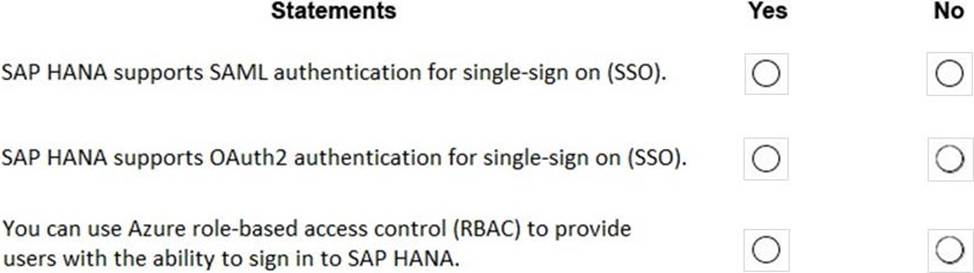
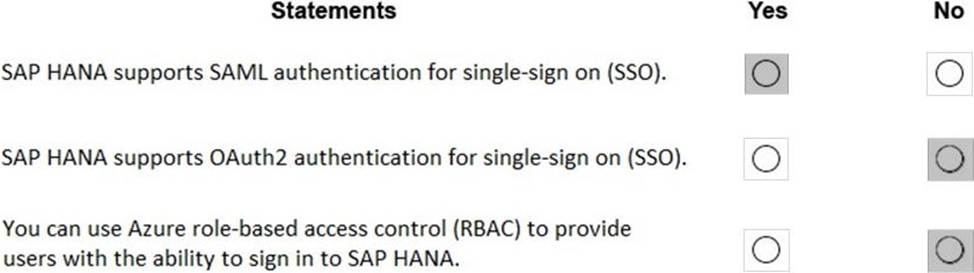
You are integrating SAP HANA and Azure Active Directory (Azure AD).
For each of the following statements, select Yes if the statement is true. Otherwise, select No. NOTE: Each correct selection is worth one point.
Explanation:
Box 1: Yes
To configure Azure AD single sign-on with SAP HANA, perform the following steps:
You plan to deploy an SAP environment on Azure.
You plan to store all SAP connection strings securely in Azure Key Vault without storing credentials on the
Azure virtual machines that host SAP.
What should you configure to allow the virtual machines to access the key vault?
- A . Azure Active Directory (Azure AD) Privilege Identity Manager (PIM)
- B . role-based access control (RBAC)
- C . a Managed Service Identity (MSI)
- D . the Custom Script Extension
C
Explanation:
To reference a credential stored in Azure Key Vault, you need to:
Note: This question is part of a series of questions that present the same scenario. Each question in the series contains a unique solution that might meet the stated goals. Some question sets might have more than one correct solution, while others might not have a correct solution.
After you answer a question in this section, you will NOT be able to return to it. As a result, these questions will not appear in the review screen.
You have a complex SAP environment that has both ABAP- and Java-based systems. The current on-premises landscapes are based on SAP NetWeaver 7.0 (Unicode and Non-Unicode) running on Windows Server and Microsoft SQL Server.
You need to migrate the SAP environment to a HANA-certified Azure environment.
Solution: You deploy a new environment to Azure that uses SAP NetWeaver 7.4. You export the databases from the on-premises environment, and then you import the databases into the Azure environment.
Does this meet the goal?
- A . Yes
- B . No
B
Explanation:
Instead use Azure Site Recovery to migrate.
Reference: https://docs.microsoft.com/en-us/azure/site-recovery/vmware-azure-architecture
HOTSPOT
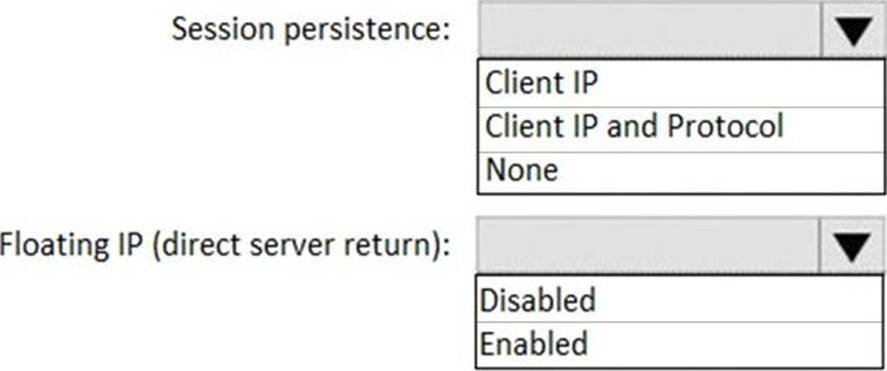
You plan to deploy a highly available ASCS instance to SUSE Linux Enterprise Server (SLES) virtual machines in Azure.
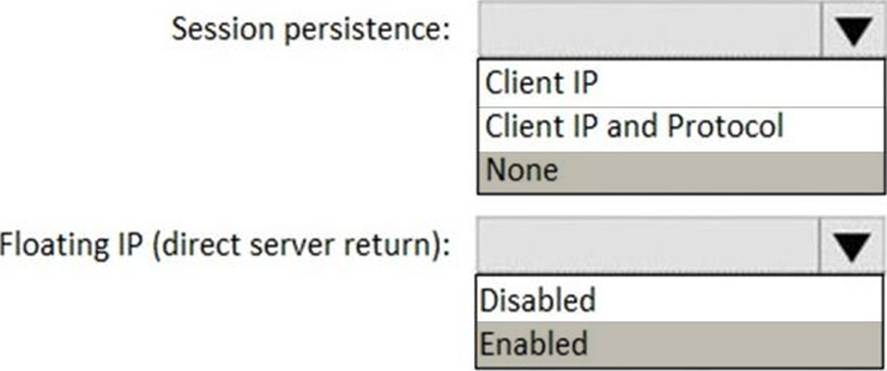
You are configuring an internal Azure Standard Load Balancer for the ASCS instance.
How should you configure the internal Standard Load Balancer? To answer, select the appropriate options in the answer area. NOTE: Each correct selection is worth one point.
Explanation:
Session persistence: None.
Floating IP: Enabled.
Reference: https://docs.microsoft.com/en-us/azure/virtual-machines/workloads/sap/high-availability-guide-suse
You have four SAP NetWeaver servers that run on Azure virtual machines deployed across two Azure Availability Zones. You plan to deploy a load balancing solution for the SAP GUI app.
What should you use?
- A . Azure Standard Load Balancer
- B . Azure Application Gateway V1
- C . Azure Basic Load Balancer
- D . Azure Application Gateway V2
HOTSPOT
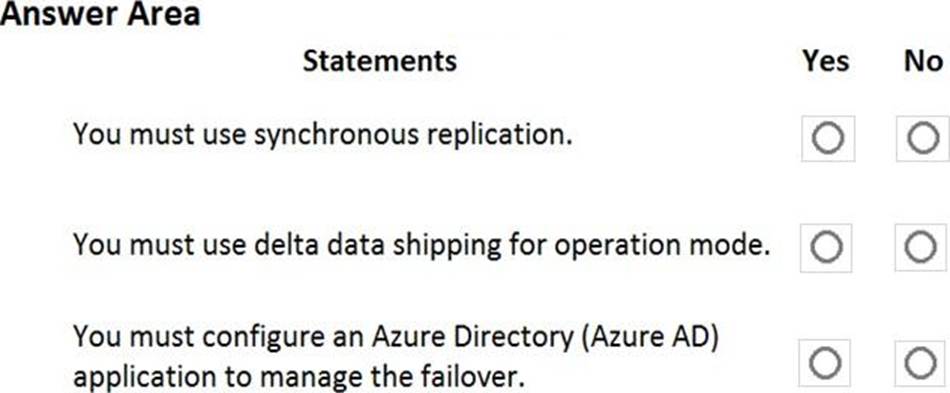
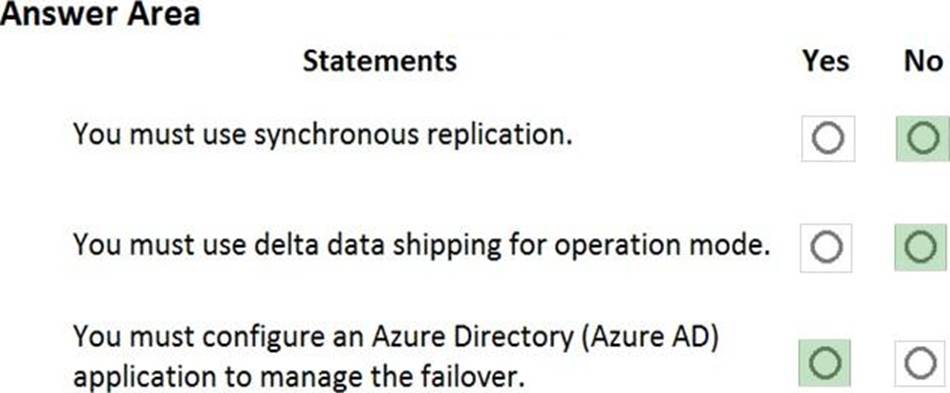
You are planning replication of the SAP HANA database for the disaster recovery environment in Azure.
For each of the following statements, select Yes if the statement is true. Otherwise, select No. NOTE: Each correct selection is worth one point.
Explanation:
Box 1: No
SAP HANA Replication consists of one primary node and at least one secondary node. Changes to the data on the primary node are replicated to the secondary node synchronously or asynchronously.
Box 2: No
Since SPS11 SAP HANA system replication can be run in two different operation modes:
delta_datashipping
logreplay
Box 3: Yes
Reference: https://docs.microsoft.com/en-us/azure/virtual-machines/workloads/sap/sap-hana-high-availability-rhel
https://blogs.sap.com/2018/01/08/your-sap-on-azure-part-4-high-availability-for-sap-hana-using-system-replication/
You plan to deploy an SAP landscape on Azure that will use SAP HANA on Azure (Large Instances).
You need to ensure that outbound traffic from the application tier can flow only to the database tier.
What should you use?
- A . network virtual appliances (NVAs)
- B . network security groups (NSGs)
- C . application security groups
- D . Azure Firewall
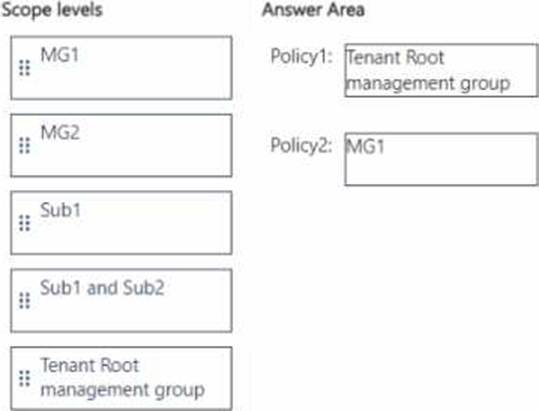
DRAG DROP
You have two Azure subscriptions as shown in the following table.
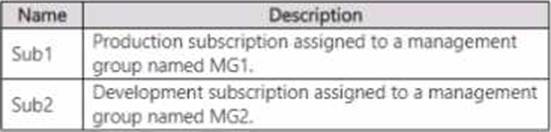
You plan to configure the following Azure policies:
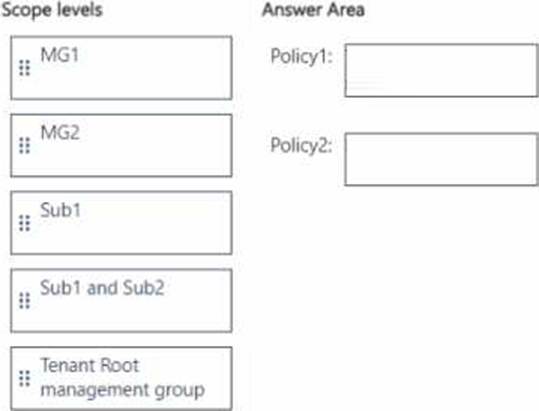
• Policy 1: Enforces resource tags to every resource in both subscriptions.
• Policy2: Enables Microsoft Defender for Servers for all existing and future production workloads.
You need to identify the scope level to assign each policy. The solution must minimize administrative effort.
At which scope level should you assign each policy? To answer, drag the appropriate scope levels to the correct policies. Each scope level may be used once, more than once, or not at all. You may need to drag the split bar between panes or scroll to view content. NOTE: Each correct selection is worth one point.
Litware is evaluating whether to add high availability after the migration?
What should you recommend to meet the technical requirements?
- A . SAP HANA system replication and Azure Availability Sets
- B . Azure virtual machine auto-restart with SAP HANA service auto-restart.
- C . Azure Site Recovery