
Microsoft AZ-120 Practice Exams
Last updated on Nov 16,2026- Exam Code: AZ-120
- Exam Name: Planning and Administering Microsoft Azure for SAP Workloads
- Certification Provider: Microsoft
- Latest update: Nov 16,2026
HOTSPOT
You have an Azure subscription.
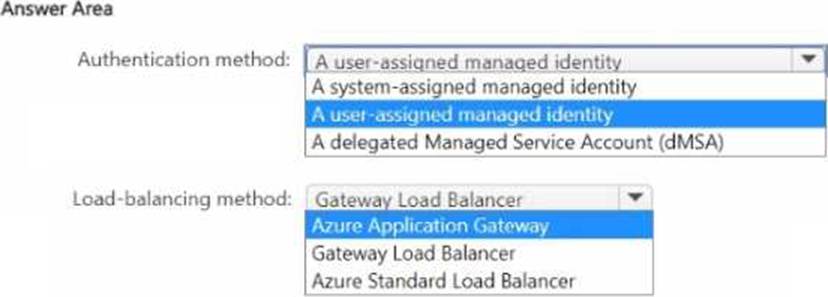
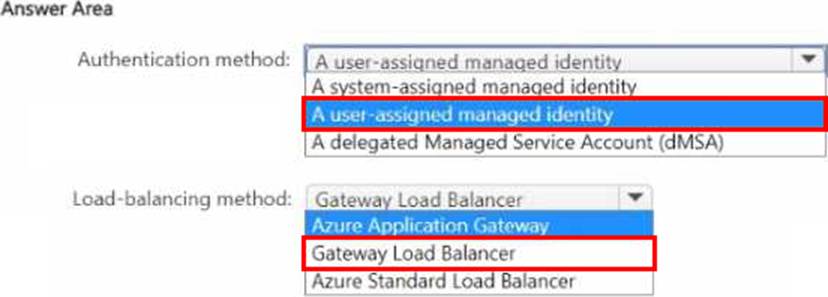
You plan to deploy an SAP production landscape in Azure that will use a Pacemaker cluster for SAP HANA system replication and an Azure fence agent
You need to recommend an authentication method and a HANA system replication load-balancing method for the Pacemaker cluster.
What should you recommend? To answer, select the appropriate options in the answer area. NOTE: Each correct selection is worth one point.
HOTSPOT
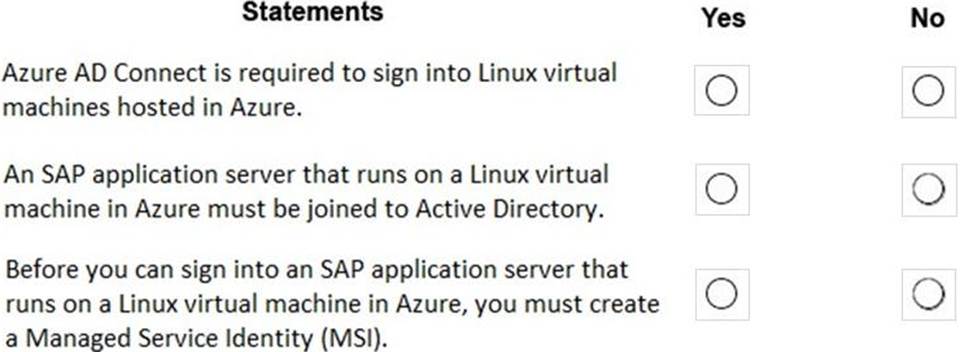
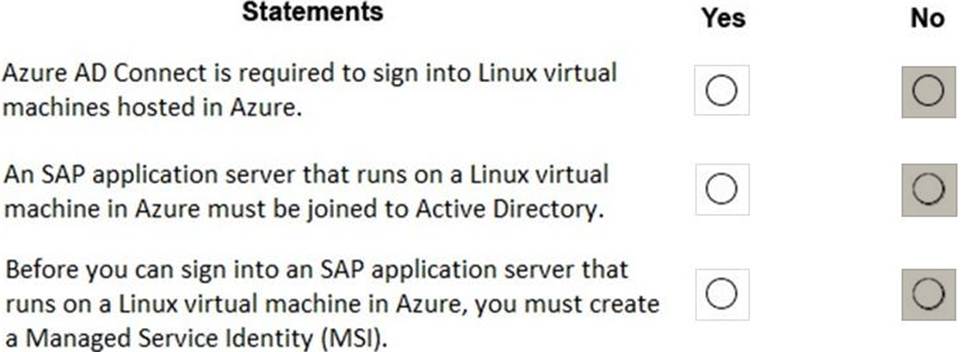
For each of the following statements, select Yes if the statement is true. Otherwise, select No. NOTE: Each correct selection is worth one point.
Explanation:
Box 1: No
To log in to a Linux VM with Azure AD credentials, install the Azure Active Directory login VM extension.
Note: Azure AD Connect is the Microsoft tool designed to meet and accomplish your hybrid identity goals.
Box 2: NO
Box 3: No
Reference: https://docs.microsoft.com/en-us/azure/virtual-machines/workloads/sap/deployment-guide
Note: This section contains one or more sets of questions with the same scenario and problem. Each question presents a unique solution to the problem. You must determine whether the solution meets the stated goals. More than one solution in the set might solve the problem. It is also possible that none of the solutions in the set solve the problem.
After you answer a question in this section, you will NOT be able to return. As a result, these questions do not appear on the Review Screen. You have an on-premises datacenter.
You have an Azure subscription that contains a virtual network named VNet1.
You have an SAP RISE managed workload.
You need to ensure transitive connectivity between the datacenter. VNet1, and the managed workload.
Solution: You configure a Site-to-Site (S2S) VPN connection between the datacenter and the managed workload and virtual network peering between VNet1 and the managed workload.
Does this meet the goal?
- A . Yes
- B . No
HOTSPOT
You have an SAP production landscape on Azure that contains the resources shown in the following table.
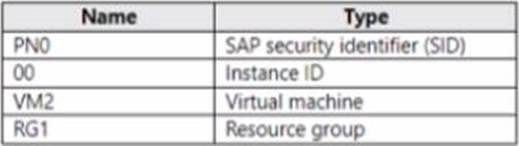
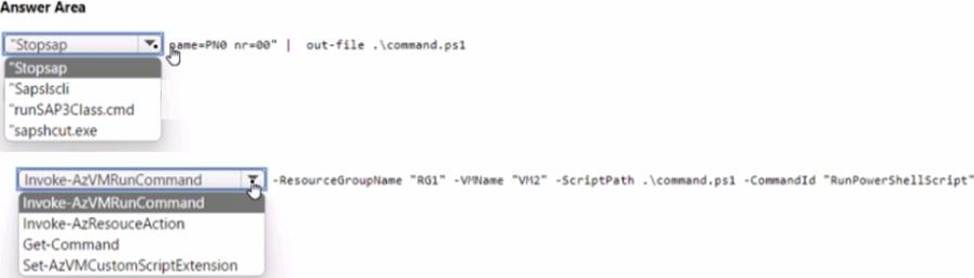
You need to stop the SAP services so that you can perform monthly maintenance.
Which command should you run from the Azure Cloud Shell? To answer, select the appropriate options in the answer area. NOTE: Each correct selection is worth one point.
You plan to deploy SAP application servers that run Windows Server 2016.
You need to use PowerShell Desired State Configuration (DSC) to configure the SAP application server once the servers are deployed.
Which Azure virtual machine extension should you install on the servers?
- A . the Azure DSC VM Extension
- B . the Azure virtual machine extension
- C . the Azure Chef extension
- D . the Azure Enhanced Monitoring Extension for SAP
A
Explanation:
The Azure Desired State Configuration (DSC) VM Extension is updated as-needed to support enhancements and new capabilities delivered by Azure, Windows Server, and the Windows
Management Framework (WMF) that includes Windows PowerShell.
Reference: https://docs.microsoft.com/en-us/powershell/scripting/dsc/getting-started/azuredscexthistory
Note: This question is part of a series of questions that present the same scenario. Each question in the series contains a unique solution that might meet the stated goals. Some question sets might have more than one correct solution, while others might not have a correct solution.
After you answer a question in this section, you will NOT be able to return to it. As a result, these questions will not appear in the review screen.
You plan to migrate an SAP HANA instance to Azure.
You need to gather CPU metrics from the last 24 hours from the instance.
Solution: You use DBA Cockpit from SAP GUI.
Does this meet the goal?
- A . Yes
- B . No
A
Explanation:
The SAP HANA cockpit provides a single point of access to a range of SAP HANA administration and monitoring tasks. It is used to monitor and ensure the overall health of the system.
The HANA Monitoring dashboard also visualizes key HANA Metrics of SAP HANA system.
Reference:
https://developers.sap.com/tutorials/dt-monitoring-hana-part1.html
https://help.sap.com/viewer/afa922439b204e9caf22c78b6b69e4f2/2.10.0.0/en-US
https://www.hanatutorials.com/p/hana-monitoring-dashboard.html
HOTSPOT
Your network contains an on-premises SAP landscape. The landscape contains a database server named DB1.
You have an Azure subscription that contains a storage account named storageaccount1.
You export multiple databases to separate folders in a folder named D:Data on DB1.
You plan to migrate the on-premises SAP landscape to Azure.
You need to copy the exported databases on DB1 to a container in storageaccount1 by using AzCopy.
How should you complete the command? To answer, select the appropriate options in the answer area. NOTE: Each correct selection is worth one point.


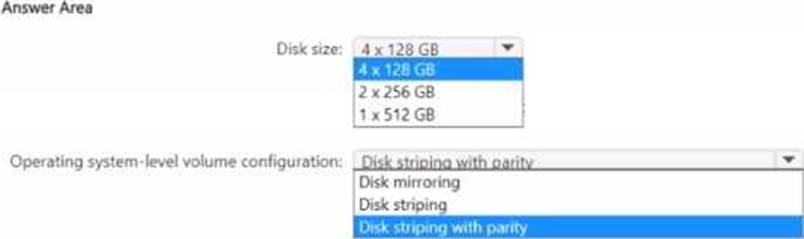
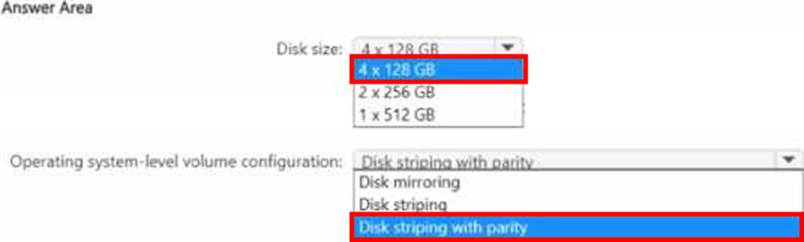
HOTSPOT
You plan to deploy an Azure virtual machine that will host an SAP HANA database.
You need to provide a 512-GB volume for the database.
The volume must meet the following requirements:
• Provide storage resiliency.
• Provide maximum throughput.
• Maximize disk space usage without affecting storage resiliency.
What should you configure? To answer, select the appropriate options in the answer area. NOTE: Each correct selection is worth one point.
You have an Azure subscription.
Your company has an SAP environment that runs on SUSE Linux Enterprise Server (SLES) servers and
SAP HANA. The environment has a primary site and a disaster recovery site. Disaster recovery is based on SAP HANA system replication. The SAP ERP environment is 4 TB and has a projected growth of 5% per month.
The company has an uptime Service Level Agreement (SLA) of 99.99%, a maximum recovery time objective (RTO) of four hours, and a recovery point objective (RPO) of 10 minutes.
You plan to migrate to Azure.
You need to design an SAP landscape for the company.
Which options meet the company’s requirements?
- A . Azure virtual machines and SLES for SAP application servers SAP HANA on Azure (Large Instances) that uses SAP HANA system replication for high availability and disaster recovery
- B . ASCS/ERS and SLES clustering that uses the Pacemaker fence agent SAP application servers deployed to an Azure Availability Zone SAP HANA on Azure (Large Instances) that uses SAP HANA system replication for database high availability and disaster recovery
- C . SAP application instances deployed to an Azure Availability Set SAP HANA on Azure (Large Instances) that uses SAP HANA system replication for database high availability and disaster recovery
- D . ASCS/ERS and SLES clustering that uses the Azure fence agent SAP application servers deployed to an Azure Availability Set SAP HANA on Azure (Large Instances) that uses SAP HANA system replication for database high availability and disaster recovery
B
Explanation:
With Availability Zones, Azure offers industry best 99.99% VM uptime SLA.
Reference: https://docs.microsoft.com/en-us/azure/traffic-manager/traffic-manager-faqs
You have an Azure subscription that contains a virtual machine named VM1. VM1 runs SUSE Linux Enterprise Server (SLES) and hosts an SAP workload. You deploy Azure Monitor for SAP solutions.
You need to configure the Linux OS provider. The solution must ensure that you can collect monitoring data by using the Prometheus endpoint on VM1.
Which firewall port should you open on VM1?
- A . 22
- B . 80
- C . 443
- D . 9100