
Juniper JN0-224 Practice Exams
Last updated on Oct 21,2026- Exam Code: JN0-224
- Exam Name: Automation and DevOps, Associate (JNCIA-DevOps)
- Certification Provider: Juniper
- Latest update: Oct 21,2026
Which two statements are correct about the Junos REST API Explorer? (Choose two.)
- A . The REST API Explorer is enabled by default on all Junos devices.
- B . The REST API Explorer returns data only in XML format.
- C . The REST API Explorer supports both GET and POST calls.
- D . The REST API Explorer supports multiple RPC calls.
C, D
Explanation:
The Junos REST API Explorer provides an interactive environment to explore and execute REST API calls.
The correct statements are:
Supports GET and POST Calls (C): The REST API Explorer allows users to make both GET and POST requests, enabling retrieval and submission of data to the Junos device.
Supports Multiple RPC Calls (D): The REST API Explorer can execute multiple RPC (Remote Procedure Call) commands, allowing a wide range of operations to be performed directly through the interface.
Option A is incorrect because the REST API Explorer is not enabled by default; it must be enabled manually. Option B is incorrect because the REST API Explorer returns data in both XML and JSON formats, not just XML.
Reference: Junos REST API Explorer Documentation: Provides details on the supported operations and how to use the Explorer for different types of requests.
Juniper Networks Documentation: Covers the setup and usage of the REST API Explorer.
What is the correct sequence for Python script execution?
- A . The code is translated to byte code, the byte code is executed in runtime, and then the code is interpreted.
- B . The code is interpreted, the code is translated to byte code, and then the byte code is executed in runtime.
- C . The code is translated to byte code, the code is interpreted, and then the byte code is executed in runtime.
- D . The byte code is executed in runtime, the code is interpreted, and then the code is translated to byte code.
B
Explanation:
Python follows a specific execution flow when a script is run:
The code is interpreted:
Python is an interpreted language, meaning that the Python interpreter reads the code line by line.
When a Python script is executed, the interpreter first reads the source code.
The code is translated to bytecode:
After interpreting the source code, Python translates it into bytecode. Bytecode is an intermediate representation of the source code that is portable and efficient for execution by the Python Virtual Machine (PVM).
The bytecode is executed in runtime:
Finally, the Python Virtual Machine (PVM) executes the bytecode. The PVM is a part of the Python
runtime environment, responsible for interpreting the bytecode into machine-specific instructions for execution.
Hence, the correct sequence is: interpreted → translated to bytecode → bytecode executed in runtime.
Why the Other Options Are Incorrect:
Options A, C, and D present an incorrect order of the script execution process, especially in how bytecode is generated and executed.
Reference: Python’s documentation on the interpreter and its execution model explains this standard process.
Exhibit.
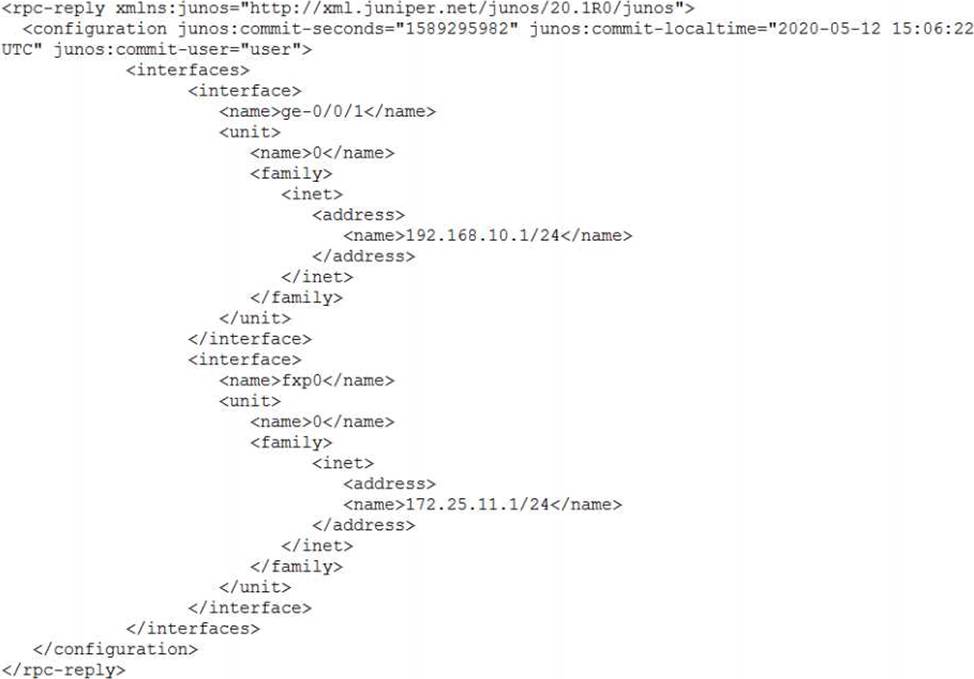
Referring to the exhibit, which XML XPath expression will only show the IP address XML elements?
- A . //address/name
- B . //name
- C . /name
- D . /address/name
A
Explanation:
https://www.w3schools.com/xml/xpath_syntax.asp
Which Python operator is used to test if two variables are equal?
- A . !=
- B . ==
- C . %
- D . =
B
Explanation:
In Python, the == operator is used to test whether two variables are equal. It returns True if the variables are equal and False if they are not.
Option B (==) is correct because it is the equality operator in Python.
Option A (!=) is used for inequality, Option C (%) is the modulus operator, and Option D (=) is used for assignment, not for testing equality.
Supporting
Reference: Python Documentation on Operators: The official Python documentation covers the use of == for equality checks.
You want to use a Python package or module.
In this scenario, which statement would accomplish this task?
- A . reap
- B . dir
- C . input
- D . Import
D
Explanation:
In Python, to use a package or module, you use the import statement. This statement allows you to load a module into your script so that you can use its functions, classes, and variables. For example, if you wanted to use the math module, you would write import math. This makes all the functions and constants in the math module available for use in your program.
Option A (reap), B (dir), and C (input) do not serve the purpose of importing modules. dir is used to list the attributes of an object, input is used to get user input, and reap is not a valid Python command related to importing modules.
Supporting
Reference: Python Documentation on Imports: The Python documentation provides clear guidelines on how to use the import statement to include modules in your Python scripts.
What are two Junos PyEZ configuration object methods? (Choose two.)
- A . commie ()
- B . device ()
- C . lockO
- D . config ()
D, C
Explanation:
In Junos PyEZ, the Config object provides various methods for interacting with device configurations.
Two of the key methods are:
lock(): This method locks the candidate configuration database to prevent other users or processes from making changes while you are modifying the configuration.
config(): This method is used to create a Config object that represents the configuration database, allowing you to load, modify, and commit configuration changes.
Option C (lock) and Option D (config) are correct because they are valid methods provided by the PyEZ Config object.
Option A (commie) and Option B (device) are incorrect as they are not methods of the Config object.
Supporting
Reference: Junos PyEZ Documentation: Details the methods available in the Config object, including lock() and config().
Which DevOps "Three way" principle addresses technical debt?
- A . feedback
- B . flow
- C . continuous experimentation and learning
- D . continuous experimentation
A
Explanation:
In the context of the DevOps "Three Ways" principles, the feedback principle directly addresses the management of technical debt.
The "Three Ways" are core principles guiding DevOps practices, and they are as follows:
Flow: Refers to the smooth and fast flow of work through the system, from development to operations.
Feedback: Emphasizes creating effective, fast, and continuous feedback loops between teams to catch issues early, address technical debt, and ensure quality.
Continuous experimentation and learning: Encourages constant experimentation, innovation, and learning from failures to improve systems and processes over time.
Feedback and Technical Debt:
Feedback loops play a crucial role in addressing technical debt. Technical debt refers to the implied cost of additional work that arises when code or system design decisions are made for short-term gains, such as quick fixes or temporary patches. Over time, technical debt can accumulate and degrade system performance, reliability, and maintainability.
The feedback loop ensures that issues related to technical debt (such as poor code quality, design shortcuts, or performance bottlenecks) are caught early in the process, ideally before they become major problems. Continuous monitoring, testing, and reviewing help identify and resolve technical debt incrementally rather than letting it accumulate unchecked.
Automation in feedback loops: In DevOps, automated testing, continuous integration (CI), and monitoring tools provide immediate feedback to developers, highlighting areas where technical debt is increasing. This feedback is crucial for making proactive decisions about refactoring code or improving infrastructure without waiting for problems to manifest in production.
For instance, the feedback loop might expose slowdowns in application performance after each new feature is added. This would trigger a review to either refactor the feature code or improve system resources, preventing further technical debt accumulation.
Flow and Technical Debt:
While flow focuses on the smooth transition of work through the pipeline, it indirectly helps with technical debt by ensuring continuous and streamlined processes. However, feedback mechanisms are the primary tools for identifying and resolving technical debt.
Continuous Experimentation and Learning:
This principle promotes innovation and learning from failures but does not directly address technical
debt. The focus here is more on risk-taking and improvement rather than managing or eliminating technical debt.
Reference from DevOps Practices:
The Phoenix Project, a book often referenced in DevOps, discusses how feedback loops are essential for maintaining system integrity and managing technical debt effectively. By improving feedback mechanisms, teams can address small issues before they become costly to fix.
The DevOps Handbook also highlights the importance of feedback in managing technical debt, emphasizing that fast feedback allows for continuous improvement and avoids the accumulation of bad practices that would otherwise lead to technical debt.
Juniper Automation and DevOps Context: Juniper’s automation frameworks integrate feedback mechanisms using tools like continuous monitoring and automated testing. These tools help engineers track the health of network systems, identify configuration drifts, and resolve issues before they lead to significant technical debt.
Additional Resources:
The Phoenix Project by Gene Kim
The DevOps Handbook
Which two processes are used by Junos automation? (Choose two.)
- A . mod
- B . jsd
- C . ifd
- D . kmd
BD
Explanation:
Junos automation relies on several key processes to handle various automation and API interactions.
Let’s break down the two key processes involved:
jsd (Junos Script Daemon):
The jsd process is responsible for handling automation scripts, including Python and SLAX scripts, as well as handling JET (Junos Extension Toolkit) API requests. This process is fundamental in the automation framework of Junos, as it deals with external and internal API requests, ensuring that the necessary scripts are executed when specific triggers or events occur.
kmd (Key Management Daemon):
The kmd process is involved in key management for IPsec and other security services. While its primary function is related to managing cryptographic keys, it plays a role in Junos automation by enabling secure communication and ensuring that automation tasks involving security services (such as automated IPsec tunnel creation) are handled securely.
Why the Other Options Are Incorrect:
You are asked to use the REST API to retrieve interface configuration information from your Junos device. You decide to use a cURL HTTP GET command to retrieve this information.
In this scenario, which statement is correct?
- A . The request is handled by the mod process running on the Junos device.
- B . The request is handled by the isrpd process running on the Junos device.
- C . The request is handled by the rpd process running on the Junos device.
- D . The request is handled by the isd process running on the Junos device
B
Explanation:
When using the REST API on a Junos device, the isrpd (Integrated Service Routing Process Daemon) process is responsible for handling REST API requests. This process listens for incoming HTTP
requests and processes them accordingly, including retrieving interface configuration information when a GET request is made.
Option B is correct because the isrpd process handles the REST API requests on a Junos device.
Options A (mod process), C (rpd process), and D (isd process) are incorrect in this context as they either do not exist or serve different purposes on a Junos device.
Supporting
Reference: Juniper Networks REST API Documentation: Provides insights into how REST API requests are managed and processed by the isrpd process on Junos devices.
Which Junos configuration database is updated by PyEZ by default?
- A . shared
- B . dynamic
- C . private
- D . ephemeral
C
Explanation:
An event script is used to automate responses to system events in Junos, such as an interface going down. These scripts are triggered automatically when a specified event occurs, making them suitable for tasks like monitoring interface status and executing actions when the status changes.
Option B (event) is correct because event scripts are designed for reacting to system events like an interface going down.
Option A (commit) is used for configuration changes, Option C (operation) is used for operational tasks, and Option D (SNMP) is not applicable in this context.
Supporting
Reference: Juniper Networks Event Scripts Documentation: Details how event scripts are used to automate responses to specific system events in Junos