
Juniper JN0-224 Practice Exams
Last updated on Oct 21,2026- Exam Code: JN0-224
- Exam Name: Automation and DevOps, Associate (JNCIA-DevOps)
- Certification Provider: Juniper
- Latest update: Oct 21,2026
Using the set rest control configuration command, what are two ways to control access to the REST API running on a Junos device? (Choose two.)
- A . Limit management access to only SSH
- B . Limit management access to specific users.
- C . Limit the number of simultaneous connections.
- D . Limit access to only certain source IP addresses
C, D
Explanation:
When using the set rest control configuration command on a Junos device, you have several options to control access to the REST API. Two effective methods include:
Limiting the number of simultaneous connections: This ensures that the REST API is not overwhelmed by too many concurrent requests, which could potentially lead to performance issues or denial of service.
Limiting access to certain source IP addresses: This method restricts API access to specific IP addresses, enhancing security by ensuring that only trusted sources can interact with the REST API.
Option A (Limit management access to only SSH) is unrelated to controlling REST API access specifically.
Option B (Limit management access to specific users) might be relevant in a different context, but it is not directly tied to REST API control via the specific command mentioned.
Supporting
Reference: Juniper Networks REST API Documentation: This documentation explains how to configure and control access to the REST API on Junos devices, including connection limits and IP-based access control.
Which two statements are correct about a Python list data type? (Choose two.)
- A . The data contained in a list data type can be modified.
- B . The data contained in a list data type is sequenced and indexed starting from 0.
- C . The data contained in a list data type cannot be modified.
- D . The data contained in a list data type is not sequenced or indexed.
A, B
Explanation:
Python lists have the following characteristics:
Modifiable Data (A): Lists are mutable, meaning you can change, add, or remove elements after the list has been created.
Sequenced and Indexed (B): Lists maintain the order of their elements and are indexed starting from 0. This means you can access elements by their position in the list.
Option C is incorrect because lists are mutable, allowing modifications. Option D is incorrect because lists are indeed sequenced and indexed, unlike dictionaries.
Reference: Python Official Documentation: Covers the properties of lists, including mutability and indexing.
Python Data Structures Guide: Explains list operations and how to manipulate them.
Which feature is used in XML to ensure that all attributes and elements have unique names?
- A . selectors
- B . predicate
- C . namespace
- D . XPath
Which HTTP status code indicates a response to a successful request?
- A . 500
- B . 302
- C . 200
- D . 400
C
Explanation:
Explanation
Reference: https://www.juniper.net/documentation/en_US/junos-space-sdk/13.1/apiref/com.juniper.junos_space.sdk.help/html/reference/Commonbehav.html
Which two statements about NETCONF layers are correct? (Choose two.)
- A . NETCONF layers use the messages layer to receive RPCs from a remote NETCONF server.
- B . NETCONF layers use the messages layer to send RPCs to a remote NETCONF server.
- C . NETCONF layers use the operations layer to receive RPCs from a remote NETCONF server.
- D . NETCONF layers use the operations layer to send RPCs to a remote NETCONF server.
B, C
Explanation:
NETCONF (Network Configuration Protocol) is a standard protocol defined for managing network devices. NETCONF operates in a layered architecture, which includes the following key layers:
Operations Layer: This layer deals with the actual operations like <get-config>, <edit-config>, <copy-config>, and others. It receives RPC (Remote Procedure Call) requests from a remote NETCONF client and processes these requests.
Messages Layer: This layer is responsible for encoding the RPCs and sending them over the network. It handles the communication between the NETCONF client and server, ensuring that the RPC messages are correctly formatted (usually in XML) and transmitted.
Statement B is correct because the Messages layer is responsible for sending RPCs to a remote NETCONF server.
Statement C is correct because the Operations layer is where the NETCONF server receives and processes the RPCs sent by the client.
Supporting
Reference: Juniper Networks NETCONF Documentation: Provides a detailed breakdown of the NETCONF protocol layers and their functions.
RFC 6241: The official specification for NETCONF, which describes the layered architecture, including the operations and messages layers.
Exhibit.
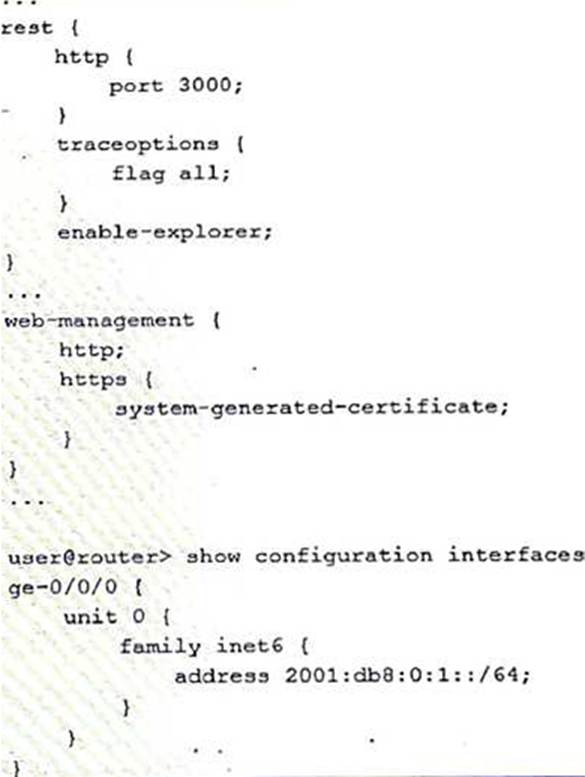
You have the configuration shown in the exhibit, but are unable to access the REST API Explorer.
Which configuration is necessary to solve this problem?
- A . Configure the rest service to be active on port 80.
- B . Configure an IPv4 address on ge-0/0/0 0.
- C . Configure a secondary IPv6 address on ge-0/0/0.0.
- D . Configure a firewall filter to explicitly permit SSH.
What is the difference between a list and a tuple in Python?
- A . Lists are immutable objects that use square brackets, and tuples are mutable objects that use parentheses.
- B . Lists are mutable objects that use square brackets, and tuples are immutable objects that use parentheses.
- C . Lists are immutable objects that use parentheses, and tuples are immutable objects that use square brackets.
- D . Lists are mutable objects that use parentheses, and tuples are immutable objects that use square brackets.
B
Explanation:
In Python, the distinction between lists and tuples is essential for efficient programming:
Lists:
Mutable (B): This means that once a list is created, its elements can be changed, added, or removed.
Lists are versatile and commonly used when the data is expected to change.
Square Brackets: Lists are defined using square brackets [].
Example:
my_list = [1, 2, 3]
my_list[0] = 10 # Modifying the first element
Tuples:
Immutable (B): Once a tuple is created, it cannot be altered. Tuples are used when a fixed collection of items is needed, providing more integrity to the data.
Parentheses: Tuples are defined using parentheses ().
Example:
my_tuple = (1, 2, 3)
# my_tuple[0] = 10 # This would raise an error because tuples are immutable
Reference: Python Official Documentation: The Python Language Reference provides detailed information on data types like lists and tuples, including their mutability and syntax.
Automation Scripts: In the context of automation, understanding when to use mutable or immutable data structures can significantly impact script performance and reliability.
Junos PyEZ tables are formatted using which file type?
- A . SON
- B . YAML
- C . txt
- D . IXML
B
Explanation:
Junos PyEZ uses YAML (YAML Ain’t Markup Language) files to define the format for tables and views when working with operational and configuration data. YAML is a human-readable data format that is commonly used for configuration files, making it suitable for defining data structures in PyEZ.
Option B (YAML) is correct because PyEZ tables are defined using YAML files.
Options A (JSON), C (txt), and D (IXML) are incorrect in this context, as YAML is the standard format used.
Supporting
Reference: Junos PyEZ Tables Documentation: Explains the use of YAML files for formatting tables and views in Junos PyEZ.
Which two statements about Ansible are correct? (Choose two.)
- A . Ansible can use a single playbook to configure devices from multiple vendors.
- B . Ansible modules must be written in Go.
- C . Ansible is an open source project.
- D . Ansible requires a license to unlock full functionality.
YAML uses which two data structures? (Choose two.)
- A . arrays
- B . mappings
- C . sequences
- D . objects
B, C
Explanation:
YAML (YAML Ain’t Markup Language) primarily uses two data structures:
Mappings: These are key-value pairs, similar to dictionaries or hashes in programming languages. In YAML, mappings are used to represent associative arrays or objects. They are defined with a colon (:) separating the key from the value.
Example:
key: value
name: John Doe
Sequences: These are ordered lists of items, equivalent to arrays or lists in other programming languages. Sequences in YAML are denoted by a dash (-) followed by a space and then the item.
Example:
fruits:
– Apple
– Banana
– Cherry
Detailed Explanation
Mappings (B) allow you to define relationships between keys and values, making it possible to represent more complex data structures like dictionaries or objects.
Sequences (C) allow you to represent ordered collections, which is important for listing elements that must maintain a specific order.
YAML is often used in configuration files and data serialization in DevOps environments, such as in Ansible playbooks, Kubernetes manifest files, and CI/CD pipeline definitions. Its simplicity and human-readable format make it a popular choice for these applications.
Reference: YAML Official Documentation: YAML’s specification outlines these core data structures.
Juniper Automation and DevOps Documentation: Provides best practices for using YAML in network automation scripts and configuration management.