
Juniper JN0-214 Practice Exams
Last updated on Oct 21,2026- Exam Code: JN0-214
- Exam Name: Cloud, Associate (JNCIA-Cloud)
- Certification Provider: Juniper
- Latest update: Oct 21,2026
Which cloud service model provides access to networking, storage, servers, and virtualization in a cloud environment?
- A . Platform as a Service (PaaS)
- B . Software as a Service (SaaS)
- C . Infrastructure as a Service (IaaS)
- D . Database as a Service (DaaS)
C
Explanation:
Cloud service models define how services are delivered and managed in a cloud environment.
The three primary models are:
Infrastructure as a Service (IaaS): Provides virtualized computing resources such as servers, storage, networking, and virtualization over the internet. Customers manage their own operating systems, applications, and data, while the cloud provider manages the underlying infrastructure.
Platform as a Service (PaaS): Provides a platform for developers to build, deploy, and manage applications without worrying about the underlying infrastructure. Examples include Google App Engine and Microsoft Azure App Services.
Software as a Service (SaaS): Delivers fully functional applications over the internet, eliminating the need for users to install or maintain software locally. Examples include Salesforce CRM, Google Workspace, and Microsoft Office 365.
Database as a Service (DaaS): A specialized subset of PaaS that provides managed database services.
In this question, the focus is on access to networking, storage, servers, and virtualization, which are the core components of IaaS. IaaS allows customers to rent infrastructure on-demand and build their own environments without investing in physical hardware.
Why IaaS?
Flexibility: Customers have full control over the operating systems, applications, and configurations.
Scalability: Resources can be scaled up or down based on demand.
Cost Efficiency: Pay-as-you-go pricing eliminates upfront hardware costs.
JNCIA Cloud
Reference: The JNCIA-Cloud certification emphasizes understanding the different cloud service models and their use cases. IaaS is particularly relevant for organizations that want to leverage cloud infrastructure while maintaining control over their applications and data.
For example, Juniper Contrail integrates with IaaS platforms like OpenStack to provide advanced networking and security features for virtualized environments.
Reference: NIST Cloud Computing Reference Architecture
Juniper JNCIA-Cloud Study Guide: Cloud Service Models
You must provide tunneling in the overlay that supports multipath capabilities.
Which two protocols provide this function? (Choose two.)
- A . MPLSoGRE
- B . VXLAN
- C . VPN
- D . MPLSoUDP
BD
Explanation:
In cloud networking, overlay networks are used to create virtualized networks that abstract the underlying physical infrastructure. To support multipath capabilities , certain protocols provide efficient tunneling mechanisms.
Let’s analyze each option:
Which Kubernetes component guarantees the availability of ReplicaSet pods on one or more nodes?
- A . kube-proxy
- B . kube-scheduler
- C . kube controller
- D . kubelet
C
Explanation:
Kubernetes components work together to ensure the availability and proper functioning of resources like ReplicaSets.
Let’s analyze each option:
Which key value store is used as a Kubernetes’s backend store?
- A . etcd
- B . firebase
- C . postgres
- D . mongodb
A
Explanation:
Kubernetes relies on a distributed key-value store to maintain its state and configuration data.
Let’s analyze each option:
Which command would you use to see which VMs are running on your KVM device?
- A . virt-install
- B . virsh net-list
- C . virsh list
- D . VBoxManage list runningvms
C
Explanation:
KVM (Kernel-based Virtual Machine) is a popular open-source virtualization technology that allows you to run virtual machines (VMs) on Linux systems. The virsh command-line tool is used to manage
KVM VMs.
Let’s analyze each option:
Click the Exhibit button.
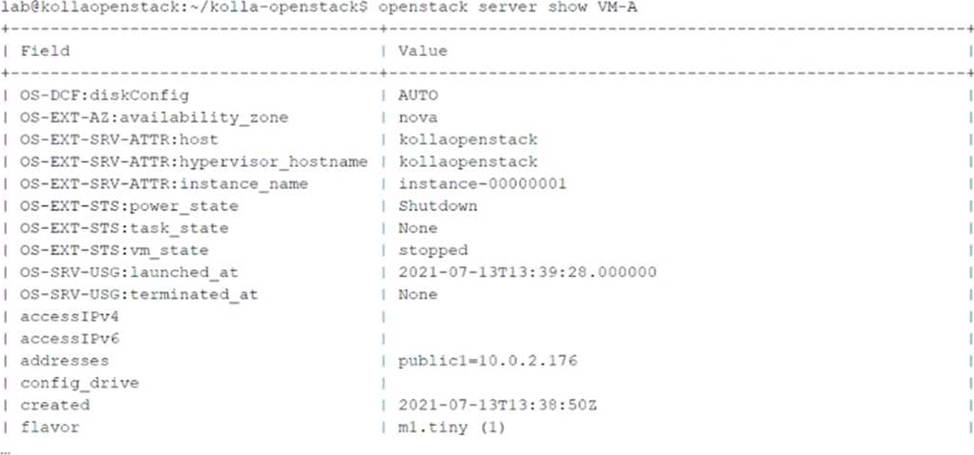
You have issued the openstack server show VM-A command and received the output shown in the exhibit.
To which virtual network is the VM-A instance attached?
- A . m1.tiny
- B . public1
- C . Nova
- D . kollaopenstack
B
Explanation:
The openstack server show command provides detailed information about a specific virtual machine (VM) instance in OpenStack. The output includes details such as the instance name, network attachments, power state, and more. Let’s analyze the question and options:
Key Information from the Exhibit:
The addresses field in the output shows
public1=10.0.2.176
This indicates that the VM-A instance is attached to the virtual network named public1 , with an assigned IP address of 10.0.2.176.
Option Analysis:
You just uploaded a qcow2 image of a vSRX virtual machine in OpenStack.
In this scenario, which service stores the virtual machine (VM) image?
- A . Glance
- B . Ironic
- C . Neutron
- D . Nova
A
Explanation:
OpenStack provides various services to manage cloud infrastructure resources, including virtual machine (VM) images.
Let’s analyze each option:
You have built a Kubernetes environment offering virtual machine hosting using KubeVirt.
Which type of service have you created in this scenario?
- A . Software as a Service (Saa
- B . Platform as a Service (Paa
- C . Infrastructure as a Service (laaS)
- D . Bare Metal as a Service (BMaaS)
C
Explanation:
Kubernetes combined with KubeVirt enables the hosting of virtual machines (VMs) alongside containerized workloads. This setup aligns with a specific cloud service model.
Let’s analyze each option:
You are asked to support an application in your cluster that uses a non-IP protocol.
In this scenario, which type of virtual network should you create to support this application?
- A . a Layer 3 virtual network
- B . a Layer 2 virtual network
- C . an Ethernet VPN (EVPN) Type 5 virtual network
- D . a virtual network router connected to the virtual network
B
Explanation:
In cloud environments, virtual networks are used to support applications that may rely on different protocols for communication.
Let’s analyze each option:
Which OpenStack service displays server details of the compute node?
- A . Keystone
- B . Neutron
- C . Cinder
- D . Nova
D
Explanation:
OpenStack provides various services to manage cloud infrastructure resources, including compute nodes and virtual machines (VMs).
Let’s analyze each option: