
Juniper JN0-214 Practice Exams
Last updated on Oct 21,2026- Exam Code: JN0-214
- Exam Name: Cloud, Associate (JNCIA-Cloud)
- Certification Provider: Juniper
- Latest update: Oct 21,2026
Which statement about software-defined networking is true?
- A . It must manage networks through the use of containers and repositories.
- B . It manages networks by separating the data forwarding plane from the control plane.
- C . It applies security policies individually to each separate node.
- D . It manages networks by merging the data forwarding plane with the control plane.
B
Explanation:
Software-Defined Networking (SDN) is a revolutionary approach to network management that separates the control plane from the data (forwarding) plane.
Let’s analyze each option:
What are two Kubernetes worker node components? (Choose two.)
- A . kube-apiserver
- B . kubelet
- C . kube-scheduler
- D . kube-proxy
B, D
Explanation:
Kubernetes worker nodes are responsible for running containerized applications and managing the workloads assigned to them. Each worker node contains several key components that enable it to function within a Kubernetes cluster.
Let’s analyze each option:
What are two available installation methods for an OpenShift cluster? (Choose two.)
- A . installer-provisioned infrastructure
- B . kubeadm
- C . user-provisioned infrastructure
- D . kubespray
A, C
Explanation:
OpenShift provides multiple methods for installing and deploying clusters, depending on the level of control and automation desired.
Let’s analyze each option:
Your organization has legacy virtual machine workloads that need to be managed within a Kubernetes deployment.
Which Kubernetes add-on would be used to satisfy this requirement?
- A . ADOT
- B . Canal
- C . KubeVirt
- D . Romana
C
Explanation:
Kubernetes is designed primarily for managing containerized workloads, but it can also support legacy virtual machine (VM) workloads through specific add-ons.
Let’s analyze each option:
Which two statements are correct about Network Functions Virtualization (NFV)? (Choose two.)
- A . the NFV framework explains how VNFs fits into the whole solution.
- B . The NFV Infrastructure (NFVI) is a component of NFV.
- C . The NFV Infrastructure (NFVI) is not a component of NFV.
- D . The NFV framework is defined by the W3C.
A, B
Explanation:
Network Functions Virtualization (NFV) is a framework designed to virtualize network services traditionally run on proprietary hardware. It decouples network functions from dedicated hardware appliances and implements them as software running on standard servers or virtual machines.
Let’s analyze each statement:
Regarding the third-party CNI in OpenShift, which statement is correct?
- A . In OpenShift, you can remove and install a third-party CNI after the cluster has been deployed.
- B . In OpenShift, you must specify the third-party CNI to be installed during the initial cluster deployment.
- C . OpenShift does not support third-party CNIs.
- D . In OpenShift, you can have multiple third-party CNIs installed simultaneously.
B
Explanation:
OpenShift supports third-party Container Network Interfaces (CNIs) to provide advanced networking capabilities. However, there are specific requirements and limitations when using third-party CNIs.
Let’s analyze each statement:
Which command should you use to obtain low-level information about Docker objects?
- A . docker info <OBJECT_NAME>
- B . docker inspect <OBJECT_NAME>
- C . docker container <OBJECT_NAME>
- D . docker system <OBJECT_NAME>
B
Explanation:
Docker provides various commands to manage and interact with Docker objects such as containers, images, networks, and volumes. To obtain low-level information about these objects, the docker inspect command is used.
Let’s analyze each option:
Click the Exhibit button.
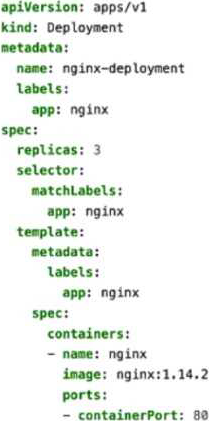
You apply the manifest file shown in the exhibit.
Which two statements are correct in this scenario? (Choose two.)
- A . The created pods are receiving traffic on port 80.
- B . This manifest is used to create a deployment.
- C . This manifest is used to create a deploymentConfig.
- D . Four pods are created as a result of applying this manifest.
A, B
Explanation:
The provided YAML manifest defines a Kubernetes Deployment object that creates and manages a set of pods running the NGINX web server.
Let’s analyze each statement in detail:
Which type of virtualization provides containerization and uses a microservices architecture?
- A . hardware-assisted virtualization
- B . OS-level virtualization
- C . full virtualization
- D . paravirtualization
B
Explanation:
Virtualization technologies enable the creation of isolated environments for running applications or services.
Let’s analyze each option: