
ISTQB ISTQB-CTFL Practice Exams
Last updated on Oct 21,2026- Exam Code: ISTQB-CTFL
- Exam Name: ISTQB-Foundation Level Exam
- Certification Provider: ISTQB
- Latest update: Oct 21,2026
Which of the following applications will be the MOST suitable for testing by Use Cases
- A . Accuracy and usability of a new Navigation system compared with previous system
- B . A billing system used to calculate monthly charge based or large number of subscribers parameters
- C . The ability of an Anti virus package to detect and quarantine a new threat
- D . Suitability and performance of a Multi media (audio video based) system to a new operating system
A
Explanation:
A new navigation system compared with a previous system is the most suitable application for testing by use cases, because it involves a high level of interaction between the user and the system, and the expected behavior and outcomes of the system are based on the user’s needs and goals. Use cases can help to specify the functional requirements of the new navigation system, such as the ability to enter a destination, select a route, follow the directions, receive alerts, etc. Use cases can also help to compare the accuracy and usability of the new system with the previous system, by defining the success and failure scenarios, the preconditions and postconditions, and the alternative flows of each use case. Use cases can also help to design and execute test cases that cover the main and exceptional paths of each use case, and to verify the satisfaction of the user’s expectations.
The other options are not the most suitable applications for testing by use cases, because they do not involve a high level of interaction between the user and the system, or the expected behavior and outcomes of the system are not based on the user’s needs and goals. A billing system used to calculate monthly charge based on a large number of subscriber parameters is more suitable for testing by data-driven testing, which is a technique for testing the functionality and performance of a system or component by using a large set of input and output data. The ability of an antivirus package to detect and quarantine a new threat is more suitable for testing by exploratory testing, which is a technique for testing the functionality and security of a system or component by using an informal and flexible approach, based on the tester’s experience and intuition. The suitability and performance of a multimedia (audio video based) system to a new operating system is more suitable for testing by compatibility testing, which is a technique for testing the functionality and performance of a system or component by using different hardware, software, or network environments.
Reference = CTFL 4.0 Syllabus, Section 3.1.1, page 28-29; Section 4.1.1, page 44-45; Section 4.2.1, page 47-48.
Which of the following would be LEAST appropriate as part of an incident report covering the observation of a failure during testing?
- A . SOL injection into the username entry field allowed a variety of SQL commands to be executed by the application without the appropriate authority.
- B . The user interface was complicated and confusing and I found It quite difficult to follow the test script.
- C . The updates made as part of the add new member’ function did not reflect the expected change as the name was written into the address field.
- D . The expected result for the ‘list friends’ response time was less than 10 seconds, whereas the average response time obtained was 13 seconds.
B
Explanation:
An incident report during testing should focus on factual observations of failures or defects in the system, including their impacts and how they deviate from expected results. Options A, C, and D describe specific issues that are directly related to the system’s behavior or performance and are suitable for inclusion in an incident report. Option B, which describes the user interface as "complicated and confusing" and relates to the tester’s personal difficulty in following the test script, is more subjective and relates to the tester’s experience rather than an objective observation of a system failure. Therefore, option B is the least appropriate for an incident report.
Which of the following are the phases of the ISTQB fundamental test process?
- A . Test planning and control, Test analysis and design, Test implementation and execution, Evaluating ex t criteria and reporting. Test closure activities
- B . Test planning, Test analysis and design. Test implementation and control. Checking test coverage and reporting, Test closure activities
- C . Test planning and control, Test specification and design. Test implementation and execution, Evaluating test coverage and reporting, Retesting and regression testing, Test closure activities
- D . Test planning. Test specification and design. Test implementation and execution. Evaluating exit criteria and reporting. Retesting and test closure activities
A
Explanation:
The ISTQB fundamental test process consists of five main phases, as described in the ISTQB Foundation Level Syllabus, Version 4.0, 2018, Section 2.2, page 15:
Test planning and control: This phase involves defining the test objectives, scope, strategy, resources, schedule, risks, and metrics, as well as monitoring and controlling the test activities and results throughout the test process.
Test analysis and design: This phase involves analyzing the test basis (such as requirements, specifications, or user stories) to identify test conditions (such as features, functions, or scenarios) that need to be tested, and designing test cases and test procedures (such as inputs, expected outcomes, and execution steps) to cover the test conditions. This phase also involves evaluating the testability of the test basis and the test items (such as software or system components), and selecting and implementing test techniques (such as equivalence partitioning, boundary value analysis, or state transition testing) to achieve the test objectives and optimize the test coverage and efficiency.
Test implementation and execution: This phase involves preparing the test environment (such as hardware, software, data, or tools) and testware (such as test cases, test procedures, test data, or test scripts) for test execution, and executing the test procedures or scripts according to the test plan and schedule. This phase also involves logging the outcome of test execution, comparing the actual results with the expected results, and reporting any discrepancies as incidents (such as defects, errors, or failures).
Evaluating exit criteria and reporting: This phase involves checking if the planned test activities have been completed and the exit criteria (such as quality, coverage, or risk levels) have been met, and reporting the test results and outcomes to the stakeholders. This phase also involves making recommendations for the release or acceptance decision based on the test results and outcomes, and identifying any residual risks (such as known defects or untested areas) that need to be addressed or mitigated.
Test closure activities: This phase involves finalizing and archiving the testware and test environment for future reuse, and evaluating the test process and the test project against the test objectives and the test plan. This phase also involves identifying any lessons learned and best practices, and communicating the findings and suggestions for improvement to the relevant parties.
Reference = ISTQB Certified Tester Foundation Level Syllabus, Version 4.0, 2018, Section 2.2, page 15; ISTQB Glossary of Testing Terms, Version 4.0, 2018, pages 37-38; ISTQB CTFL 4.0 – Sample Exam –
Answers, Version 1.1, 2023, Question 88, page 32.
Consider the following statements about risk-based testing.
I) Risk-based testing has the objective to reduce the level of protect risks.
II) Tests should be prioritized to find tie critical detects as early as possible.
III) Non-testing activities may also help to reduce risk IV) Risks have to be reassessed on a regular basis.
V) The project stakeholders can give useful input to determine the risks
- A . I III IV and V are true. II is false.
- B . II, III IV and V are correct. I is false.
- C . I, II and IV are true. III and V are false.
- D . II, Ill and V are true. 1 ants Iv are false.
B
Explanation:
The following statements about risk-based testing are correct:
II) Tests should be prioritized to find tie critical detects as early as possible. Risk-based testing
involves prioritizing tests based on risk level, which reflects both the likelihood and impact of defects or failures. Tests with higher risk level should be executed earlier than tests with lower risk level, in order to find and fix critical defects as soon as possible.
III) Non-testing activities may also help to reduce risk. Risk-based testing does not only involve testing activities, but also other activities that can help mitigate risks, such as reviews, inspections, audits, simulations or prototyping.
The tests at the bottom layer of the test pyramid:
- A . run faster than the tests at the top layer of the pyramid
- B . cover larger pieces of functionalities than the tests at the top layer of the pyramid
- C . are defined as ‘Ul Tests’ or ‘End-To-End tests’ in the different models of the pyramid
- D . are unscripted tests produced by experience-based test techniques
Which of the following is the most important task of a typical test leader?
- A . To automate tests.
- B . To prepare and acquire test data.
- C . To set up the test environment.
- D . To coordinate the test strategy with project managers.
D
Explanation:
The most important task of a typical test leader is to coordinate the test strategy with project managers. The test strategy is a high-level document that defines the general approach and objectives of testing for a project or an organization. The test leader is responsible for defining, documenting, communicating, and implementing the test strategy in alignment with the project goals and constraints. The test leader also needs to coordinate with project managers and other stakeholders to ensure that the test strategy is feasible, effective, and efficient. The other options are not the most important tasks of a typical test leader. To automate tests is a task of a test automation engineer or a test automation specialist. To prepare and acquire test data is a task of a test analyst or a test engineer. To set up the test environment is a task of a test environment manager or a test environment specialist.
Verified Reference: A Study Guide to the ISTQB® Foundation Level 2018 Syllabus – Springer, page 13.
A typical objective of testing is to ensure that:
- A . testing is used to drive the development of a software
- B . a software has been tested using a combination of test techniques
- C . there are no defects in a software that is about to be released
- D . a software has been properly covered
B
Explanation:
This answer is correct because a typical objective of testing is to ensure that a software has been tested using a combination of test techniques, such as black-box, white-box, or experience-based techniques, that are appropriate for the test objectives, test levels, and test types. Testing using a combination of test techniques can increase the effectiveness and efficiency of testing, as different techniques can target different aspects of the software quality, such as functionality, usability, performance, security, reliability, etc. Testing using a combination of test techniques can also reduce the risk of missing defects that could be detected by one technique but not by another.
Reference: ISTQB Foundation Level Syllabus v4.0, Section 2.3.1.1, Section 2.3.2
For each test case to be executed, the following table specifies its dependencies and the required configuration of the test environment for running such test case:
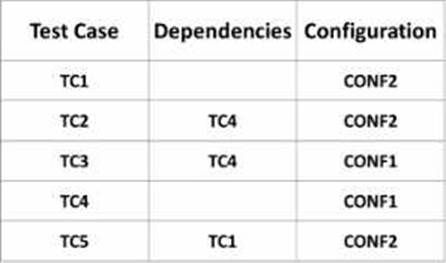
Assume that C0NF1 is the initial configuration of the test environment Based on this assumption, which of the following is a test execution schedule that is compatible with the specified dependencies and allows minimising the number of switches between the different configurations of the test environment^
- A . TC4, TC3, TC2, TC1, TC5.
- B . TCI, TC5, TC4, TC3, TC2
- C . TC4, TC3, TC2, TC5, TC1.
- D . TC4, TC1, TC5, TC2, TC3
A
Explanation:
To determine the optimal test execution schedule that minimizes the number of configuration switches and respects the dependencies, we start with the initial configuration, CONF1.
TC4: It has no dependencies and runs on CONF1 (initial configuration).
TC3: Depends on TC4 and runs on CONF1. Since TC4 is already executed, we can proceed with TC3.
TC2: Depends on TC4 and runs on CONF2. We switch to CONF2 after TC3.
TC1: No dependencies and runs on CONF2. Since we are already in CONF2, we can execute TC1 next.
TC5: Depends on TC1 and runs on CONF2. Since TC1 is already executed, we can proceed with TC5 without additional configuration switches.
By following this sequence (TC4, TC3, TC2, TC1, TC5), we respect the dependencies and minimize the number of configuration switches
A Static analysis tool analyzes a given program’s CONTROL FLOW among other things.
Which of the following options represents the most likely outcome of the control flow analysis:
- A . Identification of unreachable code
- B . Report on adherence to the coding standards
- C . Number of comment lines
- D . Number of source code lines
A
Explanation:
A static analysis tool is a tool that analyzes a given program’s source code or executable code without executing it. A static analysis tool can perform various types of analysis on a program’s code, such as syntax checking, data flow analysis, control flow analysis, complexity measurement, coding standards compliance checking, etc. Control flow analysis is a type of analysis that examines how a program’s statements are executed in different paths or branches. One of the most likely outcomes of control flow analysis is identification of unreachable code, which is code that can never be executed due to logical errors or design flaws. Unreachable code can reduce readability and maintainability of the code, as well as increase complexity and size. The other options are not outcomes of control flow analysis, but rather outcomes of other types of analysis. Report on adherence to coding standards is an outcome of coding standards compliance checking. Number of comment lines and number of source code lines are outcomes of complexity measurement.
Verified Reference: A Study Guide to the ISTQB® Foundation Level 2018 Syllabus – Springer, page 8.
Which of the following BEST describes checklist-based testing?
- A . Checklist-based testing includes formal tests from detailed lists of test conditions, allowing much repeatability
- B . Checklist-based testing may involve a list of tests based on what is important to the user as well as an understanding of why and how software fails
- C . Checklist-based testing, while popular, provides little consistency and few guidelines concerning test case development
- D . Checklist-based testing is restricted to non-functional testing, including usability, performance, and security test
B
Explanation:
Checklist-based testing involves using checklists that contain items, such as potential test conditions, that should be tested. These checklists are often based on insights into what is important to the user, potential areas where software might fail, and specific aspects that need to be tested. It provides a structured yet flexible approach to testing, ensuring key areas are covered while allowing testers to use their experience and understanding of the system. Checklist-based testing is not limited to non-functional testing but can be applied to various types of testing, including functional testing.
Reference: ISTQB Certified Tester Foundation Level Syllabus v4.0, Section 4.4.5.