
Huawei H12-831_V1.0 Practice Exams
Last updated on Oct 22,2026- Exam Code: H12-831_V1.0
- Exam Name: HCIP-Datacom-Advanced Routing & Switching Technology V1.0
- Certification Provider: Huawei
- Latest update: Oct 22,2026
The output information of a switch is shown in the figure. Which of the following can be determined from this information?
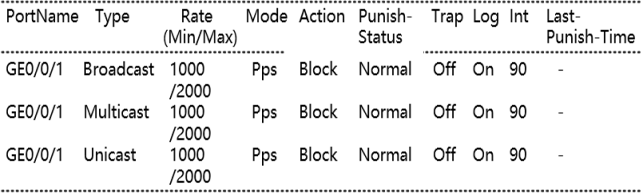
- A . When the average rate of unknown multicast packets is 1500 pps, GE0/0/1 will block the multicast packets.
- B . The administrator configured the traffic suppression function on the GE0/0/1 port of the switch.
- C . After GE0/0/1 blocks broadcast packets, they will be forwarded normally only when the average rate of broadcast packets is less than 1000ps.
- D . When the average rate of unicast packets is known to be 2500 pps, GE0/0/1 will be closed
A network device has established an OSPF neighbor relationship. The configuration of its GE0/0/0 interface is shown in the figure. Which of the following commands executed on this interface will not affect the OSPF neighbor status of this interface? (Multiple choice)
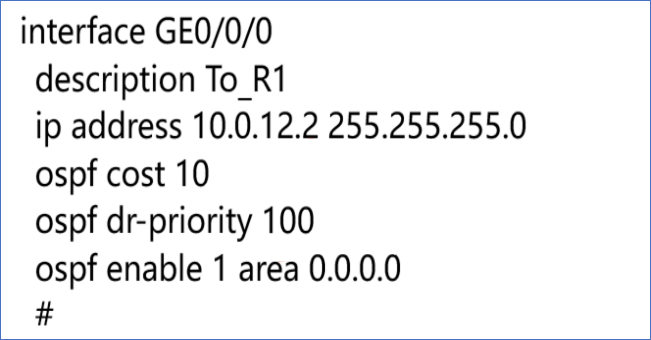
- A . undo ospf dr-priority
- B . undo description
- C . undo ospf Cost
- D . undo ip address 10.0.12.2 24
When dealing with a fault in the existing network, a network engineer drew a topology diagram as shown in the figure. All routers run SPF. Which of the following descriptions about the access path between PC1 and PC2 is correct?
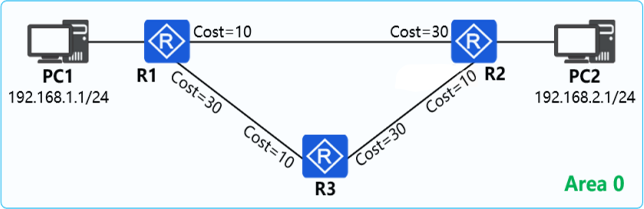
- A . The path from PC1 to PC2 is: PC1-R1-R3-R2-PC2; the path from PC2 to PC1 is: PC2-R2-R3-R1-PC1
- B . The path from PC1 to PC2 is: PC1-R1-R3-R2-PC2; the path from PC2 to PC1 is: PC2-R2-R1-PC1
- C . The path from PC1 to PC2 is: PC1-R1-R2-PC2: The path from PC2 to PC1 is: PC2-R2-R3-R1-PC1
- D . The path from PC1 to PC2 is: PC1-R1-R2-PC2, and the path from PC2 to PC1 is: PC2-R2-R1-PC1
In the network shown in the figure, the network engineer found that the path between PC1 and PC2 is not the optimal path, and the cost value of each link is the same. Based on this analysis, which of the following priorities may the switch have?
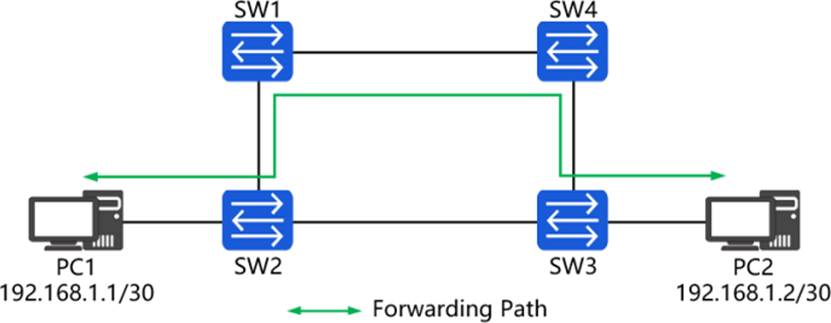
- A . SW1 32768; SW2 4096; SW3 0; SW4 8192
- B . SW1 32768; SW2 0; SW3 4096; SW4 8192
- C . SW1 0; SW2 32768; SW3 8192; SW4 4096
- D . SW1 32768; SW2 12288; SW3 4096; SW4 8192
When a network device encounters any of the following faults, the network device will report the error message with OID 1.3.6.1.4.1.2011.5.25.155.31.3 (node name hwOspfv2IntraAreaRouteridConflict) to the network management server through SNWP?
- A . The local device deletes the OSPF routes advertised by other devices
- B . The OSPF neighbor flapping suppression status changes
- C . OSPF detects a router ID conflict within the area
- D . OSPF detects a local link DRIP address conflict
In the network shown in the figure, R1, R2, R4, and R5 run IS-IS in area 49.0001, R3 and R6 run IS-IS in area 49.0002, and "import-route isis level-2 into level-1" is configured on R2 and R5. Within AS 65000, R1, R3, R4, and R6 all establish IBGP neighbor relationships with R2 and R5, of which R2 and R5 are RRs, and R1, R4, R3, and R6 are clients. R2 and R5 also establish an IBGP neighbor relationship and configure the same Cluster ID. IBGP neighbor relationships are all established using the Loopback0 interface. The IP address of the Loopback0 interface of each device is 10.0.X.X/32, and the Router ID is 10.0.X.X, where X is the device number. R1 and R4 import the external network 192.168.1.0/24 into BGP, and R3 and R6 import the external network 192.168.2.0/24 into BGP. In the BGP process of all routers, configure "maximum load-balancing ibgp 8".
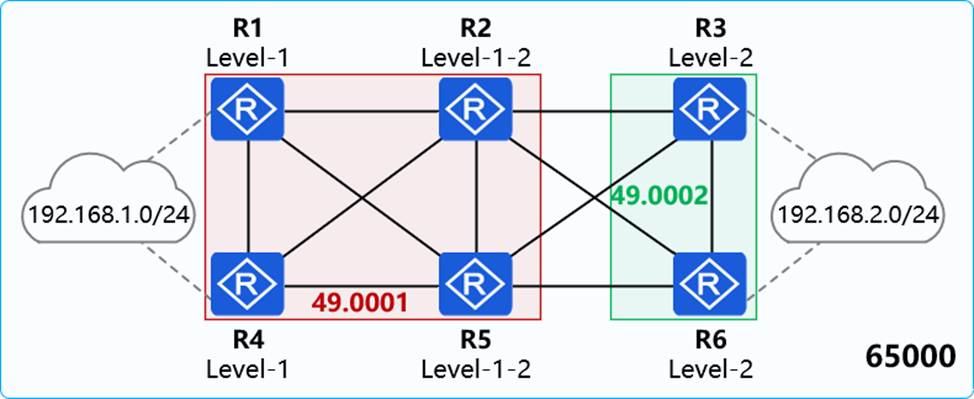
Which of the following descriptions are correct by default? (Multiple choice)
- A . There are two equal-cost routes to 192.168.2.0/24 in R5’s routing table.
- B . There are two equal-cost routes to 192.168.1.0/24 in R2’s routing table
- C . R1’s routing table has an equal-cost route to 192.168.2.0/24, and the next-hop IP is the same.
- D . R3’s routing table has an equal-cost route to 192.168.1.0/24, and the next-hop IP is different.
The MPLS label is a 20-bit identifier. When the administrator configures a static LSP, the label values of different IPLS devices cannot overlap.
- A . True
- B . False
In the OSPF network shown in the figure, Area 1 and Area 2 are both common areas, and R4 introduces the external route 10.0.4.4/32.
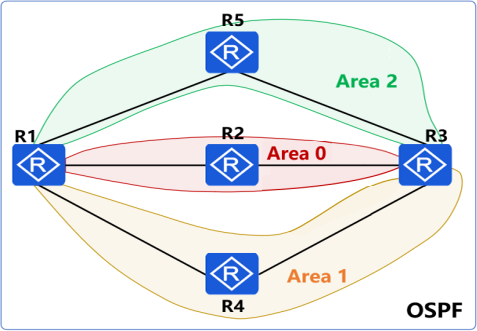
The "asbr-summary 10.0.4.0 255.255.255.0" command is configured in the OSPF processes of R1 and R3. Which of the following routers have a route entry for 10.0.4.4/32 in their routing tables? (Multiple choice)
- A . R1
- B . R2
- C . R5
- D . R3
R4’s Router ID is 10.0.4.4. In R4’s LSDB, the LSA shown in the figure is seen. The network engineer makes the following inferences based on the LSA. Which of them are correct? (Multiple choice)
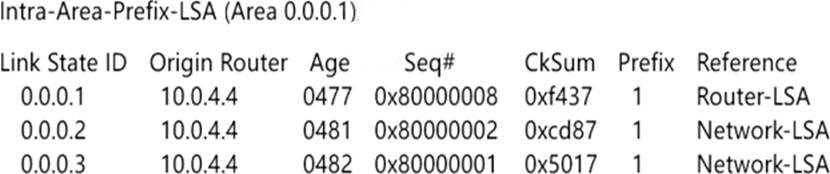
- A . R4 is the DR on a link
- B . At least one link of R4 does not have an OSPFv3 neighbor relationship established
- C . These three LSAs are located in area 1
- D . Area 1 is a stub area
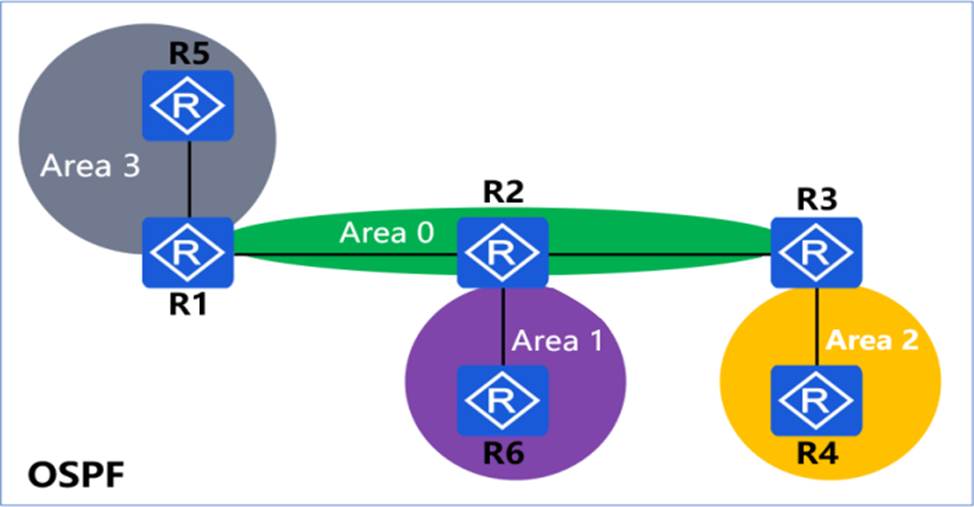
In the OSPF network shown in the figure, the area numbers are marked in the figure, where area 1 is a common area, area 2 is a stub area, and area 3 is an NSSA area. If R5 introduces an external route 10.0.5.5/32, which of the following routers does not have a route entry for 10.0.5.5/32 in its routing table?
- A . R4
- B . R6
- C . R2
- D . R3