
Huawei H12-323_V2.0-ENU Practice Exams
Last updated on Oct 22,2026- Exam Code: H12-323_V2.0-ENU
- Exam Name: HCIP-WLAN V2.0
- Certification Provider: Huawei
- Latest update: Oct 22,2026
In WLAN networks, which of the following GI intervals does not belong to the 802.11ax standard?
- A . 1.6 microseconds
- B . 0.8 microseconds
- C . 3.2 microseconds
- D . 0.4 microseconds
In roaming scenarios, some terminals will not roam to an AP with better signal even if the AP forces them to go offline due to individual differences. Instead, they will "stubbornly" associate with the AP they last associated with, or even stop associating. For such terminals, WAC will directly kick them offline.
- A . True
- B . False
Huawei’s terminal dial-up test solution is mainly used to detect Wi-Fi user experience, network quality, link status and other information.
Which of the following items are included in the terminal dial test? (Multiple choice)
- A . Web Connectivity
- B . Terminal signal strength
- C . Intranet uplink rate
- D . Internet uplink and downlink speeds
Which of the following steps does not belong to the "five-step network planning" of WLAN Planner?
- A . Environment Setup
- B . Import drawings
- C . Regional Settings
- D . Export Report
WLAN Planner supports the project import function. The imported project is independent of the source project shared by others, and their editing operations do not interfere with each other.
- A . True
- B . False
In the WLAN backhaul scenario, due to the complex environment and high bandwidth requirements of the business, reasonable planning is required when designing and installing APs.
Which of the following deployment suggestions for backhaul scenarios is wrong?
- A . It is necessary to confirm in advance whether there are obvious obstacles on the propagation path between MP and MPP nodes.
- B . Check in advance whether there is interference in the Wi-Fi frequency band near the site
- C . The antenna installation height must be within the radius r of the building’s high Fresnel zone
- D . When selecting a directional antenna, the main lobe coverage of the MPP antenna should cover all MP antennas.
Perform a roaming test through the CloudCampus app. After the test is completed, the roaming record is as shown in the figure below. Which options are correct for describing this roaming? (Multiple choice) 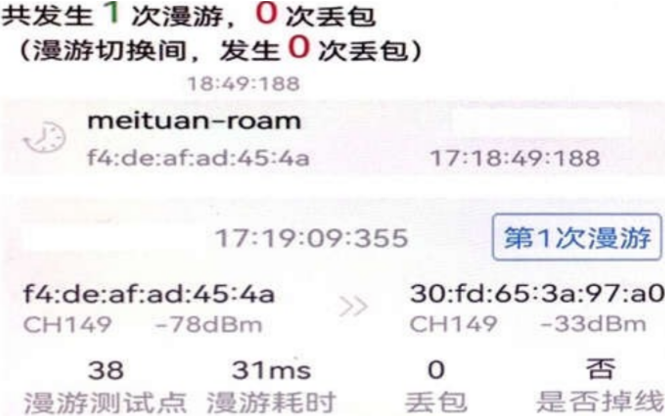
- A . The signal strength of the terminal before roaming is -78 dBm
- B . No packet loss occurred during roaming test
- C . The signal strength of the terminal after roaming access to the AP is -33 dBm
- D . The working channel of the AP accessed by the terminal changes before and after roaming
In a WLAN network, the working principle of a smart antenna is to receive signals transmitted by a terminal in an omnidirectional mode, determine the location of the terminal based on the received signal through a smart antenna algorithm, and then control the CPU to select a directional radiation mode in which the maximum radiation direction points to the terminal.
- A . True
- B . False
Which of the following is the default management SSID name when the AP is in FITAP or Cloud AP mode?
- A . HUAWEI-LeaderAP-xxxx, where xxxx is the last four digits of the AP MAC address
- B . xxxx is the unsigned 4-digit AP MAC address.
- C . HUAWE lmanage xxxx, where xxxx is the last four digits of the AP MAC address
- D . HUAWE xxxx xxxx is the last four digits of the AP MAC address
Which of the following statements about the two typical scenarios of LAN survey coverage scenario and bridge backhaul is wrong? (Multiple choice)
- A . The coverage scene should be surveyed as comprehensively as possible. The entire project site must be surveyed under any conditions.
- B . In the outdoor bridge backhaul scenario, if most areas are similar, you can select an area that is convenient for surveying to measure.
- C . Difficult areas for outdoor bridge backhaul are uncertain altitude, complex obstacles, and uncertain installation methods.
- D . Indoor distribution is selected for high-density coverage scenarios, and indoor placement is selected for low-density coverage scenarios.