
HP HPE7-A02 Practice Exams
Last updated on Oct 22,2026- Exam Code: HPE7-A02
- Exam Name: HPE Network Security Professional Exam
- Certification Provider: HP
- Latest update: Oct 22,2026
(Note that the HPE Aruba Networking Central interface shown here might look slightly different from what you see in your HPE Aruba Networking Central interface as versions change; however, similar concepts continue to apply.)
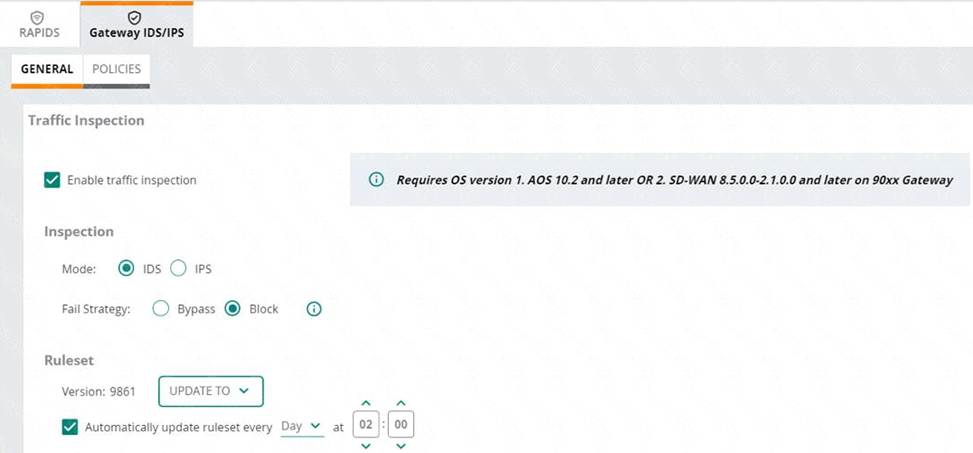
An HPE Aruba Networking 9×00 gateway is part of an HPE Aruba Networking Central group that has the settings shown in the exhibit.
What would cause the gateway to drop traffic as part of its IDPS settings?
- A . Its site-to-site VPN connections failing
- B . Traffic matching a rule in the active ruleset
- C . Its IDPS engine failing
- D . Traffic showing anomalous behavior
B
Explanation:
In the exhibit, the HPE Aruba Networking Central settings for the 9×00 gateway show that traffic inspection is enabled, and the gateway is set to operate in IDS (Intrusion Detection System) mode with the fail strategy set to "Block". This configuration means that the gateway will drop traffic if it matches a rule in the active ruleset.
You have installed an HPE Aruba Networking Network Analytic Engine (NAE) script on an AOS-CX switch to monitor a particular function.
Which additional step must you complete to start the monitoring?
- A . Reboot the switch.
- B . Enable NAE, which is disabled by default.
- C . Edit the script to define monitor parameters.
- D . Create an agent from the script.
D
Explanation:
After installing an HPE Aruba Networking Network Analytic Engine (NAE) script on an AOS-CX switch, the additional step required to start the monitoring is to create an agent from the script. The agent is responsible for executing the script and collecting the monitoring data as defined by the script parameters.
You have enabled "rogue AP containment" in the Wireless IPS settings for a company’s HPE Aruba Networking APs.
What form of containment does HPE Aruba Networking recommend?
- A . Wireless deauthentication only
- B . Wireless tarpit and wired containment
- C . Wireless tarpit only
- D . Wired containment
A
Explanation:
Rogue AP Containment Methods:
HPE Aruba Networking recommends using wireless deauthentication as the preferred method for rogue AP containment.
Deauthentication sends deauth frames to clients connected to rogue APs, causing them to disconnect. This method is effective without introducing unnecessary disruptions to the wired infrastructure.
Key Points:
Wireless Deauthentication is simple, efficient, and widely supported across client devices.
Tarpit Containment is more aggressive and may cause unintentional disruptions to legitimate clients.
Wired Containment involves blocking traffic at the switch level but is complex and may impact legitimate infrastructure traffic.
Option Analysis:
Option A: Correct. Wireless deauthentication is the recommended method as it targets rogue AP clients without excessive network impact.
Option B: Incorrect. Combining wireless tarpit and wired containment is overkill and not typically recommended.
Option C: Incorrect. Wireless tarpit can be effective but is generally not the first choice due to its aggressive nature.
Option D: Incorrect. Wired containment is more complex and reserved for specific use cases, not general recommendations.
A company has AOS-CX switches and HPE Aruba Networking ClearPass Policy Manager (CPPM). The company wants switches to implement 802.1X authentication to CPPM and download user roles.
What is one task that you must complete on CPPM to support this use case?
- A . Export roles on CPPM to a file that uses XML format.
- B . Create an admin account for the switch on CPPM with the HPE Aruba Networking User Role Download privilege level.
- C . Configure RADIUS enforcement profiles that specify the HPE-User-Role VSA.
- D . Upload the switch TPM certificate as a trusted CA certificate with the Others usage.
C
Explanation:
A company uses HPE Aruba Networking ClearPass Policy Manager (CPPM) as a TACACS+ server to authenticate managers on its AOS-CX switches. The company wants CPPM to control which commands managers are allowed to enter. You see there is no field to enter these commands in ClearPass.
How do you start configuring the command list on CPPM?
- A . Add the Shell service to the managers’ TACACS+ enforcement profiles.
- B . Edit the TACACS+ settings in the AOS-CX switches’ network device entries.
- C . Create an enforcement policy with the TACACS+ type.
- D . Edit the settings for CPPM’s default TACACS+ admin roles.
A
Explanation:
To control which commands managers are allowed to enter on AOS-CX switches using HPE Aruba Networking ClearPass Policy Manager (CPPM) as a TACACS+ server, you need to add the Shell service to the TACACS+ enforcement profiles for the managers. This service allows you to define and enforce specific command sets and access privileges for users authenticated via TACACS+. By configuring the Shell service in the enforcement profile, you can specify the commands that are permitted or denied for the managers, ensuring controlled and secure access to the switch’s command-line interface.
Reference: Aruba’s ClearPass Policy Manager documentation provides detailed instructions on setting up TACACS+ services, including configuring Shell profiles for command authorization and enforcement policies.