
HP HPE7-A02 Practice Exams
Last updated on Oct 22,2026- Exam Code: HPE7-A02
- Exam Name: HPE Network Security Professional Exam
- Certification Provider: HP
- Latest update: Oct 22,2026
What is one use case for implementing user-based tunneling (UBT) on AOS-CX switches?
- A . Centralizing the distribution of wired traffic without requiring HPE Aruba Networking gateways
- B . Tunneling traffic directly to a third-party firewall in a client data center
- C . Adding 802.1X while continuing to use the existing VLAN and ACL structure in the Ethernet network
- D . Applying enhanced security features such as deep packet inspection (DPI) to wired traffic
D
Explanation:
Implementing user-based tunneling (UBT) on AOS-CX switches is beneficial for applying enhanced security features such as deep packet inspection (DPI) to wired traffic. UBT allows the traffic from specific users or devices to be tunneled to a central controller or security appliance where advanced security policies, including DPI, can be applied. This approach ensures that even wired traffic benefits from the same level of security and inspection typically available for wireless traffic, thus enhancing overall network security.
Reference: Aruba’s documentation on UBT and AOS-CX configuration guides detail how to set up user-based tunneling and the benefits of applying advanced security features like DPI to tunneled traffic.
A company uses HPE Aruba Networking ClearPass Policy Manager (CPPM) as a TACACS+ server to authenticate managers on its AOS-CX switches. The company wants CPPM to control which commands managers are allowed to enter.
Which service must you add to the managers’ TACACS+ enforcement profile?
- A . Cpass:HTTP
- B . Shell
- C . ARAP
- D . Aruba:Common
B
Explanation:
To control which commands managers are allowed to execute on AOS-CX switches using ClearPass Policy Manager (CPPM) as a TACACS+ server, you must configure the Shell service in the TACACS+ enforcement profile. The Shell service provides the ability to define granular access controls for commands. It supports policy-driven command authorization, which is essential in controlling administrative tasks based on roles.
Reference
Official HPE Aruba ClearPass documentation on TACACS+ integration and command authorization. Industry best practices for AAA (Authentication, Authorization, and Accounting) configuration in network security architectures.
A company has HPE Aruba Networking gateways that implement gateway IDS/IPS. Admins sometimes check the Security Dashboard, but they want a faster way to discover if a gateway starts detecting threats in traffic.
What should they do?
- A . Set up Webhooks that are attached to the HPE Aruba Networking Central Threat Dashboard.
- B . Use Syslog to integrate the gateways with HPE Aruba Networking ClearPass Policy Manager (CPPM) event processing.
- C . Set up email notifications using HPE Aruba Networking Central’s global alert settings.
- D . Integrate HPE Aruba Networking ClearPass Device Insight (CPDI) with Central and schedule hourly reports.
C
Explanation:
A company has AOS-CX switches and HPE Aruba Networking ClearPass Policy Manager (CPPM). The company wants switches to implement 802.1X
authentication to CPPM and download user roles.
What is one task that you must complete on the switches to support this use case?
- A . Specify CPPM as the RADIUS server with the exact CN in CPPM’s HTTPS certificate.
- B . Install the root CA certificate for CPPM’s RADIUS certificate in a TA profile on the switches.
- C . Configure empty user-roles with names that match enforcement profile names on CPPM.
- D . Specify a ClearPass username and password that match the name and RADIUS secret in a CPPM network device entry.
B
Explanation:
To support 802.1X authentication and download user roles from HPE Aruba Networking ClearPass Policy Manager (CPPM) on AOS-CX switches, you must install the root CA certificate for CPPM’s RADIUS certificate in a Trust Anchor (TA) profile on the switches. This ensures that the switches trust the RADIUS server certificate presented by CPPM during the authentication process.
You need to create a rule in an HPE Aruba Networking ClearPass Policy Manager (CPPM) role mapping policy that references a ClearPass Device Insight Tag.
Which Type (namespace) should you specify for the rule?
- A . Application
- B . Tips
- C . Device
- D . Endpoint
D
Explanation:
When creating a rule in an HPE Aruba Networking ClearPass Policy Manager (CPPM) role mapping policy that references a ClearPass Device Insight Tag, you should specify the "Endpoint" Type (namespace) for the rule. This ensures that the policy can properly reference and utilize the tags assigned to endpoints by ClearPass Device Insight for making role mapping decisions.
Refer to the Exhibit.
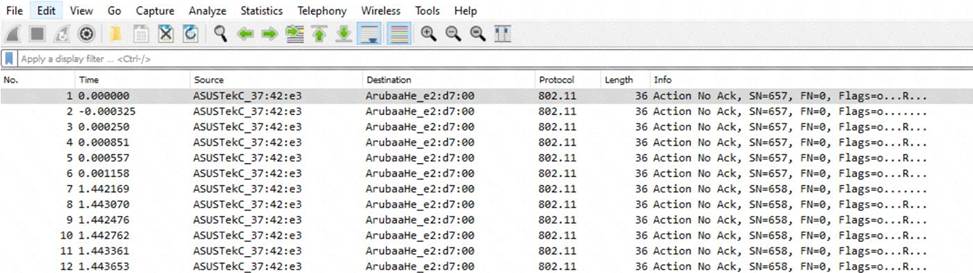
You have downloaded a packet capture that you generated on HPE Aruba Networking Central.
When you open the capture in Wireshark, you see the output shown in the exhibit.
What should you do in Wireshark so that you can better interpret the packets?
- A . Choose to decode UDP port 5555 packets as ARUBA_ERM and set the Aruba ERM Type to 0.
- B . Edit preferences for IEEE 802.11 and chose to ignore the Protection bit with IV.
- C . Apply the following display filter: wlan.fc.type == 1.
- D . Edit the Enabled Protocols and make sure that 802.11, GRE, and Aruba_ERM are enabled.
A
Explanation:
To better interpret the packets shown in the Wireshark capture, you should choose to decode UDP port 5555 packets as ARUBA_ERM and set the Aruba ERM Type to 0. This configuration will allow Wireshark to properly decode and display the Aruba-specific encapsulated remote mirroring (ERM) packets, providing a clearer understanding of the traffic.
You are setting up HPE Aruba Networking SSE to prohibit users from uploading and downloading files from Dropbox.
What is part of the process?
- A . Adding a web category that includes Dropbox
- B . Installing the HPE Aruba Networking SSE root certificate on clients
- C . Deploying a connector that can reach the remote users
- D . Deploying a connector that can reach Dropbox
A
Explanation:
Comprehensive Detailed Explanation
To prohibit users from uploading and downloading files from Dropbox using HPE Aruba Networking SSE (Secure Service Edge), you need to configure web access policies.
This typically involves:
Adding a web category to the SSE configuration that includes Dropbox.
The SSE solution uses category-based filtering to block access to specific applications or services,
such as Dropbox, based on their classification.
Other Options:
B. Installing the SSE root certificate is required for enabling SSL inspection, but this does not directly control access to Dropbox.
C and D. Deploying a connector is not necessary for this purpose as the enforcement is done via SSE policies, not by directly interfacing with Dropbox or remote users.
Reference
Aruba Networking SSE documentation on web filtering policies.
HPE Aruba SSE Application Control Best Practices Guide.