
HP HPE7-A02 Practice Exams
Last updated on Oct 23,2026- Exam Code: HPE7-A02
- Exam Name: HPE Network Security Professional Exam
- Certification Provider: HP
- Latest update: Oct 23,2026
You have created this rule in an HPE Aruba Networking ClearPass Policy Manager (CPPM) service’s enforcement policy: IF Authorization [Endpoints Repository] Conflict EQUALS true THEN apply "quarantine_profile"
What information can help you determine whether you need to configure cluster-wide profiler parameters to ignore some conflicts?
- A . Whether the company has rare Internet of Things (loT) devices
- B . Whether some devices are incapable of captive portal or 802.1X authentication
- C . Whether the company has devices that use PXE boot
- D . Whether some devices are running legacy operating systems
C
Explanation:
When you have created a rule in a ClearPass Policy Manager (CPPM) service’s enforcement policy to quarantine devices with endpoint conflicts, it is important to consider whether the company has devices that use PXE boot. PXE booting devices can create conflicts in the profiler because they may temporarily have different network attributes (e.g., MAC address or IP address) before fully booting and obtaining their final configuration. Understanding whether PXE boot is in use can help determine if profiler parameters need to be adjusted to ignore such temporary conflicts, ensuring that devices are not incorrectly quarantined.
Reference: ClearPass profiler configuration documentation and best practices include considerations for handling network devices with dynamic or temporary configurations, such as those using PXE boot.
Refer to the exhibit.
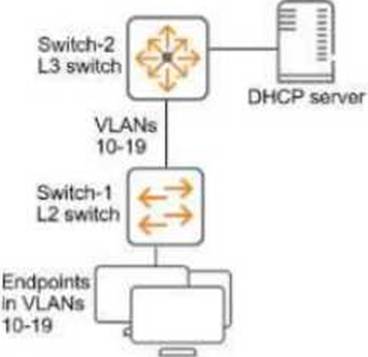
You have verified that AOS-CX Switch-1 has constructed an IP-to-MAC binding table in VLANs 10-19.
Now you need to enable ARP inspection for the endpoint connected to Switch-1.
What must you do first to prevent traffic disruption?
- A . Configure ARP inspection on VLANs 10-19 on Switch-2.
- B . Configure DHCP snooping on VLANs 10-19 on Switch-2.
- C . Configure Switch-1 uplinks as trusted ARP inspection ports.
- D . Create a static IP-to-MAC binding on Switch-1 for the DHCP server.
C
Explanation:
Dynamic ARP Inspection (DAI):
ARP inspection verifies ARP packets against a trusted IP-to-MAC binding table to prevent ARP spoofing attacks.
DHCP snooping is required to construct the IP-to-MAC binding table dynamically.
To avoid traffic disruption, uplink ports that connect to trusted switches, DHCP servers, or routers must be explicitly configured as trusted ports for ARP inspection. Steps to Prevent Traffic Disruption:
Trust the Uplinks: ARP inspection must treat uplink ports as trusted to allow ARP traffic from legitimate DHCP servers and upstream switches.
Enable DHCP Snooping: DHCP snooping must be enabled on Switch-2 to ensure consistent IP-to-MAC bindings upstream.
Why the Answer is Correct:
Option A: Incorrect. ARP inspection on Switch-2 is important but not required first to prevent disruption on Switch-1.
Option B: Incorrect. DHCP snooping must be enabled upstream eventually, but this alone will not stop immediate traffic disruption on Switch-1.
Option C: Correct. Switch-1 uplinks must be trusted ARP inspection ports first to allow legitimate upstream traffic and prevent ARP disruption.
Option D: Incorrect. Static bindings are not required if DHCP snooping is enabled, and they are manual, limiting scalability.
Conclusion:
To avoid traffic disruption, configure Switch-1 uplinks as trusted ARP inspection ports to ensure valid ARP traffic can pass upstream and downstream.
HPE Aruba Networking switches are implementing MAC-Auth to HPE Aruba Networking ClearPass Policy Manager (CPPM) for a company’s printers. The company wants to quarantine a client that spoofs a legitimate printer’s MAC address. You plan to add a rule to the MAC-Auth service enforcement policy for this purpose.
What condition should you include?
- A . Endpoint Compliance EQUALS false
- B . Endpoint Device Insight Tag EXISTS
- C . Authorization: [Endpoints Repository] Compromised EQUALS true
- D . Authorization: [Endpoints Repository] Conflict EQUALS true
D
Explanation:
MAC Spoofing Detection with Endpoint Conflict:
When two devices attempt to use the same MAC address, ClearPass identifies a Conflict state in the Endpoints Repository.
This condition can be used to detect and quarantine clients that spoof legitimate devices. Option D: Correct. The Conflict EQUALS true condition identifies devices with duplicate MAC addresses.
Option A: Incorrect. Endpoint compliance checks posture, not MAC spoofing.
Option B: Incorrect. Device Insight Tags are used for profiling but do not identify conflicts.
Option C: Incorrect. Compromised devices relate to security incidents, not MAC address conflicts.
A company has AOS-CX switches and HPE Aruba Networking APs, which run AOS-10 and bridge their SSIDs. Company security policies require 802.1X on all edge ports, some of which connect to APs.
How should you configure the auth-mode on AOS-CX switches?
- A . Leave all edge ports in client auth-mode and configure device auth-mode in the AP role.
- B . Configure all edge ports in client auth-mode.
- C . Configure all edge ports in device auth-mode.
- D . Leave all edge ports in device auth-mode and configure client auth-mode in the AP role.
A
Explanation:
HPE Aruba Networking Central displays an alert about an Infrastructure Attack that was detected. You go to the Security > RAPIDS events and see that the attack was "Detect adhoc using Valid SSID." What is one possible next step?
- A . Make sure that you have tuned the threshold for that check as false positives are common for it.
- B . Make sure that clients have updated drivers, as faulty drivers are a common explanation for this attack type.
- C . Use HPE Aruba Networking Central floorplans or the detecting AP identities to locate the general area for the threat.
- D . Look for the IP address associated with the offender and then check for that IP address among HPE Aruba Networking Central clients.
C
Explanation:
RAPIDS Ad-Hoc Detection:
The alert "Detect ad-hoc using Valid SSID" indicates that a device is broadcasting an SSID that matches a valid network SSID in ad-hoc mode. This can be an indication of an infrastructure attack or misconfiguration.
Next Steps:
Use Aruba Central floorplans or AP location data to identify the physical area where the offending device is detected.
Locate and investigate the device to determine if it is malicious or simply misconfigured.
Option Analysis:
Option A: Incorrect. While tuning thresholds is useful for reducing false positives, this step does not directly address a potential threat.
Option B: Incorrect. Faulty drivers can cause similar behavior, but this step is not immediately actionable without locating the device first.
Option C: Correct. Floorplans or AP identities help locate the threat’s physical area for further investigation.
Option D: Incorrect. RAPIDS focuses on detecting devices via SSID and MAC, not IP addresses, making this approach less relevant.