
HP HPE0-J68 Practice Exams
Last updated on Oct 23,2026- Exam Code: HPE0-J68
- Exam Name: HPE Storage Solutions
- Certification Provider: HP
- Latest update: Oct 23,2026
Which Ul should be recommended to identify eleveted latency and the root causes across host, storage, or SANs on an HPE Alletra 9000 storage array?
- A . HPE Data Services Cloud Console
- B . HPE InfoSight
- C . HPE Alletra 9000 Ul
- D . HPE Alletra 9000 CLI
B
Explanation:
V The NAND memory controller is the component responsible for wear leveling in SSDs. Wear leveling is a process used to extend the lifespan of NAND flash memory by ensuring that write and erase cycles are distributed evenly across the memory cells. This prevents any single cell from being overused, which could lead to premature failure. The NAND memory controller plays a crucial role in managing this process, ensuring the reliability and longevity of the SSD.
For more details, refer to:
HPE Storage Solutions
A customer need to update the local sever at each of their branches keep up with the increasing demand for High-performance storage. The customer cannot afford to move to SAN at each state.
Which HPE storage technology can increase performance for this customer?
- A . Smart Path
- B . SmartCache
- C . Adaptive Flash Cache
- D . Persistent Cache
B
Explanation:
HPE SmartCache is a feature available on HPE servers that accelerates storage performance by caching frequently accessed data on faster, lower-latency media such as SSDs. For customers who cannot afford to move to SANs at each branch but require high-performance storage, SmartCache provides a cost-effective solution. By leveraging SSDs as a caching layer for frequently accessed data, it can significantly improve the performance of local servers without requiring a full SAN deployment.
HPE Storage
Reference: HPE SmartCache Overview
HPE Server Technologies
Exhibit:
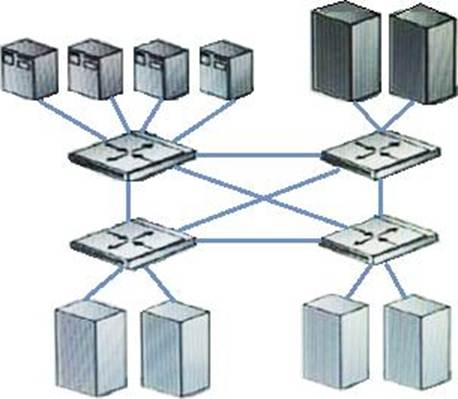
Which fabric design is shown?
- A . meshed
- B . single fabric
- C . cascaded
- D . core-edge
D
Explanation:
The fabric design shown in the exhibit is a core-edge architecture. This design consists of core switches that are centrally located and connect to edge switches, which are distributed across the network. The core switches provide high-speed backbone connectivity, while the edge switches connect directly to storage devices or servers. This architecture is commonly used in SAN environments to provide scalability, manageability, and high availability.
Reference: HPE SAN Design Principles
Core-edge Fabric Design
A customer needs to store a large amount of unstructured data that must be queried quickly.
Which type of storage meets the customer’s needs?
- A . object
- B . hash
- C . file
- D . flash
A
Explanation:
For storing a large amount of unstructured data that must be queried quickly, object storage is the most suitable option. Object storage is designed to handle massive amounts of unstructured data, such as documents, images, videos, and other media types. It stores data in a flat address space, using unique identifiers (objects), making it highly scalable and efficient for quick querying.
HPE offers solutions like HPE Scality RING, which provides robust object storage capabilities optimized for scalability and performance. Object storage is particularly effective in big data environments and applications that require rapid access to large datasets.
For more information, see:
HPE Object Storage Solutions
A customer has a large deployment of HPE Synergy compute modules. HPE 3PAR StoreServ arrays, and HPE StoreOnce system in a single data center. They are concerned about the risk of data loss due to site disaster and seeks cost-effective offsite Disaster Recovery protection without the need to deploy a secondary site.
Which HPE solution should you recommend?
- A . HPE StoreOnce VSA
- B . HPE StoreOnce CloudBank
- C . HPE StoreOnce RMC
- D . HPE StoreOnce Catalyst
B
Explanation:
For a customer concerned about offsite disaster recovery without the need to deploy a secondary site, HPE StoreOnce CloudBank is the ideal solution. CloudBank extends HPE StoreOnce to the cloud, providing cost-effective, scalable, and secure offsite storage for long-term data retention and disaster recovery. It allows customers to back up data directly to the cloud (public or private), offering a simple and affordable way to protect against site disasters without the overhead of managing a secondary physical site.
StoreOnce CloudBank supports integration with existing backup and data management solutions,
ensuring a seamless disaster recovery process.
For detailed information, refer to:
HPE StoreOnce Overview
Which HPE 3Par feature improves CPU utilization, reduces latency and improve IOPS?
- A . Zero Detect
- B . Persistent Cache
- C . Express Indexing
- D . Express Writes
D
Explanation:
The Express Writes feature in HPE 3PAR improves CPU utilization, reduces latency, and enhances IOPS by optimizing the write path in the array. This feature accelerates write operations by reducing the overhead associated with processing and managing writes, leading to higher performance, especially in environments with intensive transactional workloads. Express Writes is a key technology in HPE 3PAR that contributes to the overall efficiency and performance of the storage system.
For more details, refer to:
HPE 3PAR StoreServ Express Writes
The customer is deploying a new HPE AUetra dHCI Storage. Select a correct statement related to HPE Storage Setup Manager:
- A . A new user account must be created
- B . vCenter connectivity configuration is a mandatory step in the setup process in SSM
- C . The setup process includes setting up an IP addressing
- D . HPE SSM requires connectivity to HPE GreenLake platform
C
Explanation:
When deploying a new HPE Alletra dHCI Storage system, one of the steps in the setup process using HPE Storage Setup Manager (SSM) is configuring IP addressing. Proper IP addressing is crucial for ensuring that all components of the dHCI environment, including storage, compute, and networking, can communicate effectively. This step is part of the initial configuration to ensure seamless operation and integration within the existing IT infrastructure.
Reference: HPE Alletra dHCI Setup Guide
HPE Storage Setup Manager Overview
Refer to the exhibit.
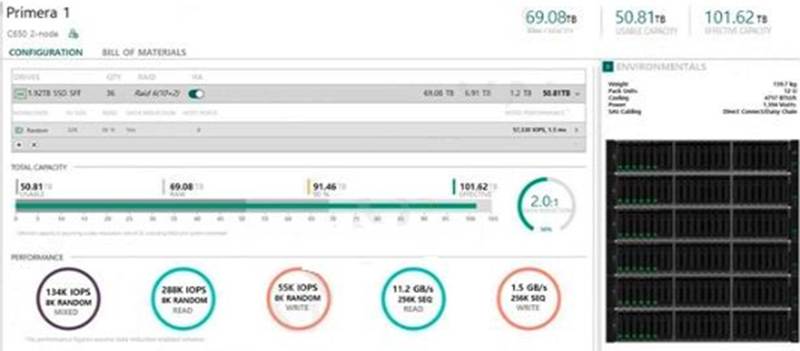
A customer purchased a Primera C6S0 array to replace several older 3PAR arrays. They plan to upgrade the system as each 3PAP reaches the end of its lease. The initial sizing included 100TB effective capacity for an Oracle database environment.
The first 3PAR to come off lease has 100TB of VDI boot images that support thousands of users.
Which addition to the Primera should you recommend?
A)

B)

C)

D)

- A . Option A
- B . Option B
- C . Option C
- D . Option D
A
Explanation:
The exhibit shows various configurations for expanding an HPE Primera C6S0 array. The customer is planning to upgrade the system as older 3PAR arrays come off lease. Since the next 3PAR system to be replaced holds 100TB of VDI boot images for thousands of users, the recommended addition to the Primera array should focus on providing the necessary performance and capacity for VDI workloads.
Option A in the exhibit appears to include a configuration that balances SSD storage with high performance, making it suitable for VDI environments. This option would allow the customer to maintain a high level of performance while migrating and consolidating their VDI workloads onto the new Primera system.
Reference: HPE Primera Storage Overview
HPE Storage for VDI
What are two advantages of HPE Recovery Manager Central? (Select two.)
- A . Enables automatic transparent failover
- B . Less expensive than traditional backup
- C . Includes Peer Copy asynchronous replication
- D . Manual data provisioning and policy-based copy protection
- E . Integration capabilities utilizing HTML
B,C
Explanation:
HPE Recovery Manager Central (RMC) provides a modern approach to data protection by integrating snapshots, backup, and replication into a single solution. The two primary advantages of RMC are: Less expensive than traditional backup: RMC reduces the need for separate backup software and infrastructure, lowering overall costs. It leverages storage snapshots for data protection, which reduces the time and storage space needed for backups compared to traditional methods.
Includes Peer Copy asynchronous replication: RMC includes Peer Copy, which enables asynchronous replication between HPE 3PAR StoreServ and HPE Nimble Storage systems. This feature facilitates efficient data protection and disaster recovery by replicating data to a secondary site without impacting the performance of the primary storage.
These advantages make RMC a powerful and cost-effective solution for modern data protection needs.
Reference: HPE Recovery Manager Central
HPE Data Protection Solutions
You want to enhance the security of backups performed via HPE GreenLake for Backup and Recovery.
What is a true statement describing end-to-end backup data encryption on that platform?
- A . It does leverage AES-512
- B . It does support external key managers
- C . It is executed by the Protection Store Gateway
- D . It allows encryption keys to be exported and saved