
HP HPE0-J68 Practice Exams
Last updated on Oct 23,2026- Exam Code: HPE0-J68
- Exam Name: HPE Storage Solutions
- Certification Provider: HP
- Latest update: Oct 23,2026
A customer with several HPE 3PAR StoreServ arrays has reported latencies with newly updated applications.
You have proposed changes to the AO configuration and need to provide high-resolution reports on how the change has affected the latencies.
What should you propose on delivering the service time and I/O workload information daily for you and the customer?
- A . Use IMC to schedule performance data gathering and email delivery.
- B . Schedule SSMC System Reporter to send the defined email reports.
- C . Enable the Service Processor to gather Performance data and schedule data transfer.
- D . Login to InfoSight and analyze Advanced Performance history.
B
Explanation:
The HPE 3PAR SSMC (StoreServ Management Console) System Reporter is the tool that should be used to generate and schedule high-resolution performance reports, including service time and I/O workload information. By configuring System Reporter to send daily email reports, both you and the customer can monitor the impact of changes made to the Adaptive Optimization (AO) configuration.
This ensures that any latency issues or performance improvements are documented and can be analyzed regularly.
Reference: HPE 3PAR SSMC System Reporter
HPE Performance Monitoring Tools
A customer needs to upgrade their HPE storage environment, including driver and firmware levels
and OS, to the latest version.
Where can you find the needed information about supported versions?
- A . HPE Storage Assessment Foundry
- B . HPE SAN Design Reference Guide
- C . HPE OneView
- D . HPE SPOCK
D
Explanation:
HPE SPOCK (Single Point of Connectivity Knowledge) is the authoritative source for information on supported configurations, firmware levels, drivers, and operating systems for HPE storage products. It provides detailed compatibility matrices and reference documents for ensuring that all components in the HPE storage environment, including storage arrays, SAN switches, servers, and operating systems, are compatible and supported.
SPOCK is regularly updated with the latest information, making it an essential tool for planning
upgrades and ensuring a stable, supported configuration in HPE storage environments.
Reference: HPE SPOCK
HPE Storage Overview
You are designing a new enterprise array solution. The customer is interested in a caching tier that provides extremely low-latency and persistent storage at the same time. They also need to support more
than 500GB.
Which technology should you recommend?
- A . DRAM
- B . SRAM
- C . NVMe SCM
- D . NAND SSD
C
Explanation:
For the customer requiring a caching tier that offers extremely low-latency and persistent storage, NVMe Storage Class Memory (SCM) (Option C) is the ideal technology. NVMe SCM provides the performance characteristics of DRAM with the persistence of traditional storage, making it suitable for caching applications where ultra-low latency is crucial. NVMe SCM also supports capacities exceeding 500GB, which aligns with the customer’s requirement.
This technology is particularly advantageous in environments where quick access to data is critical, such as in financial services or real-time analytics applications. It bridges the gap between volatile DRAM and slower NAND SSDs, providing a highly responsive and durable storage solution.
Reference: HPE NVMe Storage Solutions
HPE Storage Class Memory
Which type of networking switch handles both Ethernet and fibre channel traffic?
- A . Director
- B . Virtual
- C . Edge
- D . Converged
D
Explanation:
Converged switches are designed to handle both Ethernet and Fibre Channel traffic, enabling them to support converged networks where both storage and regular data traffic are managed through a single infrastructure. This approach simplifies network management and can reduce costs by consolidating the networking hardware required for both types of traffic.
Reference: HPE Networking Solutions
HPE Converged Infrastructure
You have proposed that a customer replace their legacy SAN switches with new?-Series switches. They are concerned about the management of all the devices, so you have included SANnav in the proposal.
What are the benefits of SANnav that you should emphasize to this customer? (Choose two.)
- A . It runs in a dedicated JVM
- B . It offers automated SPOCK validation
- C . It runs in a browser
- D . It provides a global View
- E . It provides fine-grain visibility into Storage Fabrics (FC + Ethernet)
Which low-cost storage technology is suitable for long-term archiving?
- A . Persistent Memory
- B . Tape
- C . RAM
- D . NVMe flash storage
B
Explanation:
Tape storage is a low-cost technology that is highly suitable for long-term archiving. It provides an economical solution for storing large volumes of data that do not require frequent access. Tape is durable, with a long lifespan, and offers high capacity at a low cost per gigabyte, making it an ideal choice for archiving and compliance-driven storage needs. Additionally, tape storage is energy-efficient since it consumes no power when not in use, further reducing long-term costs.
Reference: HPE StoreEver Tape Solutions
HPE Archiving Solutions
Select the correct statement regarding the interoperability of different drive interfaces.
- A . SATA drives can be connected to the SAS backplane
- B . NVMe drives can be connected to SATA backplane
- C . NVMe only supports 15K enterprise-class disks
- D . SAS drives can be connected to SATA backplane
Exhibit:
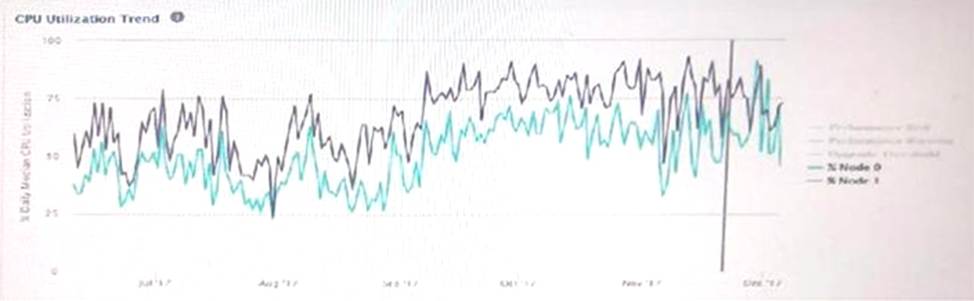
The customer has upgraded the first of their two HPE StoreServ 8200to the latest inform OS version to take the advantage of the compression feature. You have been asked to design the storage configuration to support oracle database volume to utilize HPE 3PAR compression .
Based on the analysis of the array. what would be your suggestion to implement the requested change?
- A . Install the catalyst agent on the oracle server to enable inline compression on the selected VV
- B . Configure the source-side the compression to offload compression to the Host
- C . Balance the workloads between the arrays to have enough headroom for compression
- D . Consider adding another node pair for compression to work efficiently
C
Explanation:
When implementing HPE 3PAR compression for Oracle database volumes, it’s crucial to ensure that there is sufficient processing capacity on the array. This can be achieved by balancing the workloads between the arrays to create the necessary headroom for compression tasks. Properly distributing the workloads will allow the system to efficiently manage the compression operations without negatively impacting performance.
Reference: HPE 3PAR StoreServ and Compression
You have proposed a Primera array to a customer for new primary storage. The customer currently has an older 3PAR array that they will continue to use moving forward. The customer would like high availability configured.
Which RMC Peer Copy pre-requisites do you need to point out to the customer? (Choose two.)
- A . No license is required
- B . 2-port 10 Gb Ethernet Adapter (NIC) is required
- C . 4-port 1 Gb Ethernet Adapter (NIC) is required in each array
- D . RMC 6.2 is required
- E . Target drive type must match source drive type
B,D
Explanation:
When configuring high availability with HPE Primera and 3PAR arrays using RMC (Recovery Manager Central) Peer Copy, there are specific prerequisites that must be met:
2-port 10 Gb Ethernet Adapter (NIC): Each array must be equipped with a 2-port 10 Gb Ethernet Adapter to support the high-speed data transfer required for Peer Copy operations.
RMC 6.2: The customer must have RMC version 6.2 or later installed, as this version includes the necessary features and enhancements to support Peer Copy between Primera and 3PAR arrays. These prerequisites are crucial to ensure seamless integration and optimal performance when setting up high availability between the two storage arrays.
Reference: HPE Primera and 3PAR Integration
HPE RMC Overview
Which value does an HPE Nimble solution provide in addition to other HPE storage solutions
- A . All inclusive software licensing over 5 years and additional capacity upgrades
- B . Upfront option for free controller upgrade after 3 years
- C . Flat support pricing for all hardware components
- D . Tier 1 and tier 2 phone support
C
Explanation:
One of the key value propositions of the HPE Nimble storage solution, in addition to its technical capabilities, is the flat support pricing model for all hardware components. This means that customers can expect consistent and predictable support costs over the lifespan of the storage system, which is particularly beneficial for budgeting and financial planning. This flat pricing model contrasts with other storage solutions where support costs can vary significantly as the system ages. Nimble’s support model, combined with its predictive analytics and all-inclusive software, ensures that customers have a comprehensive and cost-effective storage solution.
For more insights, refer to:
HPE Nimble Storage
HPE Storage Solutions