
HP HPE0-J68 Practice Exams
Last updated on Oct 23,2026- Exam Code: HPE0-J68
- Exam Name: HPE Storage Solutions
- Certification Provider: HP
- Latest update: Oct 23,2026
You are proposing a StoreOnce solution to a customer that has always used tape for a backup target.
What should you suggest to ensure that the StoreOnce deduplication is correctly sized?
- A . StoreOnce timeless storage
- B . DDAnalyzer
- C . proof of concept with StoreOnce VSA
- D . OCA
D
Explanation:
When proposing a StoreOnce solution to a customer transitioning from tape backups, it’s crucial to correctly size the deduplication requirements. OCA (Outcome-based Capacity Analyzer) is the recommended tool for this purpose. OCA helps to predict and size the deduplication storage needs by analyzing the data types and patterns, ensuring that the StoreOnce system is correctly configured to handle the customer’s backup workloads efficiently.
Which 3PAR storeServ feature allow to host to continue I/O uninterrupted during a firmware update?
- A . Persistent Memory
- B . Persistent port (96)
- C . Peer persistenceD Persistent Cache
B
Explanation:
The HPE 3PAR StoreServ Persistent Port feature allows a host to continue I/O operations uninterrupted during a firmware update. It achieves this by automatically failing over the ports of the storage system to a peer port on another node, ensuring continuous data availability and service delivery. This feature is crucial during firmware upgrades or any maintenance activity where minimal disruption is desired.
HPE Storage
Reference: HPE 3PAR StoreServ Architecture
HPE 3PAR StoreServ Features
DRAG DROP
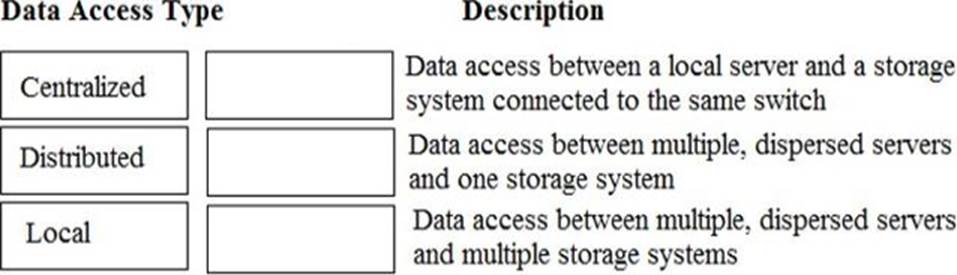
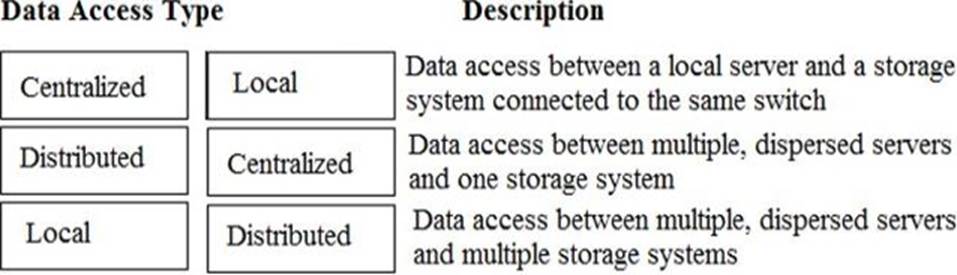
Match the data access type in a SAN fabric to the correct description.
What is the typical protocol used to access data from object storage?
- A . FC
- B . NVMe
- C . HTTP
- D . iSCSI
C
Explanation:
The typical protocol used to access data from object storage is HTTP (Option C). Object storage systems, such as those used in cloud environments, typically expose their data through RESTful APIs over HTTP. This allows for easy access and manipulation of data objects over the web. Unlike traditional block or file storage, object storage is designed for scalability and is commonly used for storing large amounts of unstructured data, such as media files, backups, and archives.
HTTP is the standard protocol for web communications, making it the ideal choice for accessing data in object storage environments, which are often cloud-based or designed for remote access.
Reference: HPE Object Storage Overview
HPE Cloud and Object Storage Solutions
Your customer would like to consolidate the management of all three of their HPE XP8 storage arrays via a "single pane of glass" UI.
Which UI should you recommend?
- A . RAID Manager
- B . Remote Web Console
- C . Intelligent Storage Management
- D . Smart Storage Administrator
A customer is planning to connect a new HPE 3PAR StoreServ system to its existing Synergy based
composable infrastructure via direct-attach.
Which tool would be used to manage the storage?
- A . HPE SAN Network Advisor
- B . HPE Synergy Image Streamer
- C . HPE Synergy Composer
- D . HPE InfoSight for 3PAR
C
Explanation:
HPE Synergy Composer is the tool used to manage the HPE 3PAR StoreServ system when it is connected to a Synergy-based composable infrastructure via direct-attach. Synergy Composer is powered by HPE OneView and provides a unified interface for managing compute, storage, and networking resources within the Synergy environment. It allows administrators to manage the storage configurations, provisioning, and lifecycle management of the connected HPE 3PAR StoreServ system, ensuring seamless integration with the composable infrastructure.
Reference: HPE Synergy Composer
HPE 3PAR and Synergy Integration
How does HPE GreenLake for Block Storage perform VV and LD ownership?
- A . VV LDs are adaptively shared based on the array config
- B . VV LDs are owned by a single node
- C . VV LDs are shared based on system parameter ”enh_ownership"
- D . VV LDs are shared across all nodes
B
Explanation:
In HPE GreenLake for Block Storage, VV (Virtual Volumes) and LD (Logical Devices) are owned by a single node. This ownership model is critical for ensuring data consistency and managing the resources effectively across the storage array. By having a single node own the VV LDs, the system can maintain optimal performance and reliability, especially in clustered environments where multiple nodes are involved.
For more information, refer to:
HPE GreenLake Block Storage
What technology allows VMs to appear as individual machines from an FC-SAN and storage array perspective?
- A . TDPZ
- B . VSAN
- C . NPIV
- D . Smart SAN
Your customer is interested in HPE GreenLake for Block storage, but questions the capabilities of monitoring when using cloud-based management.
Which two types of performance-related information can be displayed in a graph format, within Data Ops Manager, without further configuration? (Select two.)
- A . Top host ports by write throughput
- B . Top volume sets by read IOPS
- C . Top SAN switches by read IOPS
- D . Top SAN switches by latency
- E . SAP HANA OLTP requests per second
When performing an OS update on an HPE Alletra 6000, which of the following options should you perform if the process fails?
- A . Power down, then swap controllers and power up to trigger reimaging
- B . Use the included USB drive and boot from the recovery image
- C . Connect to console via serial cable and run the "factoryimage" command
- D . Wait for the rollback to the previous version to complete and then troubleshoot