
HP HPE0-J68 Practice Exams
Last updated on Oct 23,2026- Exam Code: HPE0-J68
- Exam Name: HPE Storage Solutions
- Certification Provider: HP
- Latest update: Oct 23,2026
Which function is built into the HPE 3par OS and enable users to move data and workloads between array without impacting applications, users, or services?
- A . Peer persistence
- B . Adaptive optimization
- C . Peer motion
- D . Remote copy
C
Explanation:
HPE 3PAR Peer Motion is a feature built into the HPE 3PAR OS that allows users to move data and workloads between arrays without impacting applications, users, or services. This non-disruptive data migration capability is particularly useful during hardware refreshes, technology upgrades, or when balancing workloads across arrays. Peer Motion facilitates seamless, online data migration, ensuring continuity of operations and zero downtime during the process.
Reference: HPE 3PAR Peer Motion
HPE Storage Migration Solutions
HOTSPOT
You need to create an N:M relationship between VMware hypervisors and virtual volumes with the least amount of administrative overhead.
Click the option where you can create a group of VMware hypervisors for volumes provisioning.
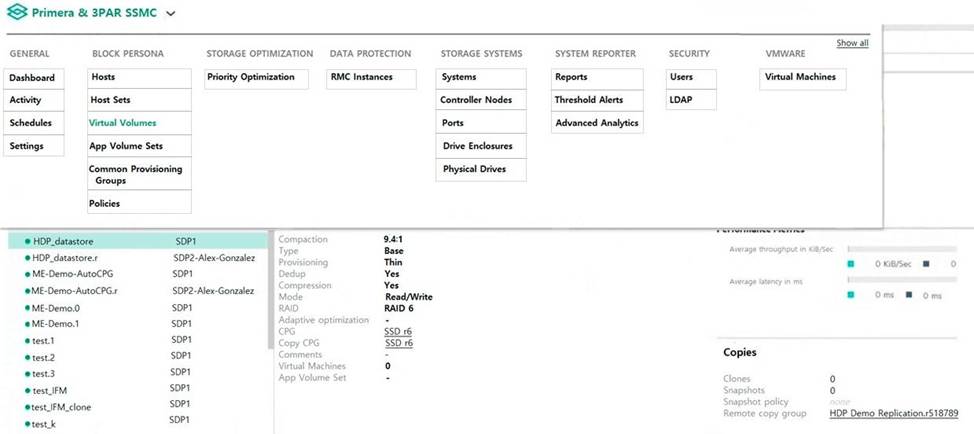
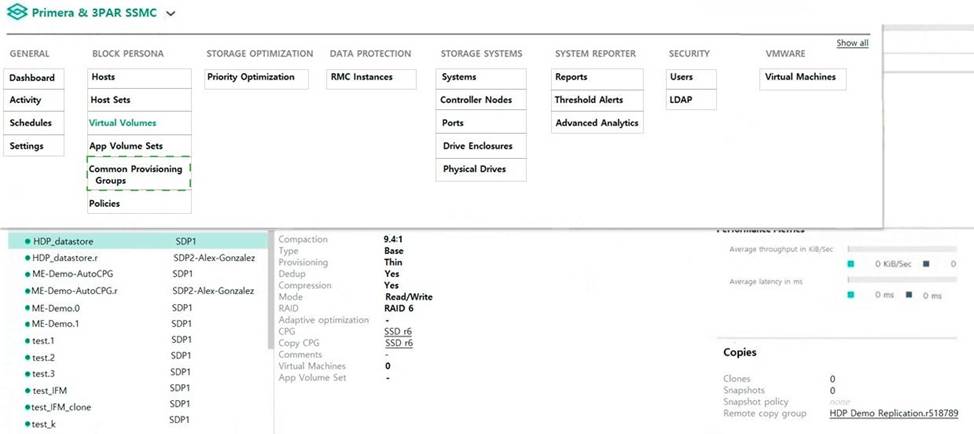
Explanation:
Graphical user interface, text Description automatically generated
How many simultaneous disk failures can an HPE Alletra 6000 tolerate?
- A . 1
- B . 2
- C . 4
- D . 3
DRAG DROP
Refer to the exhibit.
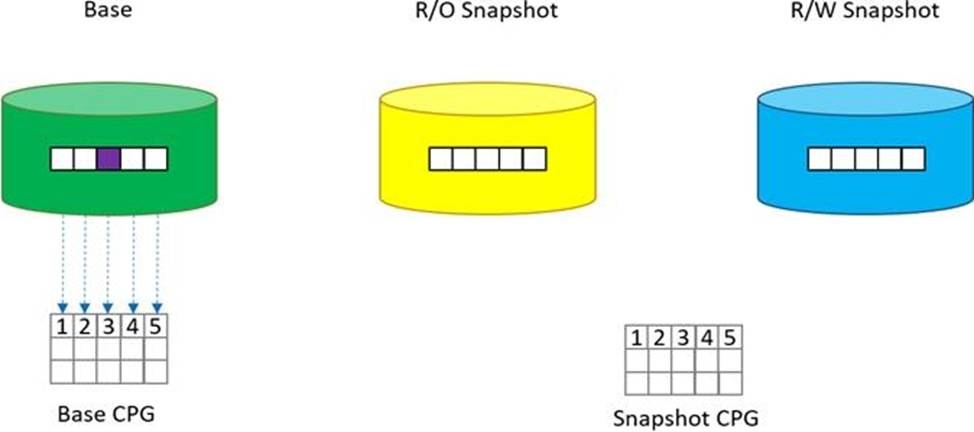
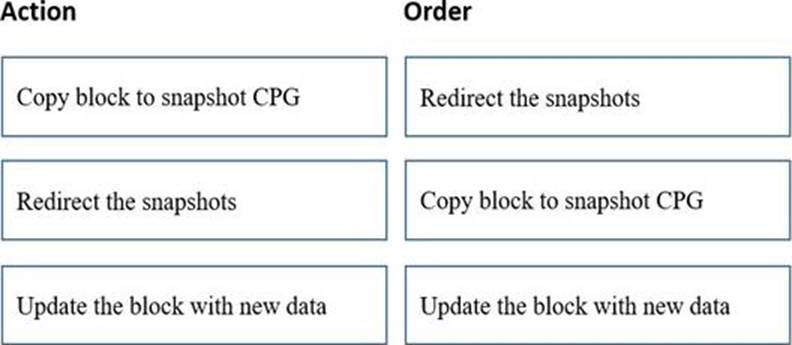
You create two snapshots of a thin provisioned base volume in an HPE Primera. One snapshot is read only and the other is read-write. A write occurs at the location shown in in the diagram. Place the actions on the left into the order they are taken on the right.
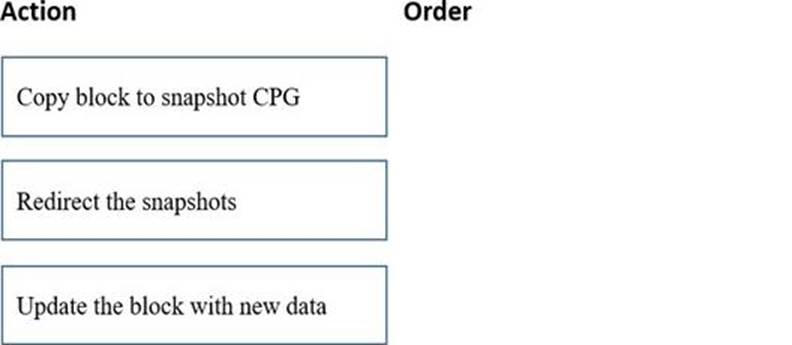
Explanation:
A picture containing diagram Description automatically generated
How does the HPE StoreVirtual VSA storage platform scale performance and capacity?
- A . eliminates the need for storage controllers
- B . enables access through multiple protocols
- C . aggregates all resources into a single storage pool
- D . recreates storage pools on multiple devices
C
Explanation:
The HPE StoreVirtual VSA platform scales performance and capacity by aggregating all resources (storage, compute, and networking) into a single, unified storage pool. This approach allows for seamless scalability as additional resources can be added to the storage pool without disrupting operations. The unified pool of resources ensures that the storage platform can efficiently handle growing workloads and increasing data storage demands.
Reference: HPE StoreVirtual VSA
HPE Software-Defined Storage Solutions
You need to learn more about source-side deduplication technology.
Which HPE StoreOnce backup target type supports this technology?
- A . SMB NAS
- B . NFS NAS
- C . Virtual Tape Library
- D . Catalyst Store
DRAG DROP
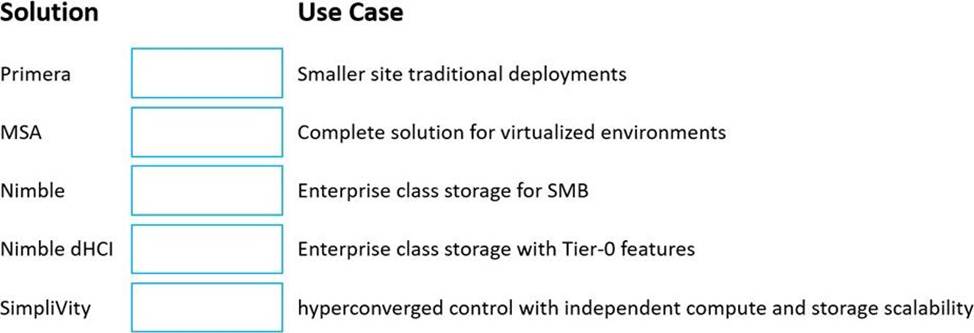
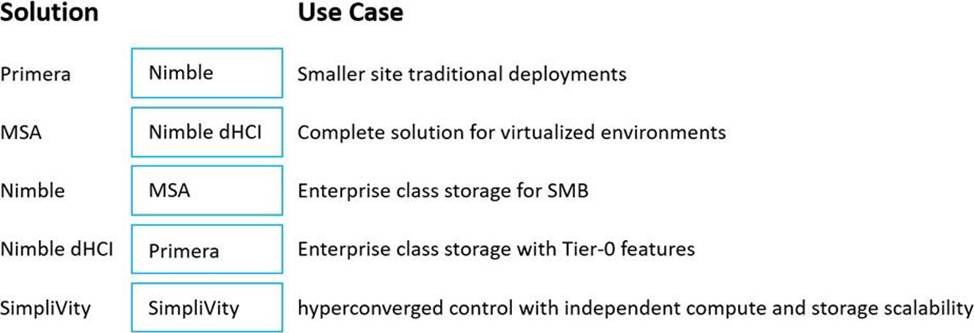
Match each HPE storage solution to its use case.
Explanation:
Graphical user interface, text, application Description automatically generated
Which management interface uses four basic commands (Create, read, update ad delete )to enable administrators to define ad radically simply management processes?
- A . Rest API
- B . WMI
- C . SMI-S
- D . WEBEM
A
Explanation:
The REST API (Representational State Transfer Application Programming Interface) uses four basic commands: Create, Read, Update, and Delete (often abbreviated as CRUD). These commands enable administrators to define and simplify management processes in a programmatic way. REST APIs are widely used in modern IT environments for their simplicity and efficiency in managing and interacting with systems, including storage and networking solutions.
Reference: HPE REST API Documentation
Introduction to REST API
Which statement describes HPE StoreVirtual Network RAID functionality?
- A . Redundancy is managed on a per-volume basis.
- B . With Network RAID 10+2 data is striped and mirrored across two or more storage systems.
- C . Network RAID 10 requires an even number of storage nodes.
- D . Volumes remain available if an odd number of nodes are available.
A
Explanation:
HPE StoreVirtual Network RAID provides redundancy by managing it on a per-volume basis. This means that the level of RAID protection (e.g., Network RAID 0, 10, 10+1, etc.) is set individually for each volume, allowing flexibility in how data protection is applied depending on the importance and performance requirements of the data stored. Unlike traditional RAID, which is managed at the disk level, Network RAID in StoreVirtual VSA allows for more granular control and can be tailored to the specific needs of different workloads.
You deployed and configured an all-flash Nimble array. The customer wants to attach their Windows-based server to the array.
Which HPE tool can you use on the host server to make the integration easier?
- A . StorServe Management Console
- B . Channel bonding
- C . Connection Manager
- D . Centralized Management Console
C
Explanation:
To make the integration of a Windows-based server with an all-flash Nimble array easier, HPE’s Connection Manager (Option C) is the recommended tool. Connection Manager simplifies the configuration of iSCSI or Fibre Channel connections between the server and the Nimble storage array. It helps automate the setup process, ensuring that the best practices for connectivity are followed, which results in optimized performance and reliability.
This tool is particularly useful for administrators who may not be storage experts, as it streamlines the complex tasks associated with connecting servers to enterprise-grade storage systems.
Reference: HPE Nimble Connection Manager
HPE Storage Integration Tools