
Google Professional Cloud Developer Practice Exams
Last updated on Oct 24,2026- Exam Code: Professional Cloud Developer
- Exam Name: Professional Cloud Developer
- Certification Provider: Google
- Latest update: Oct 24,2026
For this question, refer to the HipLocal case study.
HipLocal is expanding into new locations. They must capture additional data each time the application is launched in a new European country. This is causing delays in the development process due to constant schema changes and a lack of environments for conducting testing on the application changes.
How should they resolve the issue while meeting the business requirements?
- A . Create new Cloud SQL instances in Europe and North America for testing and deployment. Provide developers with local MySQL instances to conduct testing on the application changes.
- B . Migrate data to Bigtable. Instruct the development teams to use the Cloud SDK to emulate a local Bigtable development environment.
- C . Move from Cloud SQL to MySQL hosted on Compute Engine. Replicate hosts across regions in the Americas and Europe. Provide developers with local MySQL instances to conduct testing on the application changes.
- D . Migrate data to Firestore in Native mode and set up instan
B
Explanation:
Topic 2, Misc. Questions
You are developing an application hosted on Google Cloud that uses a MySQL relational database schema. The application will have a large volume of reads and writes to the database and will require backups and ongoing capacity planning. Your team does not have time to fully manage the database but can take on small administrative tasks.
How should you host the database?
- A . Configure Cloud SQL to host the database, and import the schema into Cloud SQL.
- B . Deploy MySQL from the Google Cloud Marketplace to the database using a client, and import the schema.
- C . Configure Bigtable to host the database, and import the data into Bigtable.
- D . Configure Cloud Spanner to host the database, and import the schema into Cloud Spanner.
- E . Configure Firestore to host the database, and import the data into Firestore.
A
Explanation:
https://cloud.google.com/spanner/docs/migrating-mysql-to-spanner#migration-process
Cloud SQL: Cloud SQL is a web service that allows you to create, configure, and use relational databases that live in Google’s cloud. It is a fully-managed service that maintains, manages, and administers your databases, allowing you to focus on your applications and services.
https://cloud.google.com/sql/docs/mysql Cloud SQL for MySQL is a fully-managed database service that helps you set up, maintain, manage, and administer your MySQL relational databases on Google Cloud Platform.
You have an application deployed in production. When a new version is deployed, you want to ensure that all production traffic is routed to the new version of your application. You also want to keep the previous version deployed so that you can revert to it if there is an issue with the new version.
Which deployment strategy should you use?
- A . Blue/green deployment
- B . Canary deployment
- C . Rolling deployment
- D . Recreate deployment
You have an analytics application that runs hundreds of queries on BigQuery every few minutes using BigQuery API. You want to find out how much time these queries take to execute.
What should you do?
- A . Use Stackdriver Monitoring to plot slot usage.
- B . Use Stackdriver Trace to plot API execution time.
- C . Use Stackdriver Trace to plot query execution time.
- D . Use Stackdriver Monitoring to plot query execution times.
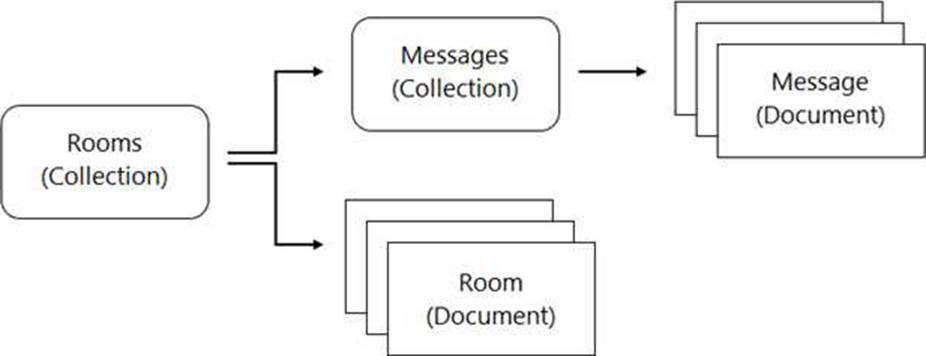
You are designing a chat room application that will host multiple rooms and retain the message history for each room. You have selected Firestore as your database.
How should you represent the data in Firestore?
A) Create a collection for the rooms. For each room, create a document that lists the contents of the messages
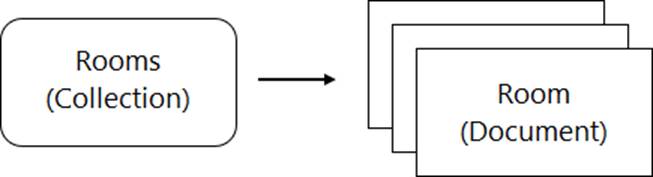
B) Create a collection for the rooms. For each room, create a collection that contains a document for each message

C) Create a collection for the rooms. For each room, create a document that contains a collection for documents, each of which contains a message.

D) Create a collection for the rooms, and create a document for each room. Create a separate collection for messages, with one document per message. Each room’s document contains a list of references to the messages.
- A . Option A
- B . Option B
- C . Option C
- D . Option D
C
Explanation:
https://firebase.google.com/docs/firestore/data-model#hierarchical-data
Your team recently deployed an application on Google Kubernetes Engine (GKE). You are monitoring your application and want to be alerted when the average memory consumption of your containers is under 20% or above 80%.
How should you configure the alerts?
- A . Create a Cloud Function that consumes the Monitoring API. Create a schedule to trigger the Cloud Function hourly and alert you if the average memory consumption is outside the defined range
- B . In Cloud Monitoring, create an alerting policy to notify you if the average memory consumption is outside the defined range
- C . Create a Cloud Function that runs on a schedule, executes kubect1 top on all the workloads on the cluster, and sends an email alert if the average memory consumption is outside the defined range
- D . Write a script that pulls the memory consumption of the instance at the OS level and sends an email alert if the average memory consumption is outside the defined range
Your analytics system executes queries against a BigQuery dataset. The SQL query is executed in batch and passes the contents of a SQL file to the BigQuery CLI. Then it redirects the BigQuery CLI output to another process. However, you are getting a permission error from the BigQuery CLI when the queries are executed. You want to resolve the issue.
What should you do?
- A . Grant the service account BigQuery Data Viewer and BigQuery Job User roles.
- B . Grant the service account BigQuery Data Editor and BigQuery Data Viewer roles.
- C . Create a view in BigQuery from the SQL query and SELECT* from the view in the CLI.
- D . Create a new dataset in BigQuery, and copy the source table to the new dataset Query the new dataset and table from the CLI.
You are deploying a Python application to Cloud Run using Cloud Build.
The Cloud Build pipeline is shown below:
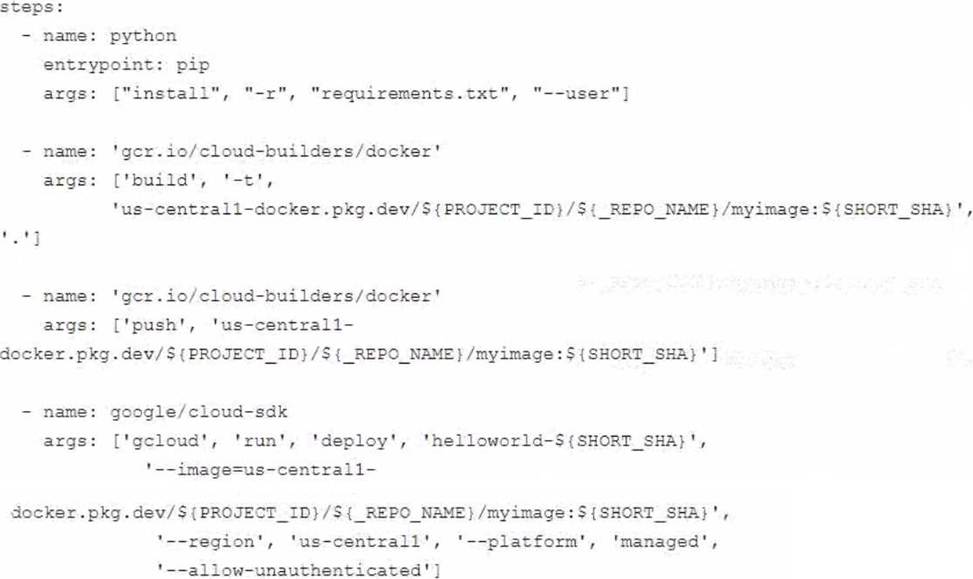
You want to optimize deployment times and avoid unnecessary steps What should you do?
- A . Remove the step that pushes the container to Artifact Registry.
- B . Add the ―cache-from argument to the Docker build step in your build config file.
- C . Store image artifacts in a Cloud Storage bucket in the same region as the Cloud Run instance.
- D . Deploy a new Docker registry in a VPC and use Cloud Build worker pools inside the VPC to run the build pipeline.
B
Explanation:
https://cloud.google.com/build/docs/optimize-builds/speeding-up-builds#using_a_cached_docker_image
You have a mixture of packaged and internally developed applications hosted on a Compute Engine instance that is running Linux. These applications write log records as text in local files. You want the logs to be written to Cloud Logging.
What should you do?
- A . Pipe the content of the files to the Linux Syslog daemon.
- B . Install a Google version of fluentd on the Compute Engine instance.
- C . Install a Google version of collectd on the Compute Engine instance.
- D . Using cron, schedule a job to copy the log files to Cloud Storage once a day.
B
Explanation:
Reference: https://cloud.google.com/logging/docs/agent/logging/configuration