
Google Professional Cloud Developer Practice Exams
Last updated on Oct 24,2026- Exam Code: Professional Cloud Developer
- Exam Name: Professional Cloud Developer
- Certification Provider: Google
- Latest update: Oct 24,2026
You want to notify on-call engineers about a service degradation in production while minimizing Development time.
What should you do?
- A . Use Cloud Function to monitor resources and raise alerts.
- B . Use Cloud Pub/Sub to monitor resources and raise alerts.
- C . Use Stackdriver Error Reporting to capture errors and raise alerts.
- D . Use Stackdriver Monitoring to monitor resources and raise alerts.
Your organization has recently begun an initiative to replatform their legacy applications onto Google Kubernetes Engine. You need to decompose a monolithic application into microservices. Multiple instances have read and write access to a configuration file, which is stored on a shared file system. You want to minimize the effort required to manage this transition, and you want to avoid rewriting the application code.
What should you do?
- A . Create a new Cloud Storage bucket, and mount it via FUSE in the container.
- B . Create a new persistent disk, and mount the volume as a shared PersistentVolume.
- C . Create a new Filestore instance, and mount the volume as an NFS PersistentVolume.
- D . Create a new ConfigMap and volumeMount to store the contents of the configuration file.
D
Explanation:
https://cloud.google.com/kubernetes-engine/docs/concepts/configmap
ConfigMaps bind non-sensitive configuration artifacts such as configuration files, command-line arguments, and environment variables to your Pod containers and system components at runtime.
A ConfigMap separates your configurations from your Pod and components, which helps keep your workloads portable. This makes their configurations easier to change and manage, and prevents hardcoding configuration data to Pod specifications.
Your team develops services that run on Google Kubernetes Engine. Your team’s code is stored in Cloud Source Repositories. You need to quickly identify bugs in the code before it is deployed to production. You want to invest in automation to improve developer feedback and make the process as efficient as possible.
What should you do?
- A . Use Spinnaker to automate building container images from code based on Git tags.
- B . Use Cloud Build to automate building container images from code based on Git tags.
- C . Use Spinnaker to automate deploying container images to the production environment.
- D . Use Cloud Build to automate building container images from code based on forked versions.
A
Explanation:
Reference: https://spinnaker.io/docs/guides/tutorials/codelabs/kubernetes-v2-source-to-prod/
Your application is logging to Stackdriver. You want to get the count of all requests on all /api/alpha/* endpoints.
What should you do?
- A . Add a Stackdriver counter metric for path:/api/alpha/.
- B . Add a Stackdriver counter metric for endpoint:/api/alpha/*.
- C . Export the logs to Cloud Storage and count lines matching /api/alphA.
- D . Export the logs to Cloud Pub/Sub and count lines matching /api/alphA.
You have deployed an HTTP(s) Load Balancer with the gcloud commands shown below.
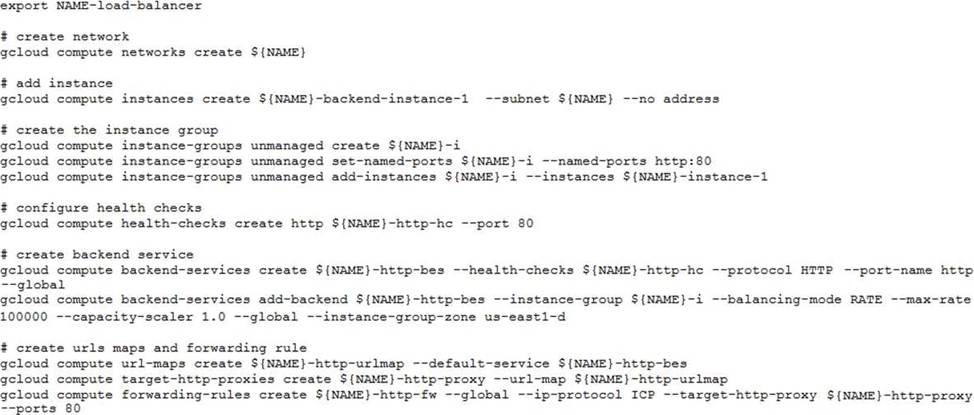
Health checks to port 80 on the Compute Engine virtual machine instance are failing and no traffic is sent to your instances. You want to resolve the problem.
Which commands should you run?
- A . gcloud compute instances add-access-config ${NAME}-backend-instance-1
- B . gcloud compute instances add-tags ${NAME}-backend-instance-1 –tags http-server
- C . gcloud compute firewall-rules create allow-lb –network load-balancer Callow tcp –source-ranges 130.211.0.0/22,35.191.0.0/16 –direction INGRESS
- D . gcloud compute firewall-rules create allow-lb –network load-balancer –allow tcp –destination-ranges 130.211.0.0/22,35.191.0.0/16 –direction EGRESS
C
Explanation:
Reference: https://cloud.google.com/vpc/docs/special-configurations
You are developing a new application. You want the application to be triggered only when a given file is updated in your Cloud Storage bucket. Your trigger might change, so your process must support different types of triggers. You want the configuration to be simple so that multiple team members can update the triggers in the future.
What should you do?
- A . Create an Eventarc trigger that monitors your Cloud Storage bucket for a specific filename, and set the target as Cloud Run.
- B . Configure Cloud Storage events to be sent to Pub/Sub, and use Pub/Sub events to trigger a Cloud Build job that executes your application.
- C . Configure a Firebase function that executes your application and is triggered when an object is updated in Cloud Storage.
- D . Configure a Cloud Function that executes your application and is triggered when an object is updated in Cloud Storage.
You are a SaaS provider deploying dedicated blogging software to customers in your Google Kubernetes Engine (GKE) cluster. You want to configure a secure multi-tenant platform to ensure that each customer has access to only their own blog and can’t affect the workloads of other customers.
What should you do?
- A . Enable Application-layer Secrets on the GKE cluster to protect the cluster.
- B . Deploy a namespace per tenant and use Network Policies in each blog deployment.
- C . Use GKE Audit Logging to identify malicious containers and delete them on discovery.
- D . Build a custom image of the blogging software and use Binary Authorization to prevent untrusted image deployments.
B
Explanation:
Reference: https://cloud.google.com/kubernetes-engine/docs/concepts/multitenancy-overview
Topic 1, HipLocal
Case Study
Company Overview
HipLocal is a community application designed to facilitate communication between people in close proximity. It is used for event planning and organizing sporting events, and for businesses to connect with their local communities. HipLocal launched recently in a few neighborhoods in Dallas and is rapidly growing into a global phenomenon. Its unique style of hyper-local community communication and business outreach is in demand around the world.
Executive statement
We are the number one local community app; it’s time to take our local community services global. Our venture capital investors want to see rapid growth and the same great experience for new local and virtual communities that come online, whether their members are 10 or 10,000 miles away from each other.
Solution concept
HipLocal wants to expand their existing service, with updated functionality, in new regions to better serve their global customers. They want to hire and train a new team to support these regions in their time zones. They will need to ensure that the application scales smoothly and provides clear uptime data.
Existing technical environment
HipLocal’s environment is a mix of on-premises hardware and infrastructure running in Google Cloud Platform. The HipLocal team understands their application well but has limited experience in global scale applications.
Their existing technical environment is as follows:
Existing APIs run on Compute Engine virtual machine instances hosted in GCP State is stored in a single instance MySQL database in GCP
Data is exported to an on-premises Teradata/Vertica data warehouse
Data analytics is performed in an on-premises Hadoop environment
The application has no logging
There are basic indicators of uptime; alerts are frequently fired when the APIs are unresponsive
Business requirements
HipLocal’s investors want to expand their footprint and support the increase in demand they are seeing. Their requirements are:
Expand availability of the application to new regions
Increase the number of concurrent users that can be supported
Ensure a consistent experience for users when they travel to different regions Obtain user activity metrics to better understand how to monetize their product Ensure compliance with regulations in the new regions (for example, GDPR) Reduce infrastructure management time and cost
Adopt the Google-recommended practices for cloud computing
Technical requirements
The application and backend must provide usage metrics and monitoring
APIs require strong authentication and authorization
Logging must be increased, and data should be stored in a cloud analytics platform
Move to serverless architecture to facilitate elastic scaling
Provide authorized access to internal apps in a secure manner
HipLocal’s.net-based auth service fails under intermittent load.
What should they do?
- A . Use App Engine for autoscaling.
- B . Use Cloud Functions for autoscaling.
- C . Use a Compute Engine cluster for the service.
- D . Use a dedicated Compute Engine virtual machine instance for the service.
D
Explanation:
Reference: https://www.qwiklabs.com/focuses/611?parent=catalog
You are a developer at a financial institution You use Cloud Shell to interact with Google Cloud services. User data is currently stored on an ephemeral disk however a recently passed regulation mandates that you can no longer store sensitive information on an ephemeral disk. You need to implement a new storage solution for your user data You want to minimize code changes.
Where should you store your user data’?
- A . Store user data on a Cloud Shell home disk and log in at least every 120 days to prevent its deletion
- B . Store user data on a persistent disk in a Compute Engine instance
- C . Store user data m BigQuery tables
- D . Store user data in a Cloud Storage bucket