
Fortinet FCSS_SASE_AD-24 Practice Exams
Last updated on Oct 22,2026- Exam Code: FCSS_SASE_AD-24
- Exam Name: FCSS - FortiSASE 24 Administrator
- Certification Provider: Fortinet
- Latest update: Oct 22,2026
Which FortiOS command is used to view the log settings configured in FortiSASE?
- A . get log settings
- B . diagnose debug log
- C . get system log settings
- D . config log settings view
Content inspection within FortiSASE is optional and only needed for specific applications.
- A . False
- B . True
Which user onboarding method in FortiSASE is best for environments with stringent security requirements?
- A . Shared password systems
- B . Multi-factor authentication (MFA)
- C . Anonymous access
- D . Single sign-on (SSO)
During FortiSASE provisioning, how many security points of presence (POPs) need to be configured by the FortiSASE administrator?
- A . 3
- B . 4
- C . 2
- D . 1
Refer to the exhibit.
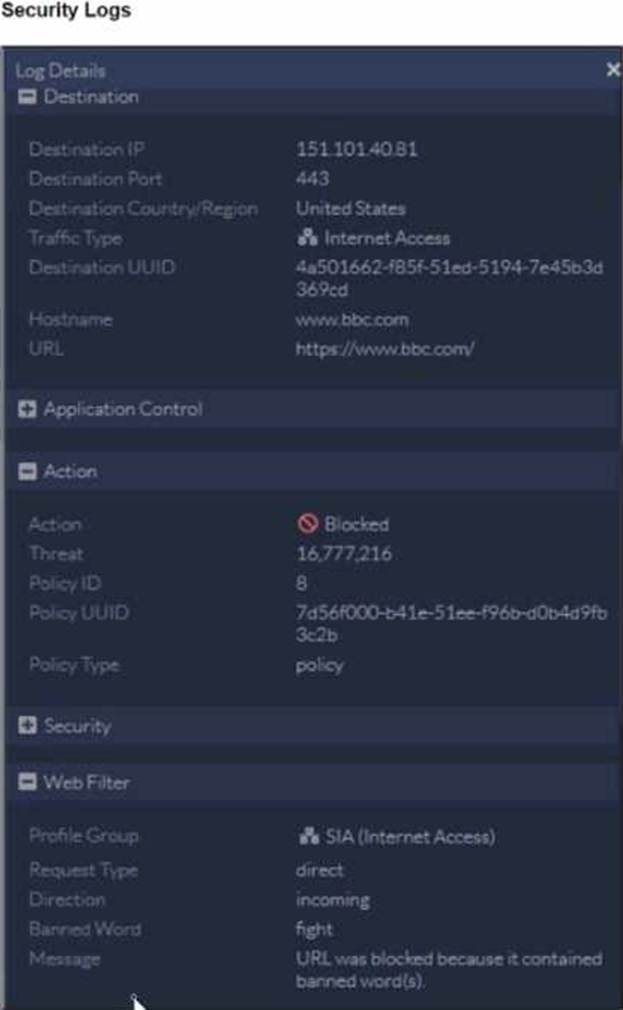
To allow access, which web tiller configuration must you change on FortiSASE?
- A . FortiGuard category-based filter
- B . content filter
- C . URL Filter
- D . inline cloud access security broker (CASB) headers
An organization needs to resolve internal hostnames using its internal rather than public DNS servers for remotely connected endpoints.
Which two components must be configured on FortiSASE to achieve this? (Choose two.)
- A . SSL deep inspection
- B . Split DNS rules
- C . Split tunnelling destinations
- D . DNS filter
AB
Explanation:
To resolve internal hostnames using internal DNS servers for remotely connected endpoints, the following two components must be configured on FortiSASE: Split DNS Rules:
Split DNS allows the configuration of specific DNS queries to be directed to internal DNS servers instead of public DNS servers.
This ensures that internal hostnames are resolved using the organization’s internal DNS infrastructure, maintaining privacy and accuracy for internal network resources.
Split Tunneling Destinations:
Split tunneling allows specific traffic (such as DNS queries for internal domains) to be routed through the VPN tunnel while other traffic is sent directly to the internet.
By configuring split tunneling destinations, you can ensure that DNS queries for internal hostnames are directed through the VPN to the internal DNS servers.
Reference: FortiOS 7.2 Administration Guide: Provides details on configuring split DNS and split tunneling for VPN clients.
FortiSASE 23.2 Documentation: Explains the implementation and configuration of split DNS and split tunneling for securely resolving internal hostnames.
What key components are involved in Secure Internet Access (SIA) within FortiSASE? (Select all that apply)
- A . Content filtering
- B . Bandwidth throttling
- C . Web application firewall (WAF)
- D . Malware protection
Which logs are important for compliance in FortiSASE? (Select all that apply)
- A . Security incident logs
- B . Compliance rule updates
- C . User activity logs
- D . Server performance logs
What benefits does analyzing historical logs in FortiSASE provide? (Select all that apply)
- A . Identifying long-term trends
- B . Enhancing real-time threat detection
- C . Supporting forensic investigations
- D . Improving user experience
In the context of analyzing security issues, what does a sudden spike in user traffic indicate when reviewed in reports?
- A . A potential distributed denial of service (DDoS) attack
- B . A planned upgrade of internet services
- C . A decrease in user productivity
- D . A social event in the organization