
Fortinet FCSS_SASE_AD-24 Practice Exams
Last updated on Oct 22,2026- Exam Code: FCSS_SASE_AD-24
- Exam Name: FCSS - FortiSASE 24 Administrator
- Certification Provider: Fortinet
- Latest update: Oct 22,2026
Which benefits does deploying SD-WAN using FortiSASE offer to an organization?
(Choose Three)
- A . Reduced operational costs
- B . Increased application performance
- C . Enhanced physical security of network devices
- D . Improved network agility
What should be prioritized when securing remote workers using FortiSASE? (Select all that apply)
- A . Implementation of MFA (Multi-Factor Authentication)
- B . Continuous monitoring of user activities
- C . Encryption of all communications
- D . Deployment of dedicated hardware firewalls
Which FortiOS command is used to verify the health of Zero Trust Network Access (ZTNA) policies in FortiSASE?
- A . diagnose ztna status
- B . get system ztna status
- C . diagnose debug application ztna
- D . get ztna policy-status
Which aspect of FortiSASE ensures that remote users’ data remains secure when accessing the internet?
- A . Data Loss Prevention (DLP)
- B . Data Loss Prevention (DLP)
- C . Secure Web Gateway (SWG)
- D . Secure SD-WAN
How does analyzing FortiSASE logs help in compliance with regulatory standards?
- A . By ensuring all recreational internet use is logged
- B . By documenting all user login times and durations
- C . By providing evidence of proactive threat detection and response
- D . By tracking the number of emails sent per day
Which role does FortiSASE play in supporting zero trust network access (ZTNA) principles9
- A . It offers hardware-based firewalls for network segmentation.
- B . It integrates with software-defined network (SDN) solutions.
- C . It can identify attributes on the endpoint for security posture check.
- D . It enables VPN connections for remote employees.
C
Explanation:
FortiSASE supports zero trust network access (ZTNA) principles by identifying attributes on the endpoint for security posture checks. ZTNA principles require continuous verification of user and device credentials, as well as their security posture, before granting access to network resources. Security Posture Check:
FortiSASE can evaluate the security posture of endpoints by checking for compliance with security policies, such as antivirus status, patch levels, and configuration settings.
This ensures that only compliant and secure devices are granted access to the network.
Zero Trust Network Access (ZTNA):
ZTNA is based on the principle of "never trust, always verify," which requires continuous assessment of user and device trustworthiness.
FortiSASE plays a crucial role in implementing ZTNA by performing these security posture checks and enforcing access control policies.
Reference: FortiOS 7.2 Administration Guide: Provides information on ZTNA and endpoint security posture checks.
FortiSASE 23.2 Documentation: Details on how FortiSASE implements ZTNA principles.
Why is content inspection necessary within security profiles?
- A . To verify user identities
- B . To detect and prevent data breaches
- C . To increase network speed
- D . To manage bandwidth usage
Refer to the exhibits.
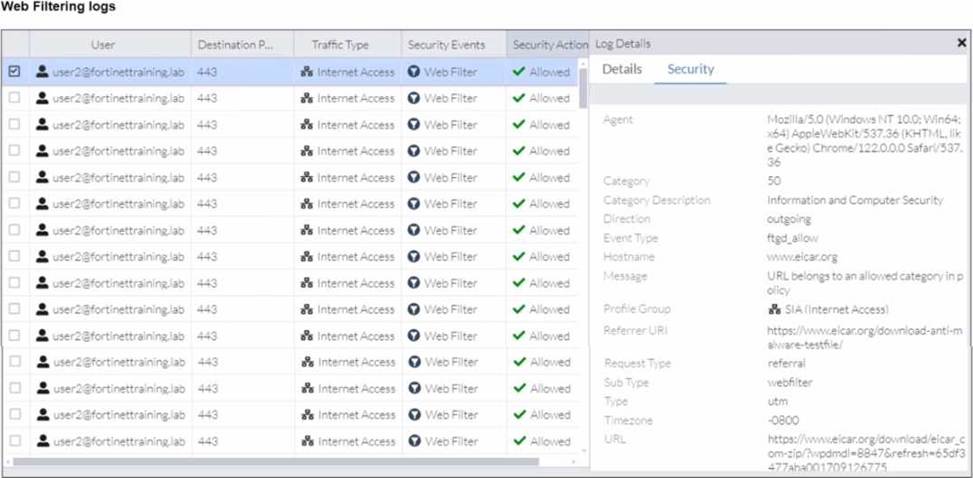
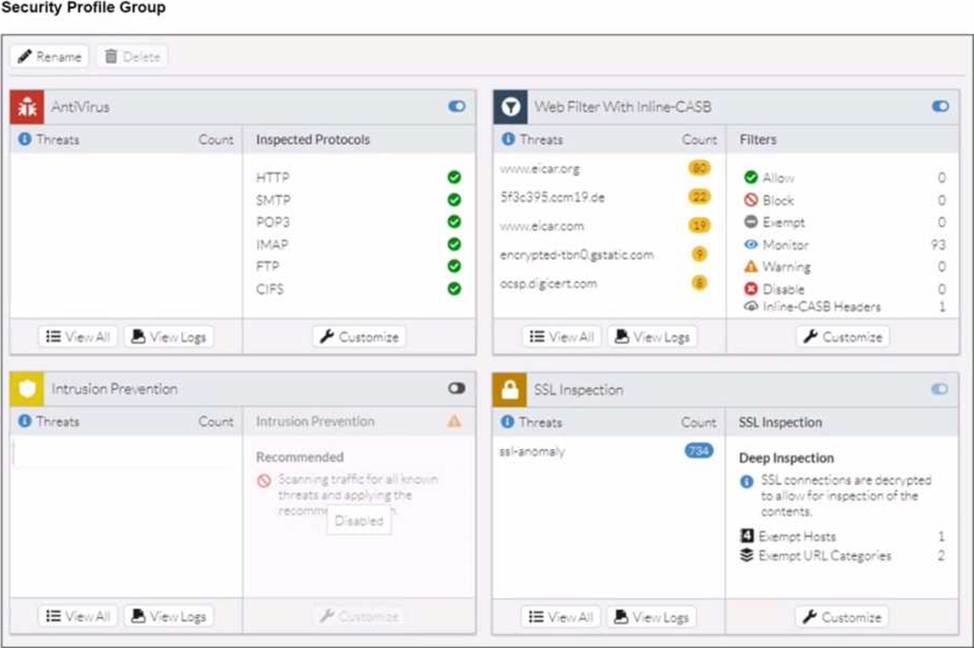
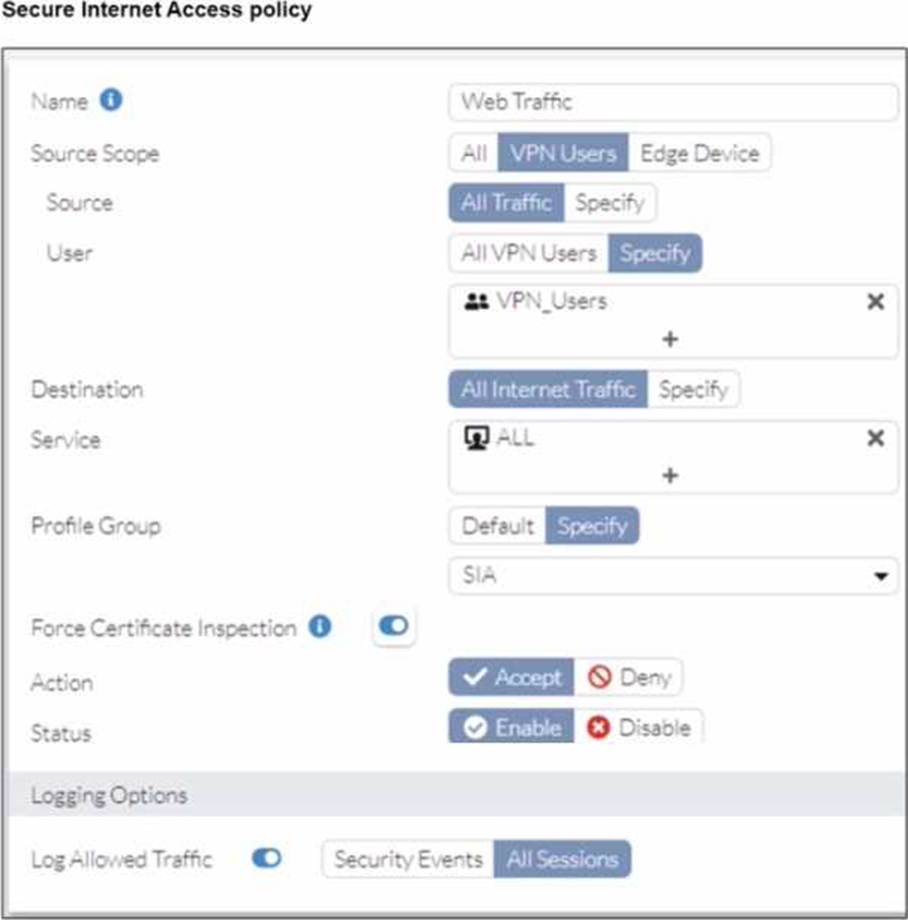
A FortiSASE administrator has configured an antivirus profile in the security profile group and applied it to the internet access policy. Remote users are still able to download the eicar.com-zip file from https://eicar.org. Traffic logs show traffic is allowed by the policy.
Which configuration on FortiSASE is allowing users to perform the download?
- A . Web filter is allowing the traffic.
- B . IPS is disabled in the security profile group.
- C . The HTTPS protocol is not enabled in the antivirus profile.
- D . Force certificate inspection is enabled in the policy.
D
Explanation:
https://community.fortinet.com/t5/FortiSASE/Technical-Tip-Force-Certificate-Inspection-option-in-FortiSASE/ta-p/302617
What is the role of Firewall as a Service (FWaaS) in FortiSASE architecture?
- A . To monitor and log all user activities
- B . To perform content inspection and enforce security policies
- C . To handle DNS queries and responses
- D . To encrypt traffic between endpoints
Which secure internet access (SIA) use case minimizes individual endpoint configuration?
- A . Site-based remote user internet access
- B . Agentless remote user internet access
- C . SIA for SSL VPN remote users
- D . SIA using ZTNA
B
Explanation:
The agentless remote user internet access use case is designed to minimize individual endpoint configuration. In this scenario, FortiSASE provides secure internet access without requiring the installation of an agent on the endpoint device. This approach is particularly useful for environments with unmanaged devices or temporary users, as it eliminates the need for complex configurations on each endpoint. Instead, security policies are enforced at the network level, ensuring consistent protection without relying on endpoint-specific software. Here’s why the other options are incorrect: