
Fortinet FCSS_EFW_AD-7.4 Practice Exams
Last updated on Nov 16,2026- Exam Code: FCSS_EFW_AD-7.4
- Exam Name: FCSS - Enterprise Firewall 7.4 Administrator
- Certification Provider: Fortinet
- Latest update: Nov 16,2026
What is the initial step performed by FortiGate when handling the first packets of a session?
- A . Installation of the session key in the network processor (NP)
- B . Data encryption and decryption
- C . Security inspections such as ACL, HPE, and IP integrity header checking
- D . Offloading the packets directly to the content processor (CP)
C
Explanation:
When FortiGate processes the first packets of a session, it follows a sequence of steps to determine how the traffic should be handled before establishing a session.
The initial step involves:
# Access Control List (ACL) checks: Determines if the traffic should be allowed or blocked based on predefined security rules.
# Hardware Packet Engine (HPE) inspections: Ensures that packet headers are valid and comply with protocol standards.
# IP Integrity Header Checking: Verifies if the IP headers are intact and not malformed or spoofed.
Once these security inspections are completed and the session is validated, FortiGate then installs the session in hardware (if offloading is enabled) or processes it in software.
Refer to the exhibit, which shows the HA status of an active-passive cluster.
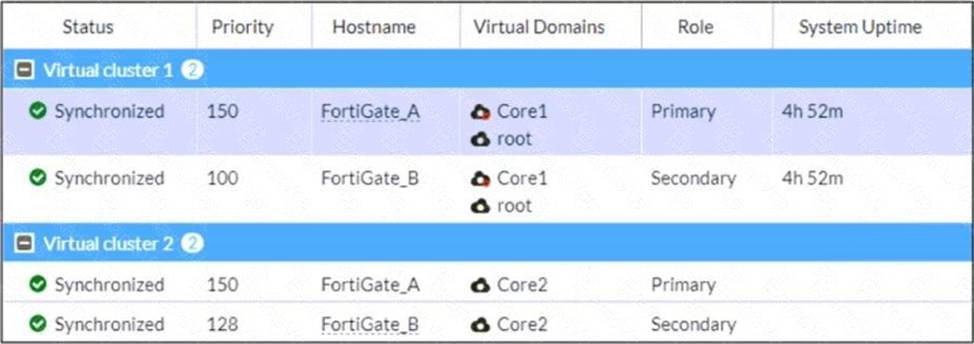
An administrator wants FortiGate_B to handle the Core2 VDOM traffic.
Which modification must the administrator apply to achieve this?
- A . The administrator must disable override on FortiGate_A.
- B . The administrator must change the priority from 100 to 160 for FortiGate_B.
- C . The administrator must change the load balancing method on FortiGate_B.
- D . The administrator must change the priority from 128 to 200 for FortiGate_B.
D
Explanation:
The exhibit shows anactive-passive HA (high availability) clusterwith two virtual clusters, where FortiGate_A is the primary device for both Core1 and Core2. If the goal is to haveFortiGate_B take over Core2 traffic, itspriority must be higherthan FortiGate_A forVirtual Cluster 2.
Currently, FortiGate_A has a priority of150for Core2, while FortiGate_B has128. IncreasingFortiGate_B’s priority to 200ensures it becomes theprimary for Virtual Cluster 2, taking over the Core2 VDOM traffic while keeping Core1 traffic on FortiGate_A.
Disabling override would prevent forced failovers but wouldn’t change the role distribution. Adjusting the load-balancing method is irrelevant in anactive-passive setup, as it only applies to active-active configurations.
Which two statements about the use of digital certificates are true?
- A . An intermediate CA can sign server certificates
- B . An intermediate CA can sign another intermediate CA certificate
- C . The end entity’s certificate can only be created by an intermediate C
- D . An intermediate CA can validate the end entity certificate signed by another intermediate CA
An administrator configured the FortiGate devices in an enterprise network to join the Fortinet Security Fabric. The administrator has a list of IP addresses that must be blocked by the data center firewall. This list is updated daily.
How can the administrator automate a firewall policy with the daily updated list?
- A . With FortiNAC
- B . With FortiAnalyzer
- C . With a Security Fabric automation
- D . With an external connector from Threat Feeds
D
Explanation:
Thebest way to automate a firewall policyusing a daily updated list ofIP addressesis by using anexternal connector from Threat Feeds. This allows FortiGate to dynamically retrievereal-time threat intelligence from external sources and apply it directly to security policies.
By configuringThreat Feeds, the administrator can:
#Automatically updatefirewall policies with the latest malicious IPs daily.
#Block trafficfrom those IPs in real-time without manual intervention.
#Integrate with FortiGuard, third-party threat intelligence sources, or custom feeds (CSV, STIX /TAXII, etc.).
A user reports that their computer was infected with malware after accessing a secured HTTPS website. However, when the administrator checks the FortiGate logs, they do not see that the website was detected as insecure despite having an SSL certificate and correct profiles applied on the policy.
How can an administrator ensure that FortiGate can analyze encrypted HTTPS traffic on a website?
- A . The administrator must enable reputable websites to allow only SSL/TLS websites rated by FortiGuard web filter.
- B . The administrator must enable URL extraction from SNI on the SSL certificate inspection to ensure the TLS three-way handshake is correctly analyzed by FortiGate.
- C . The administrator must enable DNS over TLS to protect against fake Server Name Indication (SNI) that cannot be analyzed in common DNS requests on HTTPS websites.
- D . The administrator must enable full SSL inspection in the SSL/SSH Inspection Profile to decrypt packets and ensure they are analyzed as expected.
D
Explanation:
FortiGate, like other security appliances, cannot analyze encrypted HTTPS traffic unless itdecryptsit first. If only certificate inspectionis enabled, FortiGate can see the certificate details (such as the domain and issuer) butcannot inspect the actual web content.
To fully analyze the traffic and detect potential malware threats:
#Full SSL inspection (Deep Packet Inspection)must be enabled in theSSL/SSH Inspection Profile.
# This allows FortiGate todecrypt the HTTPS traffic, inspect the content, and then re-encrypt it before forwarding it to the user.
# Without full SSL inspection, threats embedded in encrypted traffic may go undetected.
Refer to the exhibit, which shows a partial routing table.
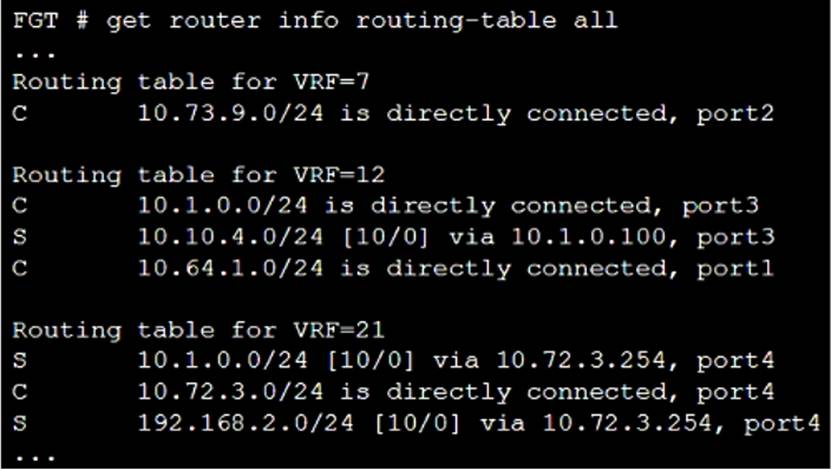
Assuming all the appropriate firewall policies are configured, what two changes would an administrator need to make if they wanted to send traffic from a client directly connected to port3, to a server directly connected to port4? (Choose two.)
- A . Configure route leaking between VRF 12 and VRF 21.
- B . Disable auto-asic-offload as this is not supported between VRF instances.
- C . Configure RIPv2 to exchange route information between the VRF instances.
- D . Configure route leaking between port3 and port4.
- E . Enable SNAT on the relevant firewall policies to prevent RPF check drops.
View the exhibit, which contains the output of a real-time debug, and then answer the question below.
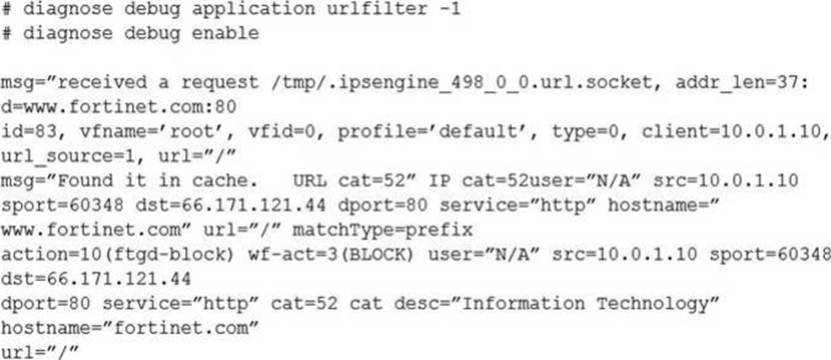
Which of the following statements is true regarding this output? (Choose two.)
- A . This web request was inspected using the root web filter profile.
- B . FortiGate found the requested URL in its local cache.
- C . The requested URL belongs to category ID 52.
- D . The web request was allowed by FortiGate
Refer to the exhibits.
The exhibits show a network topology, a firewall policy, and an SSL/SSH inspection profile configuration.
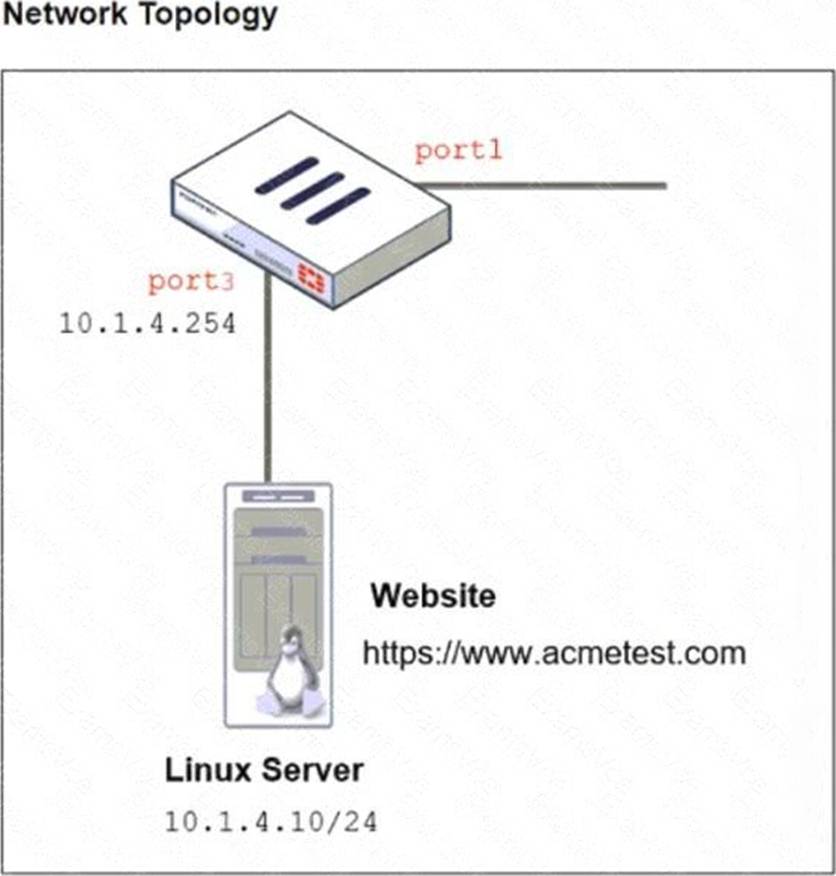
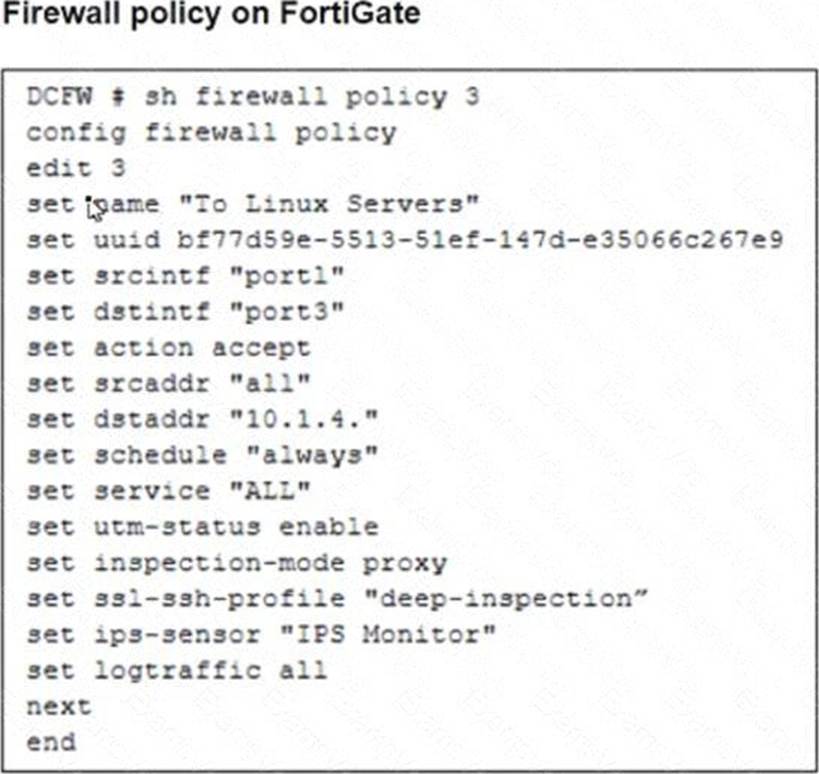
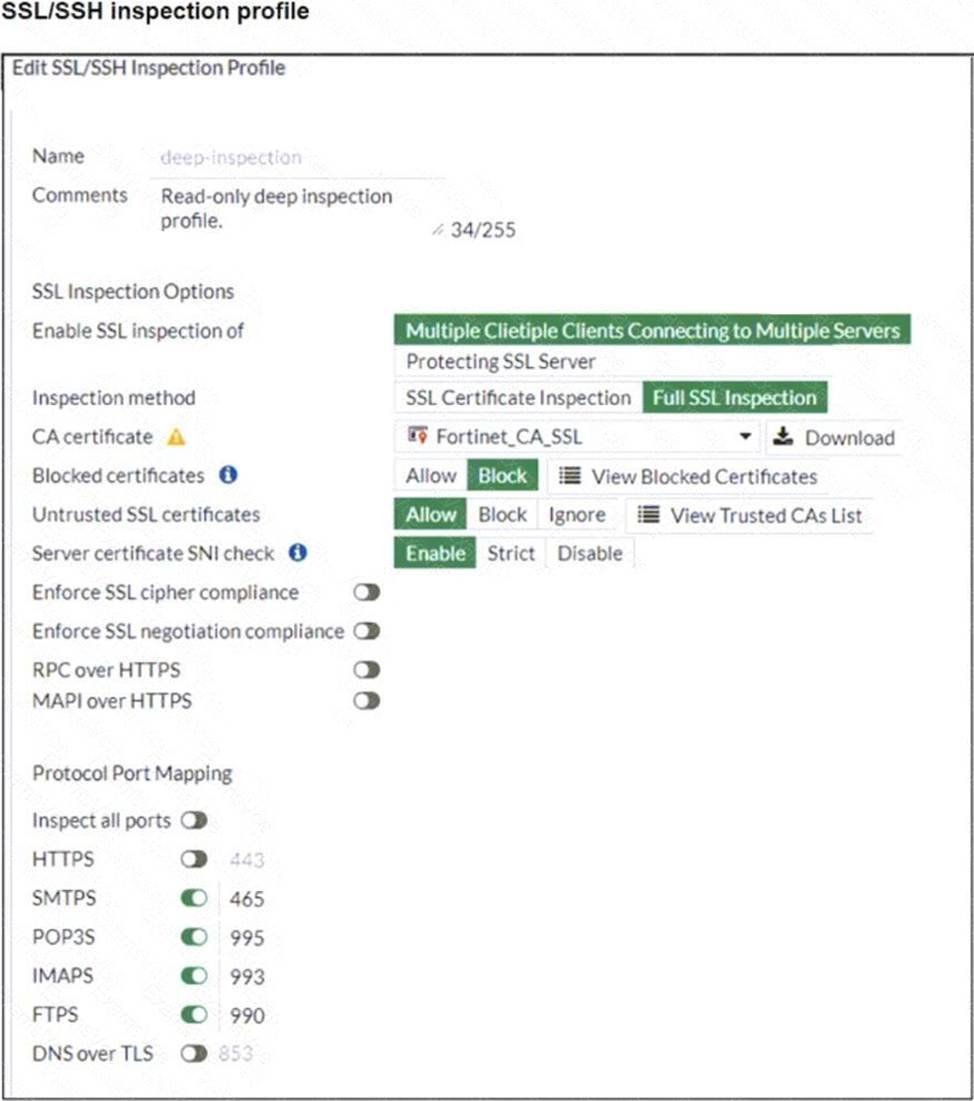
Why is FortiGate unable to detect HTTPS attacks on firewall policy ID 3 targeting the Linux server?
- A . The administrator must set the policy to inspection mode to analyze the HTTPS packets as expected.
- B . The administrator must enable HTTPS in the protocol port mapping of the deep- inspection SSL/SSH inspection profile.
- C . The administrator must enable SSL inspection of the SSL server and upload the certificate of the Linux server website to the SSL/SSH inspection profile.
- D . The administrator must enable cipher suites in the SSL/SSH inspection profile to decrypt the message.
C
Explanation:
The FortiGateSSL/SSH inspection profileis configured forFull SSL Inspection, which is necessary to analyze encrypted HTTPS traffic. However, the firewallpolicy is protecting an SSL server (the Linux server hosting the website), and currently, the SSL/SSH profileonly applies to client-side SSL inspection.
To detect HTTPS-based attacks targeting the Linux server:
#FortiGate must act as an SSL intermediaryto inspect encrypted traffic destined for the web server.
# The administratormust upload the SSL certificate of the Linux web serverto FortiGate so that theserver-side SSL inspectioncan decrypt incoming HTTPS traffic before analyzing it.
Refer to the exhibit.
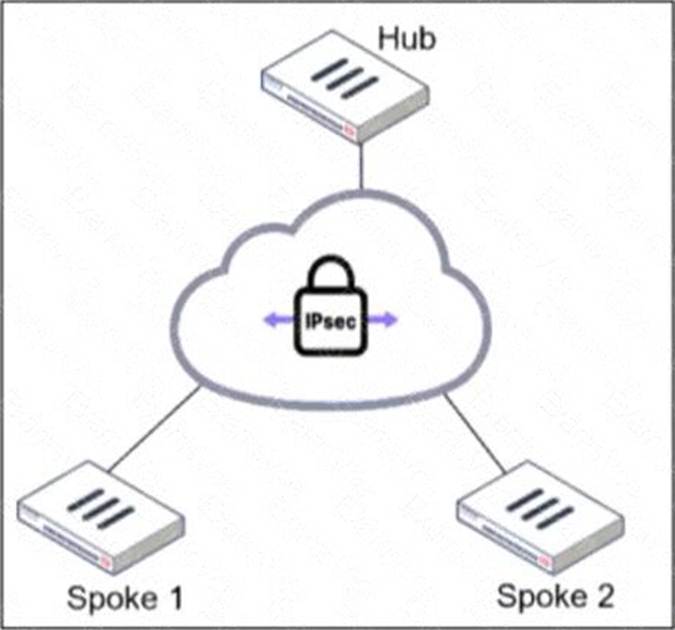
An administrator is deploying a hub and spokes network and using OSPF as dynamic protocol.
Which configuration is mandatory for neighbor adjacency?
- A . Set bfd enable in the router configuration
- B . Set network-type point-to-multipoint in the hub interface
- C . Set rfc1583-compatible enable in the router configuration
- D . Set virtual-link enable in the hub interface
B
Explanation:
In a hub-and-spoke topology using OSPF over IPsec VPNs, thepoint-to-multipointnetwork type is necessary to establish neighbor adjacencies between the hub and spokes. This network type ensures that OSPF operates correctly without requiring a designated router (DR) and allows dynamic routing updates across the IPsec tunnels.
Which two events can trigger an HA failover? (Choose two.)
- A . The failure of a solid-state drive
- B . The physical disconnection of a heartbeat interface
- C . A configuration sync failure
- D . A session sync failure