
Fortinet FCSS_EFW_AD-7.4 Practice Exams
Last updated on Nov 16,2026- Exam Code: FCSS_EFW_AD-7.4
- Exam Name: FCSS - Enterprise Firewall 7.4 Administrator
- Certification Provider: Fortinet
- Latest update: Nov 16,2026
Refer to the exhibit, which shows the VDOM section of a FortiGate device.
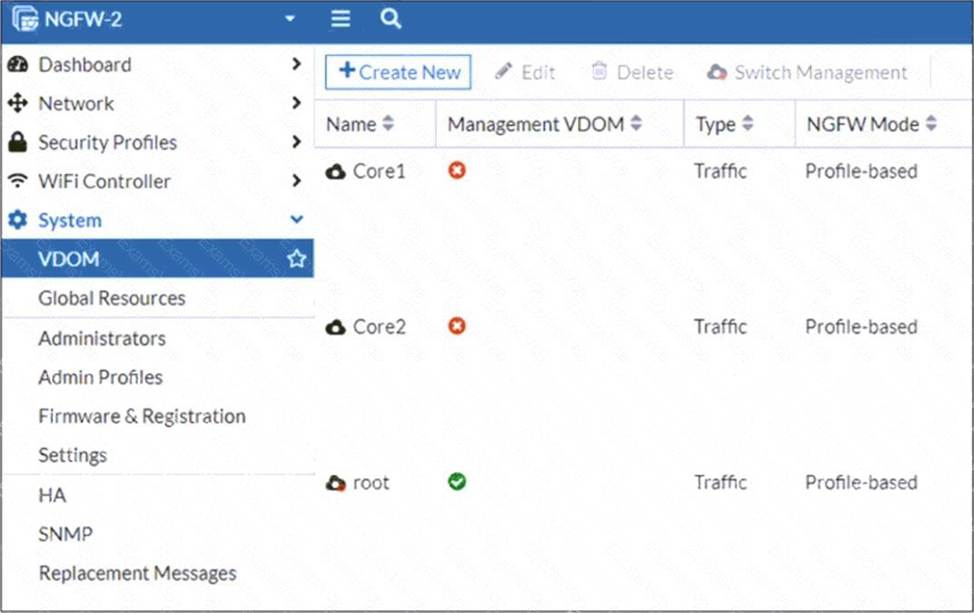
An administrator discovers that webfilter stopped working in Core1 and Core2 after a maintenance window.
Which two reasons could explain why webfilter stopped working? (Choose two.)
- A . The root VDOM does not have access to FortiManager in a closed network.
- B . The root VDOM does not have a VDOM link to connect with the Corel and Core2 VDOMs.
- C . The Core1 and Core2 VDOMs must also be enabled as Management VDOMs to receive FortiGuard updates
- D . The root VDOM does not have access to any valid public FDN.
B D
Explanation:
Since Core1 and Core2 are not designated as management VDOMs, they rely on the root VDOM for connectivity to external resources such as FortiGuard updates. If the root VDOM lacks a VDOM link to these VDOMs or cannot reach FortiGuard services, security features like web filtering will stop working.
A FortiGate has two default routes:
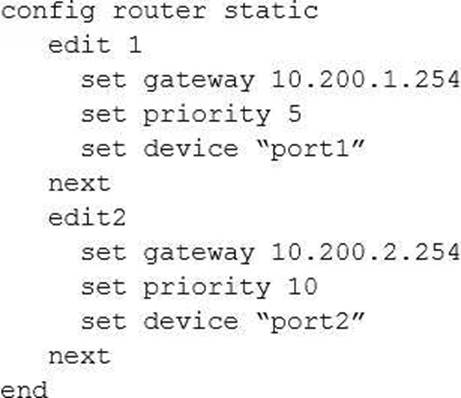
All Internet traffic is currently using port1.
The exhibit shows partial information for one sample session of Internet traffic from an internal user:
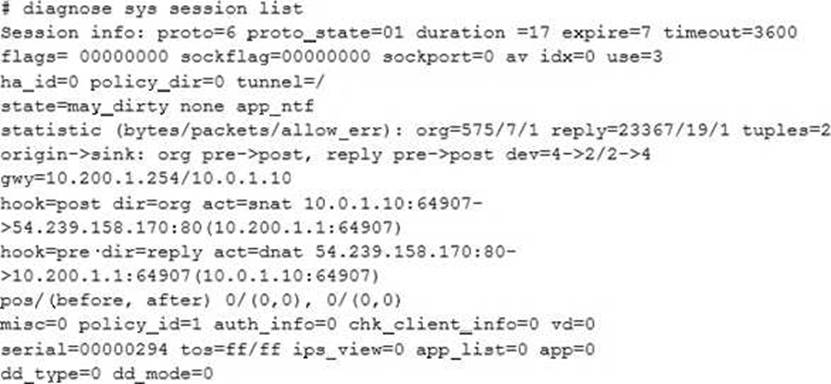
What would happen with the traffic matching the above session if the priority on the first default route (IDd1) were changed from 5 to 20?
- A . Session would remain in the session table and its traffic would keep using port1 as the outgoing interface.
- B . Session would remain in the session table and its traffic would start using port2 as the outgoing interface.
- C . Session would be deleted, so the client would need to start a new session.
- D . Session would remain in the session table and its traffic would be shared between port1 and port2.
A vulnerability scan report has revealed that a user has generated traffic to the website example.com (10.10.10.10) using a weak SSL/TLS version supported by the HTTPS web server.
What can the firewall administrator do to block all outdated SSL/TLS versions on any HTTPS web server to prevent possible attacks on user traffic?
- A . Configure the unsupported SSL version and set the minimum allowed SSL version in the HTTPS settings of the SSL/SSH inspection profile.
- B . Enable auto-detection of outdated SSL/TLS versions in the SSL/SSH inspection profile to block vulnerable websites.
- C . Install the required certificate in the client’s browser or use Active Directory policies to block specific websites as defined in the SSL/SSH inspection profile.
- D . Use the latest certificate, Fortinet_SSL_ECDSA256, and replace the CA certificate in the SSL/SSH inspection profile.
A
Explanation:
Thebest wayto block outdated SSL/TLS versions is toconfigure the SSL/SSH inspection profileto enforce a minimum SSL/TLS versionand disable weak SSL versions.
By setting theminimum allowed SSL versionin theHTTPS settings of the SSL/SSH inspection profile,
FortiGate will:
# Block any connection usingoutdated SSL/TLS versions(such as SSLv3, TLS 1.0, or TLS 1.1).
# Enforce secure communication usingonly strong SSL/TLS versions(such as TLS 1.2 or TLS 1.3).
# Protect users fromman-in-the-middle (MITM) and downgrade attacksthat exploit weak encryption.
Which three conditions are required for two FortiGate devices to form an OSP adjacency? (Choose three.)
- A . OSPF costs match
- B . OSPF peer IDs match
- C . Hello and dead intervals match
- D . OSPF IP MTUs match
- E . IP addresses are in the same subnet
View the exhibit, which contains the output of a debug command, then answer the question below.
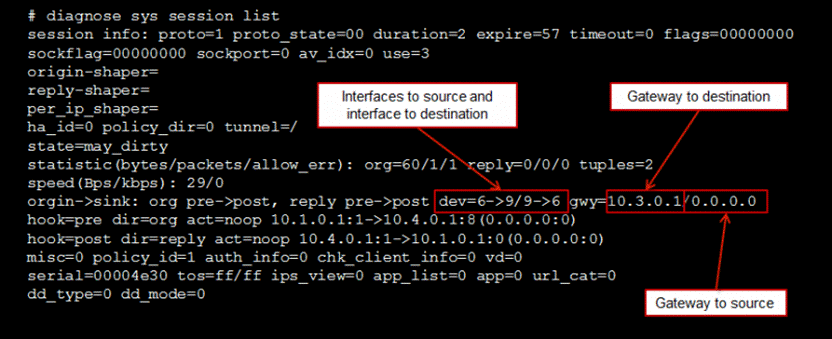
Why is the gateway to source for this session 0.0.0.0?
- A . The traffic for this session is ICMP.
- B . The the source of the traffic is directly connected to the FortiGate.
- C . The FortiGate is not doing NAT over this traffic.
- D . FortiGate has only seen the first packet sent by the originator.
Why does the ISDB block layers 3 and 4 of the OSI model when applying content filtering? (Choose two.)
- A . FortiGate has a predefined list of all IPs and ports for specific applications downloaded from FortiGuard.
- B . The ISDB blocks the IP addresses and ports of an application predefined by FortiGuard.
- C . The ISDB works in proxy mode, allowing the analysis of packets in layers 3 and 4 of the OSI model.
- D . The ISDB limits access by URL and domain.
A B
Explanation:
TheInternet Service Database (ISDB)in FortiGate is used to enforce content filtering atLayer 3 (Network Layer) and Layer 4 (Transport Layer) of the OSI model by identifying applications based on their predefined IP addresses and ports.
FortiGate has a predefined list of all IPs and ports for specific applications downloaded from
FortiGuard:
# FortiGate retrieves and updates apredefined listof IPs and ports for different internet services from FortiGuard.
# This allows FortiGate to block specific services atLayer 3 and Layer 4without requiring deep packet inspection.
The ISDB blocks the IP addresses and ports of an application predefined by FortiGuard:
# ISDB works by matching traffic to knownIP addresses and portsof categorized services.
# When an application or service is blocked, FortiGate prevents communication bydenying traffic based on its destination IP and port number.
Refer to the exhibit, which contains a CLI script configuration on FortiManager.
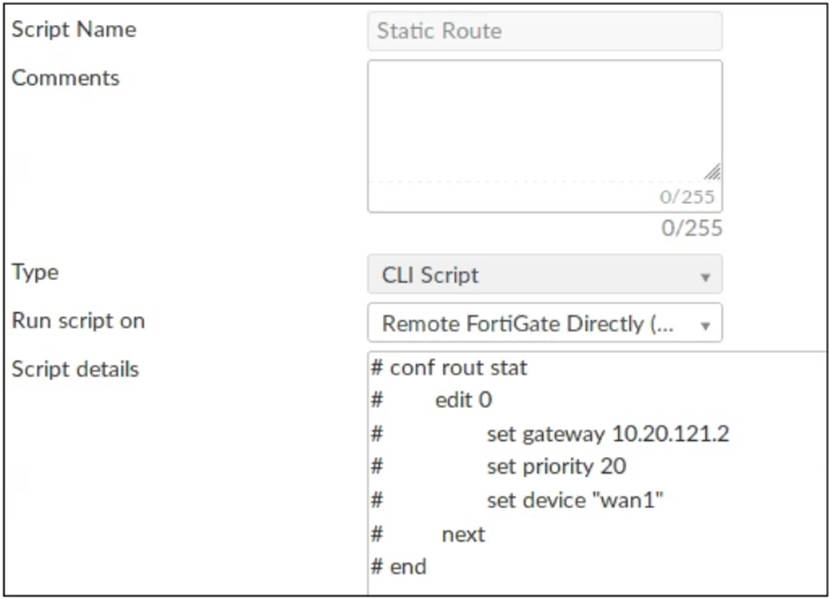
An administrator configured the CLI script on FortiManager, but the script failed to apply any changes to the managed device after being executed.
What are two reasons why the script did not make any changes to the managed device? (Choose two.)
- A . Static routes can be added using only TCL scripts.
- B . The commands that start with the # sign did not run.
- C . CLI scripts must start with #!.
- D . Incomplete commands can cause CLI scripts to fail.
Which of the following tasks are part of the manual registration process for adding a FortiGate to a FortiManager for central management? (Choose three.)
- A . Wait for the rating databases to download on FortiManager.
- B . In the FortiManager, add the unregistered FortiGate.
- C . Import the policy package from the managed FortiGate.
- D . Start the rating services on FortiManager.
- E . Add the FortiManager IP address to the FortiGate’s central management configuration.
An administrator is configuring ADVPN in a hub-and-spoke topology. The administrator will use IBGP to route traffic between the VPN sites.
Which IBGP setting needs to be enabled on the hub, for dynamic routing to work properly for on-demand tunnels?
- A . route-reflector-client
- B . next-hop-self
- C . route-server-client
- D . ibgp-multipath
A static route is configured for a FortiGate unit from the CLI using the following commands.
config router static
edit 1
set device "wan1"
set distance 20
set gateway 192.168.100.1
next
end
Which of the following conditions are required for this static default route to be displayed in the FortiGate unit’s routing table? (Choose two.)
- A . The administrative status of the wan1 interface is displayed as down.
- B . The link status of the wan1 interface is displayed as up.
- C . All other default routes should have a lower distance.
- D . The wan1 interface address and gateway address are on the same subnet.