
DELL EMC D-PE-OE-23 Practice Exams
Last updated on Oct 24,2026- Exam Code: D-PE-OE-23
- Exam Name: Dell Technologies PowerEdge Operate 2023
- Certification Provider: DELL EMC
- Latest update: Oct 24,2026
A server has two power supply units (PSUs) in a redundant configuration. One power supply unit fails. A technician replaces the failed PSU, but the server does NOT return to redundant power mode.
What is the cause of this issue?
- A . The new PSU has a different wattage than the existing PSU.
- B . The server has NOT been Power Cycles to bring the new PSU online.
- C . The power redundant options is disabled in the System Setup Utility.
- D . Both PSUs were NOT replaced at the same time.
A technician receives an email alert that one of the drives on a server has failed. Upon replacing the bad drive, they receive a second email alert that the same drive has failed. The technician installs the replacement drive in another server and it works correctly.
What is a valid troubleshooting step for this issue?
- A . Perform a full initialization on the replacement drive
- B . Check if the cables are properly seated to the backplane
- C . Recreate the RAID array
- D . Replace the PERC
Which three components do Dell PowerEdge Servers leverage to maximize Al workload throughput? (Select 3)
- A . DPU
- B . ASIC
- C . FPGA
- D . GPU
- E . CPU
C, D, E
Explanation:
Understanding Components that Maximize AI Workload Throughput in Dell PowerEdge Servers Server Components (26%)
Explain how expansion cards are connected and the features of the GPU, NDC, LOM, and OCP options Define the different processor, memory options, and memory configurations
Overview
Dell PowerEdge servers are designed to handle demanding workloads, including Artificial Intelligence (AI) applications. To maximize AI workload throughput, these servers leverage specific components that enhance computational capabilities and data processing efficiency. Components that Maximize AI Workload Throughput CPU (Central Processing Unit)
The CPU is the primary processor in a server, responsible for executing general computing tasks. In AI workloads, CPUs handle tasks that require complex logic and sequential processing.
Features in Dell PowerEdge Servers:
High core counts for parallel processing.
Support for advanced instruction sets optimized for AI computations. Multi-threading capabilities to handle multiple processes simultaneously. GPU (Graphics Processing Unit)
GPUs are specialized processors designed to handle parallel processing tasks efficiently. They excel in performing the matrix and vector operations common in AI algorithms, such as deep learning and neural networks.
Features in Dell PowerEdge Servers:
Integration of high-performance GPUs from leading vendors like NVIDIA.
Support for multiple GPUs in a single server to scale performance.
High memory bandwidth to handle large datasets.
FPGA (Field-Programmable Gate Array)
FPGAs are integrated circuits that can be configured by the customer or designer after manufacturing. They offer customizable hardware acceleration for specific tasks, making them suitable for specialized AI applications.
Features in Dell PowerEdge Servers:
Ability to offload specific AI algorithms for faster processing.
Reconfigurable to adapt to different AI models or workloads.
Lower latency compared to general-purpose processors.
Evaluation of Options
Option A: DPU (Data Processing Unit)
DPUs are specialized processors designed to offload networking and storage tasks from the CPU. While beneficial for certain workloads, they are not primarily used to maximize AI workload throughput in Dell PowerEdge servers.
Conclusion: Not one of the primary components leveraged for AI workloads.
Option B: ASIC (Application-Specific Integrated Circuit)
ASICs are custom-designed chips optimized for a particular application. While they can be used in AI applications, they are not commonly leveraged in Dell PowerEdge servers for AI workload throughput.
Conclusion: Not a standard component in Dell PowerEdge servers for AI workloads.
Option C: FPGA
Correct Answer. FPGAs are leveraged in Dell PowerEdge servers to accelerate AI workloads through hardware customization.
Option D: GPU
Correct Answer. GPUs are extensively used in Dell PowerEdge servers to maximize AI workload throughput due to their parallel processing capabilities.
Option E: CPU
Correct Answer. CPUs are fundamental components that, when combined with GPUs and FPGAs, contribute to maximizing AI workload throughput.
Dell Operate Reference
Server Components (26%):
Understanding how CPUs, GPUs, and FPGAs function and their roles in enhancing server performance for AI workloads is crucial.
Define the different processor, memory options, and memory configurations: Knowledge of CPU capabilities is essential.
Explain how expansion cards are connected and the features of the GPU, NDC, LOM, and OCP options: Understanding GPU and FPGA integration into servers.
Conclusion
Dell PowerEdge servers leverage CPUs, GPUs, and FPGAs to maximize AI workload throughput. These components work together to provide the necessary computational power and efficiency required for demanding AI applications.
A technician needs to change the iDRAC password on a Dell EMC PowerEdge 14G server in a lights-out datacenter. The be rebooted because it is in production. The iDRAC is configured with the default credentials.
How could the technician change the iDRAC password?
- A . SupportAssist Enterprise
- B . iDRAC Web GUI
- C . OpenManage Server Administrator
- D . Virtual Console; press F2 after rebooting system
Which front disk chassis option is available in a Dell EMC PowerEdge R740 server?
- A . 4x 3.5" drives
- B . 8x 3.5" drives
- C . 12x 2.5" drives
- D . 24x 2.5" drives
Starting from which Dell EMC PowerEdge server hardware generation is the Micro SD card in the IDSDM/vFlash module supported?
- A . 11G
- B . 12G
- C . 13G
- D . 14G
Exhibit.
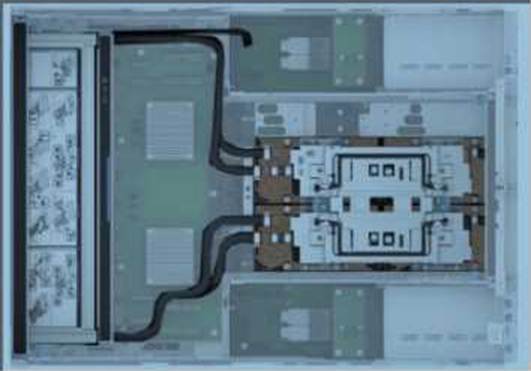
Which two components are displayed in the image? (Select 2)
- A . Power cables
- B . Paddle card
- C . Cold plates
- D . Leak sensor
BC
Explanation:
Identifying Components in the Exhibit
Server Components (26%)
Identify power options and redundancy features, thermal features, and liquid cooling
Analyzing the Image
From the image, the following two components are displayed:
Cold Plates
Cold plates are a key component of liquid cooling systems used in modern servers to dissipate heat from high-performance components like CPUs and GPUs.
The image shows two prominent cooling structures, which are indicative of cold plates mounted over
processors for efficient heat transfer.
Conclusion: Correct Answer.
Paddle Card
Paddle cards are connectors or adapters used to interface between various server components or facilitate cable management.
In this image, the paddle card can be seen as part of the interconnect between the cooling system or
main components.
Conclusion: Correct Answer.
Explanation of Other Options
Option A: Power cables
Analysis: There are no visible power cables in the image. The black tubes seen in the image are more likely part of the liquid cooling system, not power cables. Conclusion: Incorrect.
Option D: Leak sensor
Analysis: Leak sensors are used in liquid cooling systems to detect leaks, but there are no visible sensors or specific indicators of leak detection in the image. Conclusion: Incorrect.
Dell Operate Reference
Server Components (26%)
Define power and thermal options: Recognizing cooling components like cold plates is essential for understanding server cooling solutions.
Explain expansion cards and their functions: Understanding the purpose of paddle cards helps in identifying how components connect and function in the server.
Conclusion
The components visible in the image are Cold Plates and Paddle Cards. These are essential parts of the server’s cooling and connectivity systems.
A technician is ready to deploy a server. If a critical part such as the system board fails, they must be able to replace the system board, reconfigure components, and update the firmware revisions in the fastest possible time.
How should the technician meet this requirement?
- A . Back up the profile using the System Profile Settings
- B . Use the iDRAC Rollback feature to restore the firmware revisions
- C . Use the iDRAC GUI to back up the Server Profile
- D . Back up component configurations using iSM
Case Study 3
A financial services company has file sharing workflows and 2000 home directories which include 70% Microsoft Windows and 30% Linux. The Security team is also interested in credit card usage data analytics such as point of sale, geolocation, and authorization and transaction data. Home directories and file shares do not require D@RE or SEC compliance.
However, due to the sensitivity of the credit card data, the company requires D@RE for credit card information and must adhere to the U.S. SEC 17a-4(f) compliance standards. Additionally, they are interested in auditing user access and anti-virus features.
The compute and storage environment consists of the following:
– 200 TB of Fibre Channel drives on NetApp ONTAP 7
– Environment is expected to grow 200 TB over the next three years
Which combined solution addresses the company’s requirement for D@RE and U.S.SEC 17a-4(f)?
- A . All Flash and SmartLock Compliance mode
- B . SmartLock Enterprise mode and STIG
- C . SED and SmartLock Enterprise mode
- D . SED and SmartLock Compliance mode
A new Dell EMC PowerEdge server will be deployed in a branch office that does not have a good server cooling system. A Dell EMC Fresh Air system that can handle operating temperatures up to 45° C will be used.
What is required for the Fresh Air system to operate correctly?
- A . M.2/BOSS module
- B . NVDIMM memory
- C . Redundant PSU configuration
- D . PCIe SSD/NVMe drive module