
Databricks Databricks Machine Learning Associate Practice Exams
Last updated on Oct 21,2026- Exam Code: Databricks Machine Learning Associate
- Exam Name: Databricks Certified Machine Learning Associate Exam
- Certification Provider: Databricks
- Latest update: Oct 21,2026
A data scientist is using Spark SQL to import their data into a machine learning pipeline. Once the data is imported, the data scientist performs machine learning tasks using Spark ML.
Which of the following compute tools is best suited for this use case?
- A . Single Node cluster
- B . Standard cluster
- C . SQL Warehouse
- D . None of these compute tools support this task
A data scientist is performing hyperparameter tuning using an iterative optimization algorithm. Each evaluation of unique hyperparameter values is being trained on a single compute node. They are performing eight total evaluations across eight total compute nodes. While the accuracy of the model does vary over the eight evaluations, they notice there is no trend of improvement in the accuracy. The data scientist believes this is due to the parallelization of the tuning process.
Which change could the data scientist make to improve their model accuracy over the course of their tuning process?
- A . Change the number of compute nodes to be half or less than half of the number of evaluations.
- B . Change the number of compute nodes and the number of evaluations to be much larger but equal.
- C . Change the iterative optimization algorithm used to facilitate the tuning process.
- D . Change the number of compute nodes to be double or more than double the number of evaluations.
A data scientist is developing a single-node machine learning model. They have a large number of model configurations to test as a part of their experiment. As a result, the model tuning process takes too long to complete.
Which of the following approaches can be used to speed up the model tuning process?
- A . Implement MLflow Experiment Tracking
- B . Scale up with Spark ML
- C . Enable autoscaling clusters
- D . Parallelize with Hyperopt
A data scientist wants to use Spark ML to one-hot encode the categorical features in their PySpark DataFrame features_df. A list of the names of the string columns is assigned to the input_columns variable.
They have developed this code block to accomplish this task:
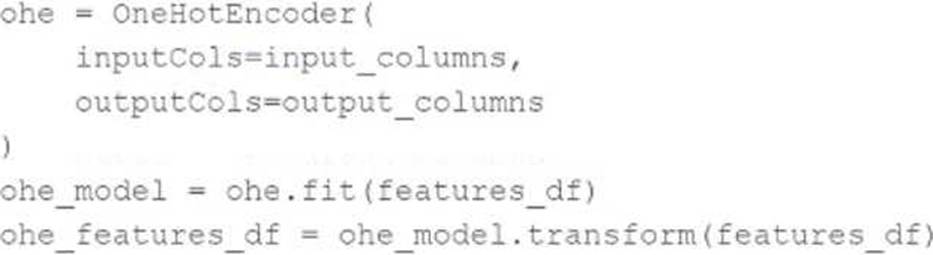
The code block is returning an error.
Which of the following adjustments does the data scientist need to make to accomplish this task?
- A . They need to specify the method parameter to the OneHotEncoder.
- B . They need to remove the line with the fit operation.
- C . They need to use Stringlndexer prior to one-hot encodinq the features.
- D . They need to use VectorAssembler prior to one-hot encoding the features.
Which approach can preserve information about the original state of data when imputing missing values?
- A . Using mean instead of median
- B . Removing variables with missing data
- C . Creating a binary indicator for imputed values
- D . A, B, and C
Which of the following tools can be used to distribute large-scale feature engineering without the use of a UDF or pandas Function API for machine learning pipelines?
- A . Keras
- B . Scikit-learn
- C . PyTorch
- D . Spark ML
A data scientist learned during their training to always use 5-fold cross-validation in their model development workflow. A colleague suggests that there are cases where a train-validation split could be preferred over k-fold cross-validation when k > 2.
Which of the following describes a potential benefit of using a train-validation split over k-fold cross-validation in this scenario?
- A . A holdout set is not necessary when using a train-validation split
- B . Reproducibility is achievable when using a train-validation split
- C . Fewer hyperparameter values need to be tested when using a train-validation split
- D . Bias is avoidable when using a train-validation split
- E . Fewer models need to be trained when using a train-validation split
A data scientist has produced two models for a single machine learning problem. One of the models performs well when one of the features has a value of less than 5, and the other model performs well when the value of that feature is greater than or equal to 5. The data scientist decides to combine the two models into a single machine learning solution.
Which of the following terms is used to describe this combination of models?
- A . Bootstrap aggregation
- B . Support vector machines
- C . Bucketing
- D . Ensemble learning
- E . Stacking
A data scientist wants to use Spark ML to impute missing values in their PySpark DataFrame features_df. They want to replace missing values in all numeric columns in features_df with each respective numeric column’s median value.
They have developed the following code block to accomplish this task:
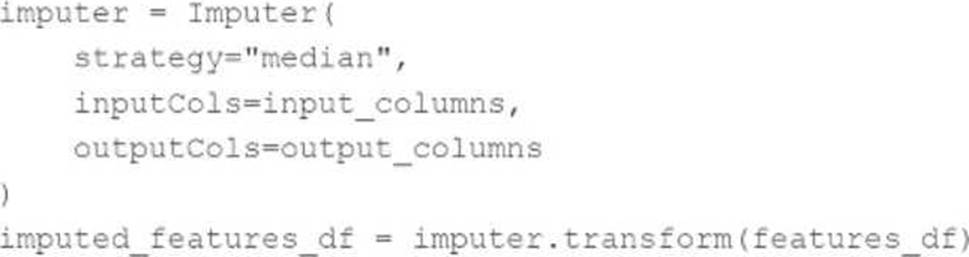
The code block is not accomplishing the task.
Which reasons describes why the code block is not accomplishing the imputation task?
- A . It does not impute both the training and test data sets.
- B . The inputCols and outputCols need to be exactly the same.
- C . The fit method needs to be called instead of transform.
- D . It does not fit the imputer on the data to create an ImputerModel.
In which of the following situations is it preferable to impute missing feature values with their median value over the mean value?
- A . When the features are of the categorical type
- B . When the features are of the boolean type
- C . When the features contain a lot of extreme outliers
- D . When the features contain no outliers
- E . When the features contain no missing no values