
Databricks Databricks Certified Data Engineer Professional Practice Exams
Last updated on Oct 22,2026- Exam Code: Databricks Certified Data Engineer Professional
- Exam Name: Databricks Certified Data Engineer Professional Exam
- Certification Provider: Databricks
- Latest update: Oct 22,2026
A table in the Lakehouse named customer_churn_params is used in churn prediction by the machine learning team. The table contains information about customers derived from a number of upstream sources. Currently, the data engineering team populates this table nightly by overwriting the table with the current valid values derived from upstream data sources.
The churn prediction model used by the ML team is fairly stable in production. The team is only interested in making predictions on records that have changed in the past 24 hours.
Which approach would simplify the identification of these changed records?
- A . Apply the churn model to all rows in the customer_churn_params table, but implement logic to perform an upsert into the predictions table that ignores rows where predictions have not changed.
- B . Convert the batch job to a Structured Streaming job using the complete output mode; configure a Structured Streaming job to read from the customer_churn_params table and incrementally predict against the churn model.
- C . Calculate the difference between the previous model predictions and the current
customer_churn_params on a key identifying unique customers before making new predictions; only make predictions on those customers not in the previous predictions. - D . Modify the overwrite logic to include a field populated by calling
spark.sql.functions.current_timestamp() as data are being written; use this field to identify records written on a particular date. - E . Replace the current overwrite logic with a merge statement to modify only those records that have changed; write logic to make predictions on the changed records identified by the change data feed.
An upstream source writes Parquet data as hourly batches to directories named with the current date.
A nightly batch job runs the following code to ingest all data from the previous day as indicated by the date variable:
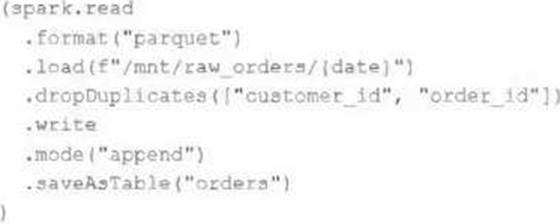
Assume that the fields customer_id and order_id serve as a composite key to uniquely identify each order.
If the upstream system is known to occasionally produce duplicate entries for a single order hours apart, which statement is correct?
- A . Each write to the orders table will only contain unique records, and only those records without duplicates in the target table will be written.
- B . Each write to the orders table will only contain unique records, but newly written records may have duplicates already present in the target table.
- C . Each write to the orders table will only contain unique records; if existing records with the same key are present in the target table, these records will be overwritten.
- D . Each write to the orders table will only contain unique records; if existing records with the same key are present in the target table, the operation will tail.
- E . Each write to the orders table will run deduplication over the union of new and existing records,
ensuring no duplicate records are present.
A small company based in the United States has recently contracted a consulting firm in India to implement several new data engineering pipelines to power artificial intelligence applications. All the company’s data is stored in regional cloud storage in the United States.
The workspace administrator at the company is uncertain about where the Databricks workspace used by the contractors should be deployed.
Assuming that all data governance considerations are accounted for, which statement accurately informs this decision?
- A . Databricks runs HDFS on cloud volume storage; as such, cloud virtual machines must be deployed in the region where the data is stored.
- B . Databricks workspaces do not rely on any regional infrastructure; as such, the decision should be made based upon what is most convenient for the workspace administrator.
- C . Cross-region reads and writes can incur significant costs and latency; whenever possible, compute should be deployed in the same region the data is stored.
- D . Databricks leverages user workstations as the driver during interactive development; as such, users should always use a workspace deployed in a region they are physically near.
- E . Databricks notebooks send all executable code from the user’s browser to virtual machines over the open internet; whenever possible, choosing a workspace region near the end users is the most secure.
The data architect has mandated that all tables in the Lakehouse should be configured as external Delta Lake tables.
Which approach will ensure that this requirement is met?
- A . Whenever a database is being created, make sure that the location keyword is used
- B . When configuring an external data warehouse for all table storage. leverage Databricks for all ELT.
- C . Whenever a table is being created, make sure that the location keyword is used.
- D . When tables are created, make sure that the external keyword is used in the create table statement.
- E . When the workspace is being configured, make sure that external cloud object storage has been mounted.
The data engineering team maintains a table of aggregate statistics through batch nightly updates. This includes total sales for the previous day alongside totals and averages for a variety of time periods including the 7 previous days, year-to-date, and quarter-to-date.
This table is named store_saies_summary and the schema is as follows:
The table daily_store_sales contains all the information needed to update store_sales_summary.
The schema for this table is:
store_id INT, sales_date DATE, total_sales FLOAT
If daily_store_sales is implemented as a Type 1 table and the total_sales column might be adjusted after manual data auditing, which approach is the safest to generate accurate reports in the store_sales_summary table?
- A . Implement the appropriate aggregate logic as a batch read against the daily_store_sales table and overwrite the store_sales_summary table with each Update.
- B . Implement the appropriate aggregate logic as a batch read against the daily_store_sales table and append new rows nightly to the store_sales_summary table.
- C . Implement the appropriate aggregate logic as a batch read against the daily_store_sales table and use upsert logic to update results in the store_sales_summary table.
- D . Implement the appropriate aggregate logic as a Structured Streaming read against the daily_store_sales table and use upsert logic to update results in the store_sales_summary table.
- E . Use Structured Streaming to subscribe to the change data feed for daily_store_sales and apply changes to the aggregates in the store_sales_summary table with each update.
When scheduling Structured Streaming jobs for production, which configuration automatically recovers from query failures and keeps costs low?
- A . Cluster: New Job Cluster;
Retries: Unlimited;
Maximum Concurrent Runs: Unlimited - B . Cluster: New Job Cluster;
Retries: None;
Maximum Concurrent Runs: 1 - C . Cluster: Existing All-Purpose Cluster; Retries: Unlimited;
Maximum Concurrent Runs: 1 - D . Cluster: Existing All-Purpose Cluster; Retries: Unlimited;
Maximum Concurrent Runs: 1 - E . Cluster: Existing All-Purpose Cluster; Retries: None;
Maximum Concurrent Runs: 1
A junior data engineer is working to implement logic for a Lakehouse table named silver_device_recordings. The source data contains 100 unique fields in a highly nested JSON structure.
The silver_device_recordings table will be used downstream for highly selective joins on a number of fields, and will also be leveraged by the machine learning team to filter on a handful of relevant fields, in total, 15 fields have been identified that will often be used for filter and join logic.
The data engineer is trying to determine the best approach for dealing with these nested fields before declaring the table schema.
Which of the following accurately presents information about Delta Lake and Databricks that may Impact their decision-making process?
- A . Because Delta Lake uses Parquet for data storage, Dremel encoding information for nesting can be directly referenced by the Delta transaction log.
- B . Tungsten encoding used by Databricks is optimized for storing string data: newly-added native support for querying JSON strings means that string types are always most efficient.
- C . Schema inference and evolution on Databricks ensure that inferred types will always accurately match the data types used by downstream systems.
- D . By default Delta Lake collects statistics on the first 32 columns in a table; these statistics are leveraged for data skipping when executing selective queries.