
CompTIA SY0-701 Practice Exams
Last updated on Nov 16,2026- Exam Code: SY0-701
- Exam Name: CompTIA Security+
- Certification Provider: CompTIA
- Latest update: Nov 16,2026
Which of the following explains why an attacker cannot easily decrypt passwords using a rainbow table attack?
- A . Digital signatures
- B . Salting
- C . Hashing
- D . Perfect forward secrecy
B
Explanation:
Salting is a technique used to enhance the security of hashed passwords by adding a unique, random value (salt) to each password before hashing it. This prevents attackers from easily decrypting passwords using rainbow tables, which are precomputed tables for reversing cryptographic hash functions. Since each password has a unique salt, the same password will produce different hash values, making rainbow table attacks ineffective.
Reference =
CompTIA Security+ SY0-701 Course Content: Domain 04 Security Operations.
CompTIA Security+ SY0-601 Study Guide: Chapter on Cryptography and Hashing Techniques.
An enterprise has been experiencing attacks focused on exploiting vulnerabilities in older browser versions with well-known exploits.
Which of the following security solutions should be configured to best provide the ability to monitor and block these known signature-based attacks?
- A . ACL
- B . DLP
- C . IDS
- D . IPS
D
Explanation:
An intrusion prevention system (IPS) is a security device that monitors network traffic and blocks or modifies malicious packets based on predefined rules or signatures. An IPS can prevent attacks that exploit known vulnerabilities in older browser versions by detecting and dropping the malicious packets before they reach the target system. An IPS can also perform other functions, such as rate limiting, encryption, or redirection.
Reference: CompTIA Security+ Study Guide: Exam SY0-701, 9th Edition, Chapter 3: Securing Networks, page 132.
Which of the following most accurately describes the order in which a security engineer should implement secure baselines?
- A . Deploy, maintain, establish
- B . Establish, maintain, deploy
- C . Establish, deploy, maintain
- D . Deploy, establish, maintain
C
Explanation:
Detailed The correct sequence is to first establish secure baselines by determining the required configurations, deploy those configurations across systems, and finally maintain the configurations through regular updates and auditing.
Reference: CompTIA Security+ SY0-701 Study Guide, Domain 4: Security Operations, Section: "Secure Baseline Development".
Which of the following is the primary purpose of a service that tracks log-ins and time spent using the service?
- A . Availability
- B . Accounting
- C . Authentication
- D . Authorization
B
Explanation:
Accounting logs user activities such as log-ins and usage duration, which is part of the AAA framework (Authentication, Authorization, and Accounting).
A client demands at least 99.99% uptime from a service provider’s hosted security services.
Which of the following documents includes the information the service provider should return to the client?
- A . MOA
- B . SOW
- C . MOU
- D . SLA
D
Explanation:
A service level agreement (SLA) is a document that defines the level of service expected by a customer from a service provider, indicating the metrics by which that service is measured, and the remedies or penalties, if any, should the agreed-upon levels not be achieved. An SLA can specify the minimum uptime or availability of a service, such as 99.99%, and the consequences for failing to meet that standard. A memorandum of agreement (MOA), a statement of work (SOW), and a memorandum of understanding (MOU) are other types of documents that can be used to establish a relationship between parties, but they do not typically include the details of service levels and performance metrics that an SLA does.
Reference: CompTIA Security+ Study Guide: Exam SY0-701, 9th Edition, page 16-17
A company is concerned about weather events causing damage to the server room and downtime.
Which of the following should the company consider?
- A . Clustering servers
- B . Geographic dispersion
- C . Load balancers
- D . Off-site backups
B
Explanation:
Geographic dispersion is a strategy that involves distributing the servers or data centers across different geographic locations. Geographic dispersion can help the company to mitigate the risk of weather events causing damage to the server room and downtime, as well as improve the availability, performance, and resilience of the network. Geographic dispersion can also enhance the disaster recovery and business continuity capabilities of the company, as it can provide backup and failover options in case of a regional outage or disruption12.
The other options are not the best ways to address the company’s concern:
Clustering servers: This is a technique that involves grouping multiple servers together to act as a single system. Clustering servers can help to improve the performance, scalability, and fault tolerance of the network, but it does not protect the servers from physical damage or downtime caused by weather events, especially if the servers are located in the same room or building3.
Load balancers: These are devices or software that distribute the network traffic or workload among multiple servers or resources. Load balancers can help to optimize the utilization, efficiency, and reliability of the network, but they do not prevent the servers from being damaged or disrupted by weather events, especially if the servers are located in the same room or building4.
Off-site backups: These are copies of data or files that are stored in a different location than the original source. Off-site backups can help to protect the data from being lost or corrupted by weather events, but they do not prevent the servers from being damaged or disrupted by weather events, nor do they ensure the availability or continuity of the network services.
Reference = 1: CompTIA Security+ SY0-701 Certification Study Guide, page 972: High Availability C CompTIA Security+ SY0-701 C 3.4, video by Professor Messer3: CompTIA Security+ SY0-701 Certification Study Guide, page 984: CompTIA Security+ SY0-701 Certification Study Guide, page 99. : CompTIA Security+ SY0-701 Certification Study Guide, page 100.
A customer has a contract with a CSP and wants to identify which controls should be implemented in the IaaS enclave.
Which of the following is most likely to contain this information?
- A . Statement of work
- B . Responsibility matrix
- C . Service-level agreement
- D . Master service agreement
B
Explanation:
A responsibility matrix clarifies the division of responsibilities between the cloud service provider (CSP) and the customer, ensuring that each party understands and implements their respective security controls.
Reference: Security+ SY0-701 Course Content.
Which of the following scenarios describes a possible business email compromise attack?
- A . An employee receives a gift card request in an email that has an executive’s name in the display field of the email.
- B . Employees who open an email attachment receive messages demanding payment in order to access files.
- C . A service desk employee receives an email from the HR director asking for log-in credentials to a cloud administrator account.
- D . An employee receives an email with a link to a phishing site that is designed to look like the company’s email portal.
A
Explanation:
A business email compromise (BEC) attack is a type of phishing attack that targets employees who have access to company funds or sensitive information. The attacker impersonates a trusted person, such as an executive, a vendor, or a client, and requests a fraudulent payment, a wire transfer, or confidential data. The attacker often uses social engineering techniques, such as urgency, pressure, or familiarity, to convince the victim to comply with the request12.
In this scenario, option A describes a possible BEC attack, where an employee receives a gift card request in an email that has an executive’s name in the display field of the email. The email may look like it is coming from the executive, but the actual email address may be spoofed or compromised. The attacker may claim that the gift cards are needed for a business purpose, such as rewarding employees or clients, and ask the employee to purchase them and send the codes. This is a common tactic used by BEC attackers to steal money from unsuspecting victims34.
Option B describes a possible ransomware attack, where malicious software encrypts the files on a device and demands a ransom for the decryption key. Option C describes a possible credential harvesting attack, where an attacker tries to obtain the login information of a privileged account by posing as a legitimate authority. Option D describes a possible phishing attack, where an attacker tries to lure the victim to a fake website that mimics the company’s email portal and capture their credentials. These are all types of cyberattacks, but they are not examples of BEC
attacks.
Reference = 1: Business Email Compromise – CompTIA Security+ SY0-701 – 2.2 2: CompTIA
Security+ SY0-701 Certification Study Guide 3: Business Email Compromise: The 12 Billion Dollar
Scam 4: TOTAL: CompTIA Security+ Cert (SY0-701) | Udemy
Which of the following threat actors is the most likely to use large financial resources to attack critical systems located in other countries?
- A . Insider
- B . Unskilled attacker
- C . Nation-state
- D . Hacktivist
C
Explanation:
A nation-state is a threat actor that is sponsored by a government or a political entity to conduct cyberattacks against other countries or organizations. Nation-states have large financial resources, advanced technical skills, and strategic objectives that may target critical systems such as military, energy, or infrastructure. Nation-states are often motivated by espionage, sabotage, or warfare12.
Reference = 1: CompTIA Security+ SY0-701 Certification Study Guide, page 542: Threat Actors C CompTIA Security+ SY0-701 C 2.1, video by Professor Messer.
A security analyst finds a rogue device during a monthly audit of current endpoint assets that are connected to the network. The corporate network utilizes 002.1X for access control. To be allowed on the network, a device must have a Known hardware address, and a valid user name and password must be entered in a captive portal.
The following is the audit report:
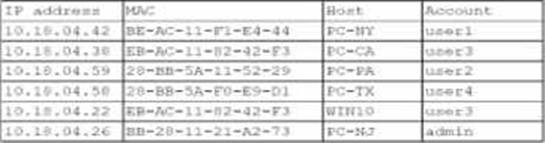
Which of the following is the most likely way a rogue device was allowed to connect?
- A . A user performed a MAC cloning attack with a personal device.
- B . A DMCP failure caused an incorrect IP address to be distributed
- C . An administrator bypassed the security controls for testing.
- D . DNS hijacking let an attacker intercept the captive portal traffic.
A
Explanation:
The most likely way a rogue device was able to connect to the network is through a MAC cloning attack. In this attack, a personal device copies the MAC address of an authorized device, bypassing the 802.1X access control that relies on known hardware addresses for network access. The matching MAC addresses in the audit report suggest that this technique was used to gain unauthorized network access.
Reference =
CompTIA Security+ SY0-701 Course Content: Domain 03 Security Architecture.
CompTIA Security+ SY0-601 Study Guide: Chapter on Network Security and MAC Address Spoofing.