
CompTIA N10-009 Practice Exams
Last updated on Nov 16,2026- Exam Code: N10-009
- Exam Name: CompTIA Network+ Certification
- Certification Provider: CompTIA
- Latest update: Nov 16,2026
Which of the following is a characteristic of the application layer?
- A . It relies upon other layers for packet delivery.OB. It checks independently for packet loss.
- B . It encrypts data in transit.
- C . It performs address translation.
A
Explanation:
Introduction to OSI Model:
The OSI model is a conceptual framework used to understand network interactions in seven layers:
Physical, Data Link, Network, Transport, Session, Presentation, and Application.
Application Layer:
The application layer (Layer 7) is the topmost layer in the OSI model. It provides network services
directly to end-user applications. This layer facilitates communication between software applications
and lower layers of the network protocol stack.
Reliance on Other Layers:
The application layer relies on the transport layer (Layer 4) for data transfer across the network. The transport layer ensures reliable data delivery through protocols like TCP and UDP.
The network layer (Layer 3) is responsible for routing packets to their destination. The data link layer (Layer 2) handles node-to-node data transfer and error detection. The physical layer (Layer 1) deals with the physical connection between devices.
Explanation of the Options:
A company has observed increased user traffic to gambling websites and wants to limit this behavior on work computers.
Which of the following should the company most likely implement?
- A . ACLs
- B . Content filter
- C . Port security
- D . Screened subnet
B
Explanation:
Comprehensive and Detailed
A content filter blocks access to specific websites based on category, URL, or keywords. This is the best solution to restrict gambling websites.
Breakdown of Options:
As part of an attack, a threat actor purposefully overflows the content-addressable memory (CAM) table on a switch.
Which of the following types of attacks is this scenario an example of?
- A . ARP spoofing
- B . Evil twin
- C . MAC flooding
- D . DNS poisoning
C
Explanation:
Definition of MAC Flooding:
MAC flooding is an attack where a malicious actor sends numerous fake MAC addresses to a switch, overwhelming its CAM table. The CAM table stores MAC addresses and their associated ports for efficient traffic forwarding.
Impact of MAC Flooding:
CAM Table Overflow: When the CAM table is full, the switch cannot learn new MAC addresses and is forced to broadcast traffic to all ports, leading to a degraded network performance and potential data interception.
Switch Behavior: The switch operates in a fail-open mode, treating the network as a hub, which can be exploited for eavesdropping on traffic.
Comparison with Other Attacks:
ARP Spoofing: Involves sending false ARP (Address Resolution Protocol) messages to associate the attacker’s MAC address with the IP address of another device.
Evil Twin: Involves creating a rogue wireless access point that mimics a legitimate one to intercept data.
DNS Poisoning: Involves corrupting the DNS cache with false information to redirect traffic to malicious sites.
Preventive Measures:
Port Security: Configure port security on switches to limit the number of MAC addresses per port, preventing CAM table overflow.
Network Segmentation: Use VLANs to segment network traffic and limit the impact of such attacks.
Reference: CompTIA Network+ study materials on network security threats and mitigation techniques.
SIMULATION
You are tasked with verifying the following requirements are met in order to ensure network security.
Requirements:
Datacenter
Ensure network is subnetted to allow all devices to communicate properly while minimizing address space usage
Provide a dedicated server to resolve IP addresses and hostnames correctly and handle port 53 traffic Building A
Ensure network is subnetted to allow all devices to communicate properly while minimizing address space usage
Provide devices to support 5 additional different office users Add an additional mobile user
Replace the Telnet server with a more secure solution
Screened subnet
Ensure network is subnetted to allow all devices to communicate properly while minimizing address space usage
Provide a server to handle external 80/443 traffic
Provide a server to handle port 20/21 traffic
INSTRUCTIONS
Drag and drop objects onto the appropriate locations. Objects can be used multiple times and not all placeholders need to be filled.
Available objects are located in both the Servers and Devices tabs of the Drag & Drop menu.
If at any time you would like to bring back the initial state of the simulation, please click the Reset All button.
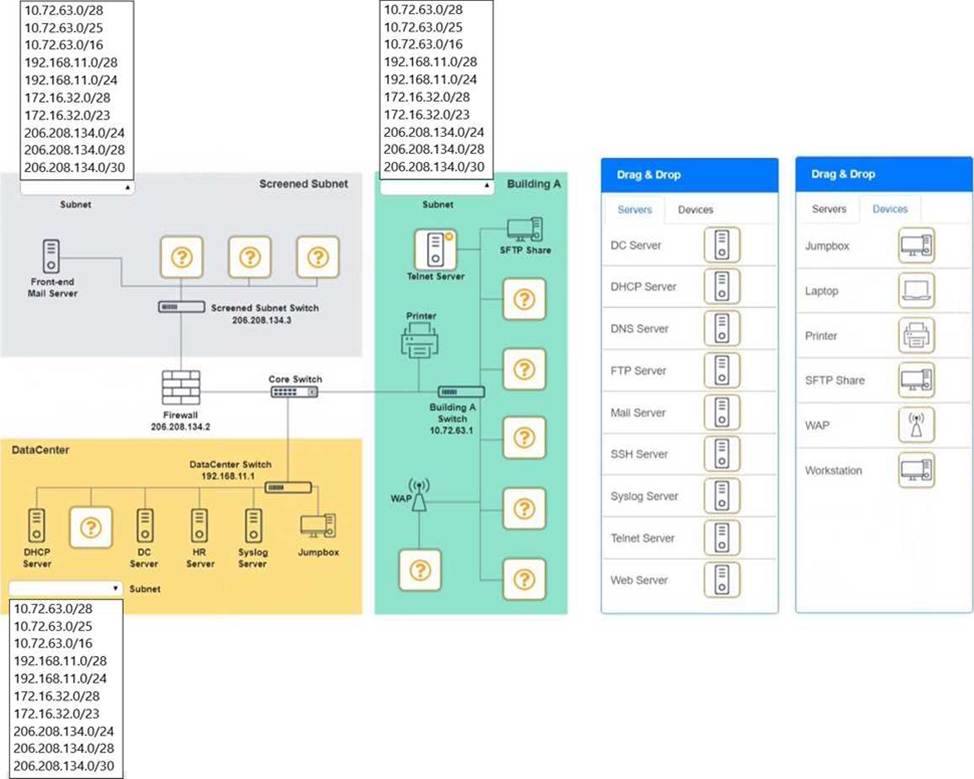
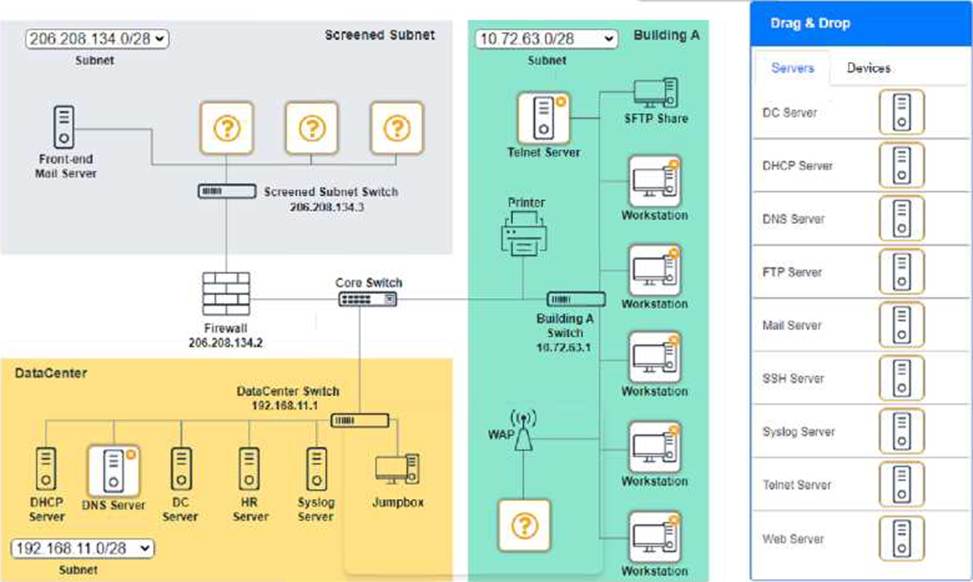
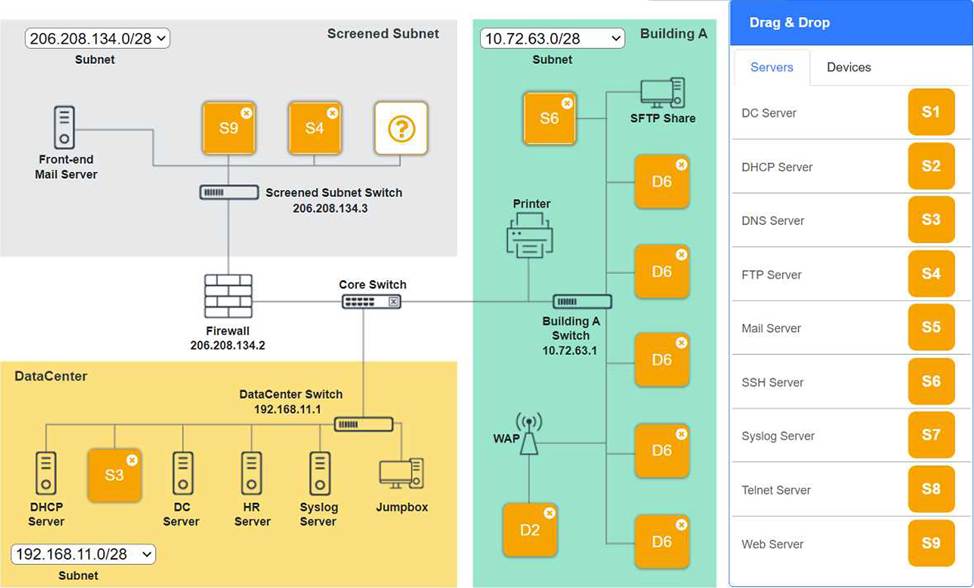
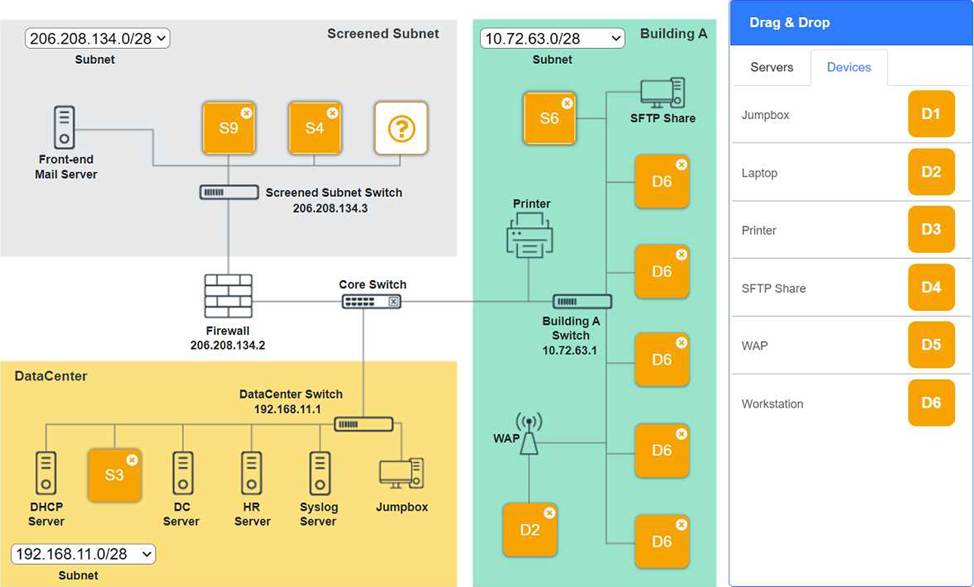
Building A devices C SSH server top left, workstations on all 5 on the right, laptop on bottom left DataCenter devices C DNS server.
SIMULATION
You are tasked with verifying the following requirements are met in order to ensure network security.
Requirements:
Datacenter
Ensure network is subnetted to allow all devices to communicate properly while minimizing address space usage
Provide a dedicated server to resolve IP addresses and hostnames correctly and handle port 53 traffic Building A
Ensure network is subnetted to allow all devices to communicate properly while minimizing address space usage
Provide devices to support 5 additional different office users Add an additional mobile user
Replace the Telnet server with a more secure solution
Screened subnet
Ensure network is subnetted to allow all devices to communicate properly while minimizing address space usage
Provide a server to handle external 80/443 traffic
Provide a server to handle port 20/21 traffic
INSTRUCTIONS
Drag and drop objects onto the appropriate locations. Objects can be used multiple times and not all placeholders need to be filled.
Available objects are located in both the Servers and Devices tabs of the Drag & Drop menu.
If at any time you would like to bring back the initial state of the simulation, please click the Reset All button.
Building A devices C SSH server top left, workstations on all 5 on the right, laptop on bottom left DataCenter devices C DNS server.
A network administrator is implementing security zones for each department.
Which of the following should the administrator use to accomplish this task?
- A . ACLs
- B . Port security
- C . Content filtering
- D . NAC
A
Explanation:
Understanding ACLs:
Access Control Lists (ACLs): A set of rules used to control network traffic and restrict access to network resources by filtering packets based on IP addresses, protocols, or ports. Implementing Security Zones:
Defining Zones: ACLs can be used to create security zones by applying specific rules to different departments, ensuring that only authorized traffic is allowed between these zones.
Control Traffic: ACLs control inbound and outbound traffic at network boundaries, enforcing security
policies and preventing unauthorized access.
Comparison with Other Options:
Port Security: Limits the number of devices that can connect to a switch port, preventing MAC address flooding attacks, but not used for defining security zones.
Content Filtering: Blocks or allows access to specific content based on predefined policies, typically used for web filtering rather than network segmentation.
NAC (Network Access Control): Controls access to the network based on the security posture of devices but does not define security zones.
Implementation Steps:
Define ACL rules based on the requirements of each department.
Apply these rules to the appropriate network interfaces or firewall policies to segment the network
into security zones.
Reference: CompTIA Network+ study materials on network security and access control methods.
Which of the following is most likely responsible for the security and handling of personal data in Europe?
- A . GDPR
- B . SCADA
- C . SAML
- D . PCI DSS
A
Explanation:
Definition of GDPR:
General Data Protection Regulation (GDPR) is a regulation in EU law on data protection and privacy for all individuals within the European Union and the European Economic Area. It also addresses the transfer of personal data outside the EU and EEA areas.
Scope and Objectives:
GDPR aims to give individuals control over their personal data and to simplify the regulatory environment for international business by unifying the regulation within the EU.
It enforces rules about data protection, requiring companies to protect the personal data and privacy of EU citizens for transactions that occur within EU member states.
Comparison with Other Options:
SCADA (Supervisory Control and Data Acquisition): Refers to control systems used in industrial and infrastructure processes, not related to personal data protection.
SAML (Security Assertion Markup Language): A standard for exchanging authentication and authorization data between parties, not specifically for personal data protection.
PCI DSS (Payment Card Industry Data Security Standard): A set of security standards designed to
ensure that all companies that accept, process, store or transmit credit card information maintain a secure environment, not specific to personal data protection in Europe. Key Provisions:
GDPR includes provisions for data processing, data subject rights, obligations of data controllers and
processors, and penalties for non-compliance.
Reference: CompTIA Network+ study materials on regulatory and compliance standards.
A network administrator is configuring a network for a new site that will have 150 users. Within the next year, the site is expected to grow by ten users. Each user will have two IP addresses (one for a computer and one for a phone).
Which of the following classful IPv4 address ranges will be best-suited for the network?
- A . Class D
- B . Class B
- C . Class A
- D . Class C
B
Explanation:
• The total number of devices = (150 + 10) users × 2 IPs per user = 320 devices
• Class C (D) supports a maximum of 254 hosts (2^8 – 2), which is too small.
• Class B (B) supports 65,534 hosts (2^16 – 2), making it the best choice.
• Why not the other options?
• Class A (C): Supports millions of addresses, which is overkill for 320 devices.
• Class D (A): Used for multicast, not for device addressing.
Reference: CompTIA Network+ (N10-009) Official Guide C Chapter 7: IP Addressing and Subnetting
Which of the following ports creates a secure connection to a directory service?
- A . 22
- B . 389
- C . 445
- D . 636
D
Explanation:
Comprehensive and Detailed
LDAP (Lightweight Directory Access Protocol) uses port 389 for standard connections and port 636 for LDAP over SSL (LDAPS), which secures directory service communication.
Breakdown of Options:
Which of the following ports is used for secure email?
- A . 25
- B . 110
- C . 143
- D . 587
D
Explanation:
Port 587 is used for secure email submission. This port is designated for message submission by mail clients to mail servers using the SMTP protocol, typically with STARTTLS for encryption.
Port 25: Traditionally used for SMTP relay, but not secure and often blocked by ISPs for outgoing mail due to spam concerns.
Port 110: Used for POP3 (Post Office Protocol version 3), not typically secured.
Port 143: Used for IMAP (Internet Message Access Protocol), which can be secured with STARTTLS or SSL/TLS.
Port 587: Specifically used for authenticated email submission (SMTP) with encryption, ensuring secure transmission of email from clients to servers. Network
Reference: CompTIA Network+ N10-007 Official Certification Guide: Discusses email protocols and ports, including secure email transmission.
Cisco Networking Academy: Provides training on securing email communications and the use of appropriate ports.
Network+ Certification All-in-One Exam Guide: Explains email protocols, ports, and security considerations for email transmission.