
CompTIA N10-009 Practice Exams
Last updated on Nov 16,2026- Exam Code: N10-009
- Exam Name: CompTIA Network+ Certification
- Certification Provider: CompTIA
- Latest update: Nov 16,2026
A network technician receives a new ticket while working on another issue. The new ticket is critical to business operations.
Which of the following documents should the technician reference to determine which ticket to complete first?
- A . NDA
- B . AUP
- C . SLA
- D . MOU
C
Explanation:
An SLA (Service Level Agreement) defines performance expectations, including response time, prioritization, and resolution time for services and support issues. It helps the technician determine which task has higher priority based on business impact.
Which of the following IP transmission types encrypts all of the transmitted data?
- A . ESP
- B . AH
- C . GRE
- D . UDP
- E . TCP
A
Explanation:
Definition of ESP (Encapsulating Security Payload):
ESP is a part of the IPsec protocol suite used to provide confidentiality, integrity, and authenticity of data. ESP encrypts the payload and optional ESP trailer, providing data confidentiality. ESP Functionality:
ESP can encrypt the entire IP packet, ensuring that the data within the packet is secure from interception or eavesdropping. It also provides options for data integrity and authentication.
ESP operates in two modes: transport mode (encrypts only the payload of the IP packet) and tunnel mode (encrypts the entire IP packet).
Comparison with Other Protocols:
AH (Authentication Header): Provides data integrity and authentication but does not encrypt the payload.
GRE (Generic Routing Encapsulation): A tunneling protocol that does not provide encryption.
UDP (User Datagram Protocol) and TCP (Transmission Control Protocol): These are transport layer protocols that do not inherently provide encryption. Encryption must be provided by additional protocols like TLS/SSL.
Use Cases:
ESP is widely used in VPNs (Virtual Private Networks) to ensure secure communication over untrusted networks like the internet.
Reference: CompTIA Network+ study materials on IPsec and encryption.
Which of the following IP transmission types encrypts all of the transmitted data?
- A . ESP
- B . AH
- C . GRE
- D . UDP
- E . TCP
A
Explanation:
Definition of ESP (Encapsulating Security Payload):
ESP is a part of the IPsec protocol suite used to provide confidentiality, integrity, and authenticity of data. ESP encrypts the payload and optional ESP trailer, providing data confidentiality. ESP Functionality:
ESP can encrypt the entire IP packet, ensuring that the data within the packet is secure from interception or eavesdropping. It also provides options for data integrity and authentication.
ESP operates in two modes: transport mode (encrypts only the payload of the IP packet) and tunnel mode (encrypts the entire IP packet).
Comparison with Other Protocols:
AH (Authentication Header): Provides data integrity and authentication but does not encrypt the payload.
GRE (Generic Routing Encapsulation): A tunneling protocol that does not provide encryption.
UDP (User Datagram Protocol) and TCP (Transmission Control Protocol): These are transport layer protocols that do not inherently provide encryption. Encryption must be provided by additional protocols like TLS/SSL.
Use Cases:
ESP is widely used in VPNs (Virtual Private Networks) to ensure secure communication over untrusted networks like the internet.
Reference: CompTIA Network+ study materials on IPsec and encryption.
A user’s desk has a workstation and an IP phone. The user is unable to browse the internet on the workstation, but the phone works.
Which of the following configurations is required?
- A . Voice VLAN
- B . Native VLAN
- C . Data VLAN
- D . Trunk port
C
Explanation:
If the IP phone works but the workstation doesn’t, it indicates that the Voice VLAN is functioning correctly, but the Data VLAN (C) is either misconfigured or missing. The workstation typically connects through the phone, which tags voice and data traffic separately using VLANs.
A network administrator is planning to host a company application in the cloud, making the application available for all internal and third-party users.
Which of the following concepts describes this arrangement?
- A . Multitenancy
- B . VPC
- C . NFV
- D . SaaS
A
Explanation:
Multitenancy is a cloud computing architecture where a single instance of software serves multiple customers or tenants. Each tenant’s data is isolated and remains invisible to other tenants. Hosting a company application in the cloud to be available for both internal and third-party users fits this concept, as it allows shared resources and infrastructure while maintaining data separation and security.
Reference: CompTIA Network+ Exam Objectives and official study guides.
A company experiences an incident involving a user who connects an unmanaged switch to the network.
Which of the following technologies should the company implement to help avoid similar
incidents without conducting an asset inventory?
- A . Screened subnet
- B . 802.1X
- C . MAC filtering
- D . Port security
D
Explanation:
Port security is a Layer 2 security feature that restricts the number of devices connecting to a network switch port. It helps prevent unauthorized devices, such as an unmanaged switch, from being connected to the network.
How Port Security Works:
Limits the number of MAC addresses that can connect to a port.
Can shut down or restrict the port if an unauthorized device is detected.
Prevents users from plugging in unauthorized networking equipment (e.g., unmanaged switches, hubs).
Incorrect Options:
A company recently rearranged some users’ workspaces and moved several users to previously used workspaces. The network administrator receives a report that all of the users who were moved are having connectivity issues.
Which of the following is the MOST likely reason?
- A . Ports are error-disabled.
- B . Ports have an incorrect native VLAN.
- C . Ports are having an MDIX issue.
- D . Ports are trunk ports.
B
Explanation:
The most likely cause is that the switch ports were previously configured for a different VLAN than the one the users’ computers are on. If the native VLAN on the port doesn’t match the end device’s VLAN, communication fails.
An employee in a corporate office clicks on a link in an email that was forwarded to them. The employee is redirected to a splash page that says the page is restricted.
Which of the following security solutions is most likely in place?
- A . DLP
- B . Captive portal
- C . Content filtering
- D . DNS sinkholing
C
Explanation:
Content filtering blocks access to restricted or malicious websites. When a user attempts to visit a site that violates company policies, they are redirected to a restriction page.
This is a common security measure to prevent employees from accessing phishing or malware-infected sites.
Content filters work by scanning URLs, keywords, or categories and blocking inappropriate or harmful content.
Option A (DLP – Data Loss Prevention): Focuses on preventing sensitive data leaks rather than blocking web access.
Option B (Captive portal): Used mainly in public Wi-Fi to authenticate users before granting access, not to restrict sites.
Option D (DNS sinkholing): Redirects malicious domain requests to a safe address but is not responsible for policy-based restrictions on general content.
Reference: CompTIA Network+ (N10-009) Official Study Guide C Section: Security Solutions
SIMULATION
After a recent power outage, users are reporting performance issues accessing the application servers. Wireless users are also reporting intermittent Internet issues.
INSTRUCTIONS
Click on each tab at the top of the screen. Select a widget to view information, then use the drop-down menus to answer the associated questions. If at any time you would like to bring back the initial state of the simulation, please click the Reset All button.
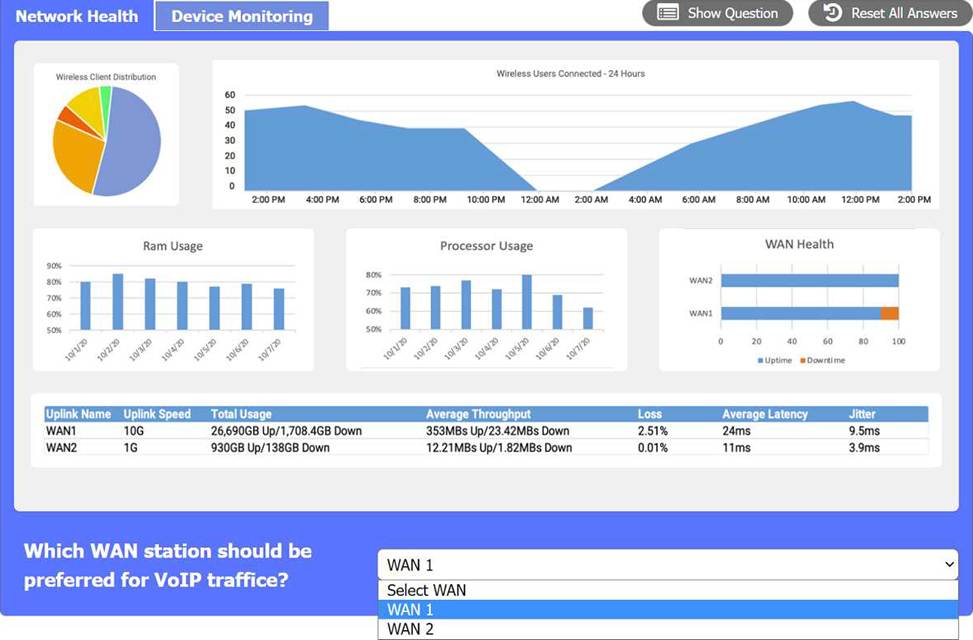
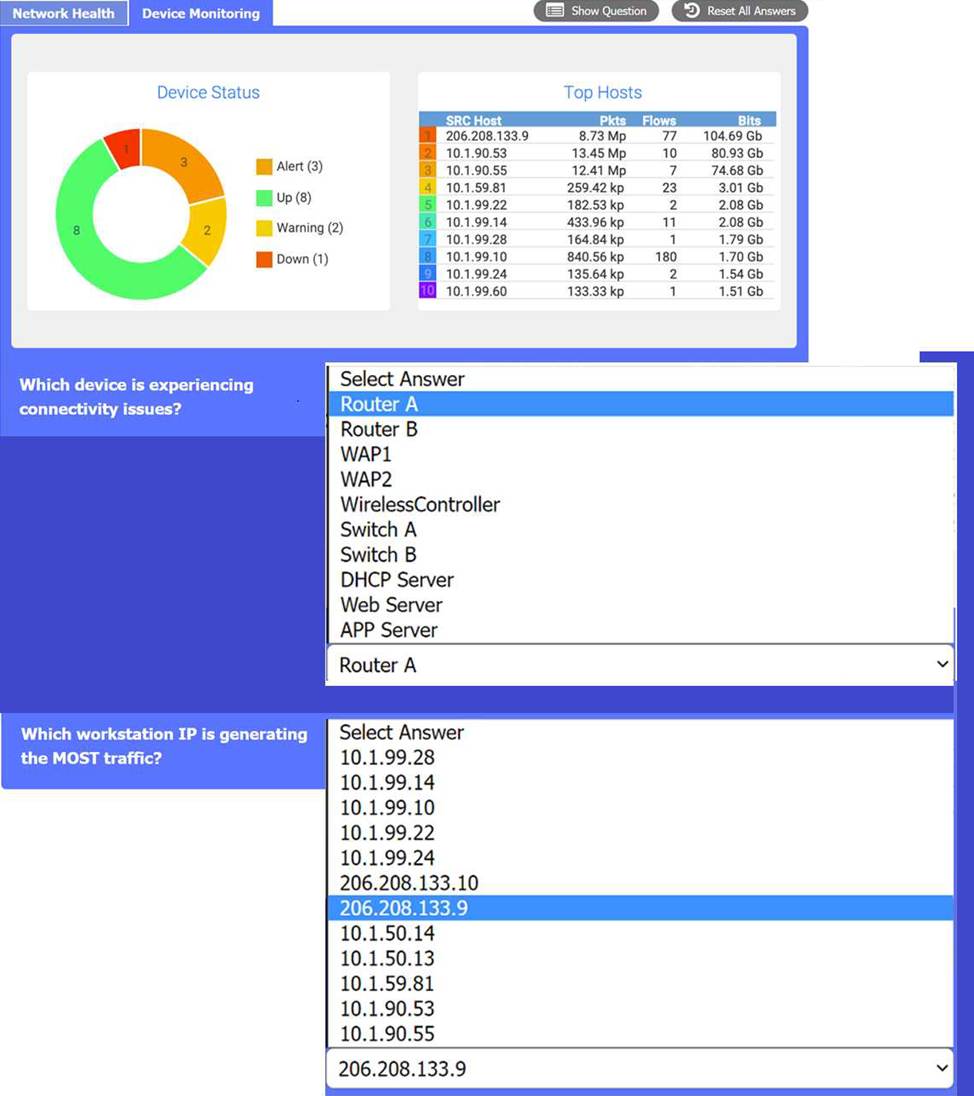
WAN 2 appears to have a lower average latency and loss percentage, which would make it the preferred WAN station for VoIP traffic. VoIP traffic requires low latency and packet loss to ensure good voice quality and reliability. WAN 1 seems to have higher RAM and processor usage, which could also affect the performance of VoIP traffic.
Here’s the summary of the key metrics for WAN 1 and WAN 2 from the image provided:
WAN 1:
Uplink Speed: 10G
Total Usage: 26.969GB Up / 1.748GB Down
Average Throughput: 353MBps Up / 23.42MBps Down
Loss: 2.51%
Average Latency: 24ms
Jitter: 9.5ms
WAN 2:
Uplink Speed: 1G
Total Usage: 930GB Up / 138GB Down
Average Throughput: 12.21MBps Up / 1.82MBps Down
Loss: 0.01%
Average Latency: 11ms
Jitter: 3.9ms
For VoIP traffic, low latency and jitter are particularly important to ensure voice quality. While WAN 1 has higher bandwidth and throughput, it also has higher latency and jitter compared to WAN 2. However, WAN 2 has much lower loss, lower latency, and lower jitter, which are more favorable for VoIP traffic that is sensitive to delays and variation in packet arrival times.
Given this information, WAN 2 would generally be preferred for VoIP traffic due to its lower latency, lower jitter, and significantly lower loss percentage, despite its lower bandwidth compared to WAN
Which of the following can be implemented to add an additional layer of security between a corporate network and network management interfaces?
- A . Jump box
- B . Console server
- C . API interface
- D . In-band management
A
Explanation:
Comprehensive and Detailed
A jump box is a hardened, isolated system that provides secure access to critical infrastructure
devices like routers and firewalls.
Reference: CompTIA Network+ (N10-009) Official Study Guide C Domain 4.3: Explain network security techniques.