
CompTIA 220-1201 Practice Exams
Last updated on Nov 16,2026- Exam Code: 220-1201
- Exam Name: CompTIA A+ Certification Exam: Core 1
- Certification Provider: CompTIA
- Latest update: Nov 16,2026
A technician needs to select PC components with a minimal number of visible internal cables.
Which of the following should the technician use?
- A . SATA drive connections
- B . Liquid cooling
- C . Modular power supply
- D . Wireless NIC
C
Explanation:
Amodular power supplyallows a technician toconnect only the power cables that are needed, reducing clutter and improving airflow. This is ideal when aiming for a clean build withminimal visible internal cables.
Option A (SATA drive connections): Still require both power and data cables, adding to cable count.
Option B (Liquid cooling): May reduce some bulk from large air coolers, but adds tubing and still needs cabling.
Option D (Wireless NIC): Adds wireless capability but has no relation to internal cabling cleanliness.
CompTIA A+ Core 1 Exam Objective
Reference:
Objective 3.3: Given a scenario, apply the appropriate PC configuration.
Which of the following is designed to be used in commercial spaces?
- A . USB 3.1 Gen 2
- B . Straight tip fiber connector
- C . Plenum cabling
- D . Cat 8
C
Explanation:
Plenum cabling is designed for use in commercial spaces where cables run through air ducts or plenum spaces, as it has fire-resistant properties and emits less toxic smoke.
Why Not A (USB 3.1 Gen 2): USB is for peripheral connections, not large-scale commercial installations.
Why Not B (Straight tip fiber connector): Fiber connectors are for high-speed connections but are not specifically for commercial spaces.
Why Not D (Cat 8): While Cat 8 is high-speed, it is not uniquely suited for commercial spaces like plenum cabling.
CompTIA A+ Exam
Reference: Core 1 (220-1201), Section 3.1, cabling standards.
Which of the following would prevent a virtual machine from communicating with any endpoints on a network or the internet?
- A . VDI
- B . Private cloud
- C . Sandbox
- D . Type 1 hypervisor
C
Explanation:
A sandboxis an isolated virtual environment used to test or run applications securely without risk to the host or network. It prevents the VM from communicating with external systems, making it ideal for testing malware or suspicious software.
Option A (VDI): Virtual Desktop Infrastructure allows network communication; it does not restrict it.
Option B (Private cloud): Refers to a cloud deployment model, not a communication barrier.
Option D (Type 1 hypervisor): Runs VMs directly on hardware and does not inherently block communication.
CompTIA A+ Core 1 Exam Objective
Reference:
Objective 4.1: Compare and contrast cloud computing concepts.
A security team wants to implement compliance controls that only permits the installation of company-approved software on user laptops.
Which of the following should the IT department deploy?
- A . EDR
- B . VPN
- C . MDM
- D . SaaS
C
Explanation:
Mobile Device Management (MDM) allows IT departments to enforce compliance controls, such as restricting the installation of unapproved software, on laptops and mobile devices.
Why Not A (EDR): Endpoint Detection and Response focuses on detecting and mitigating security threats, not compliance controls.
Why Not B (VPN): Virtual Private Networks provide secure connections but do not enforce software installation policies.
Why Not D (SaaS): Software as a Service refers to software delivery models and does not enforce compliance controls.
CompTIA A+ Exam
Reference: Core 2 (220-1102), Section 2.7, device management and security.
A user reports that the printouts from a laser printer have lines and smudges on them. The printer is also intermittently misfeeding the paper.
Which of the following components should a technician replace to address this issue?
- A . Fuser
- B . Maintenance kit
- C . Corona wire
- D . Toner cartridge
B
Explanation:
Amaintenance kitfor a laser printer often includesrollers, fuser, and other partsthat wear out over time. If the printer issmudging and misfeeding, it’s a sign thatmultiple components are failing, which a maintenance kit is designed to resolve.
Option A (Fuser): May cause smudging if it’s not heating correctly, but it won’t resolve paper misfeeds alone.
Option C (Corona wire): Can cause poor image quality if dirty but doesn’t affect paper feeding.
Option D (Toner cartridge): Can cause streaks if defective, but not paper feed issues.
CompTIA A+ Core 1 Exam Objective
Reference:
Objective 3.4: Given a scenario, install and configure printers.
A company needs to develop a disaster recovery solution based on virtual machines.
Which of the following service models is the most suitable?
- A . Infrastructure as a Service
- B . Security as a Service
- C . Platform as a Service
- D . Software as a Service
A
Explanation:
Infrastructure as a Service (IaaS)providesvirtualized computing resources over the internetsuch as servers, storage, and networking. It allows a business to quickly spin up virtual machines and is ideal fordisaster recoveryand scalable IT infrastructure needs.
Option B: SecaaS focuses on cloud-delivered security, not infrastructure.
Option C: PaaS offers development environments, not full virtual infrastructure.
Option D: SaaS delivers applications over the internet (e.g., email, CRM) ― not for disaster recovery.
CompTIA A+ Core 1 Exam Objective
Reference:
Objective 4.1: Compare and contrast cloud computing concepts.
An IT specialist compares Bluetooth and NFC technologies for mobile device connectivity.
Which of the following statements accurately describes a key difference between the two?
- A . NFC is faster than Bluetooth when transferring large files between devices.
- B . NFC consumes more power than Bluetooth, making it less suitable for devices in which battery conservation is crucial.
- C . NFC requires pairing with the receiving host, whereas Bluetooth just needs the available connection.
- D . NFC works best within a few centimeters, but Bluetooth can connect devices that are up to 32ft (10m) apart.
D
Explanation:
NFC (Near-Field Communication)operates atvery short ranges ― usually less than 4cm, and is ideal for quick, secure transactions like contactless payments.Bluetoothsupportslonger ranges (up to 10 meters or 32 feet)and is suited for ongoing connections like wireless headsets or file transfers.
Option A: Bluetooth is faster for large file transfers.
Option B: NFC usesless power, not more.
Option C: NFC doesnotrequire pairing ― Bluetooth does.
CompTIA A+ Core 1 Exam Objective
Reference:
Objective 1.5: Given a scenario, connect and configure accessories and ports of mobile devices.
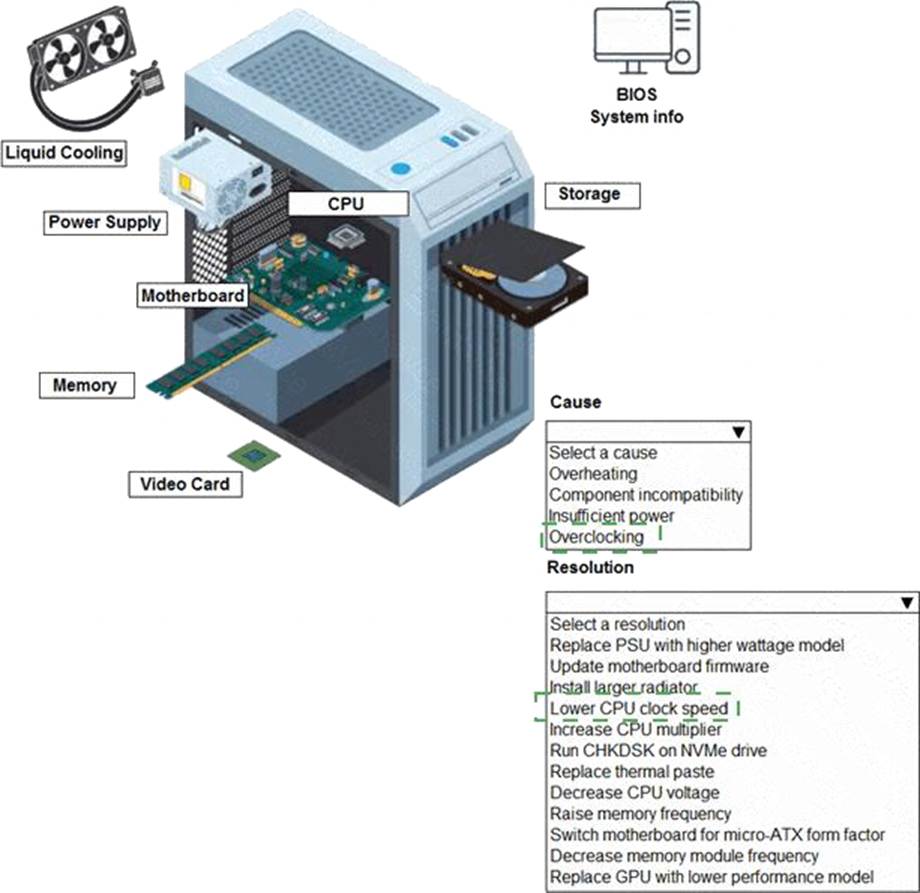
A customer built a computer for gaming, sourcing individual components and then assembling the system. The OS starts up, but within a few minutes the machine locks up. The customer brought the computer to a technician to diagnose the issue.
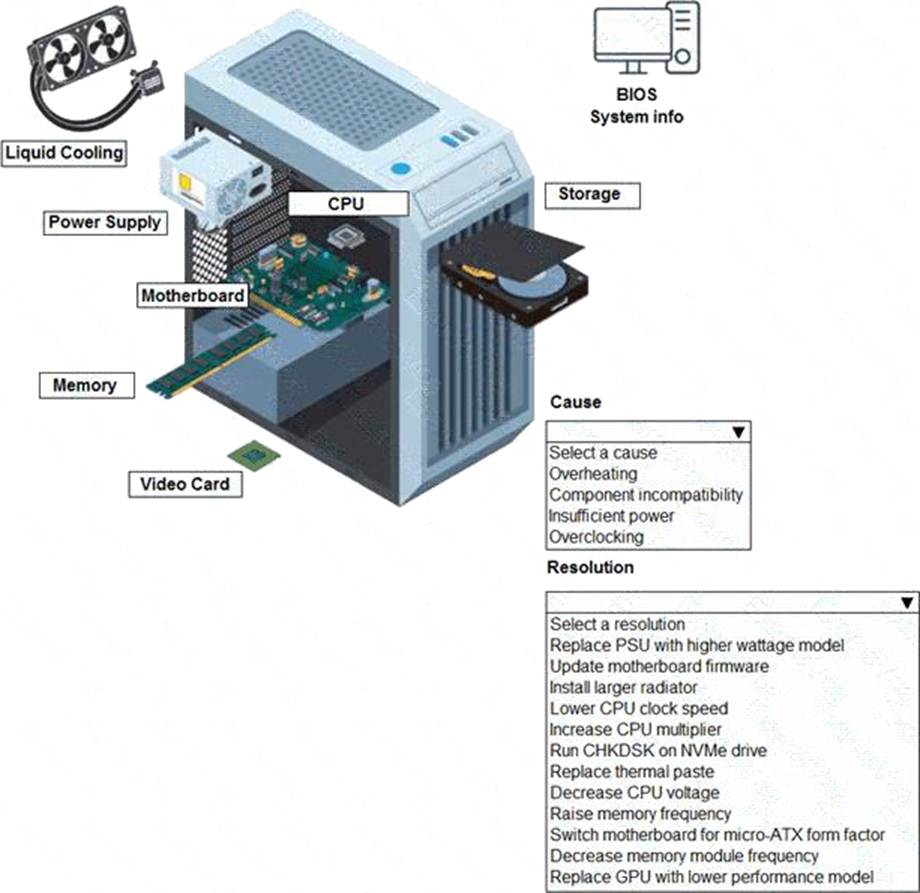
Explanation:
correct answer is "Overclocking" and "Reduce CPU Clock speed"
CPU is at 4.5 Ghz when normal is 3.2 Ghz. Overclocking too much can cause freezes, and this is a gaming computer sothe user probably took it too far. http: //blog.logicalincrements.com/2018/12/4-troubleshooting-tips-overclocking-pc/
Which of the following DNS record types is used to direct email to a mail server?
- A . CNAME
- B . SRV
- C . MX
- D . SOA
C
Explanation:
An MX (Mail Exchange) record specifies the mail server responsible for receiving email for a domain.
Why Not A (CNAME): CNAME is used for domain aliasing, not for email delivery.
Why Not B (SRV): SRV records are used to locate specific services, not mail servers.
Why Not D (SOA): SOA records provide domain information but do not handle email.
CompTIA A+ Exam
Reference: Core 1 (220-1201), Section 2.6, DNS record types.
Which of the following resolutions is commonly known as Ultra HD?
- A . 1920×1080
- B . 2048×1080
- C . 3840×2160
- D . 7680×4320
C
Explanation:
Ultra HD (UHD), also referred to as4K UHD, has a resolution of3840x2160. It’s four times the resolution of standard 1080p (Full HD), offering more screen real estate and sharper images.
Option A (1920×1080): Full HD (FHD), not UHD.
Option B (2048×1080): DCI 2K ― used in cinema, not common for Ultra HD.
Option D (7680×4320): Known as 8K UHD, not standard Ultra HD.
CompTIA A+ Core 1 Exam Objective
Reference:
Objective 1.7: Compare and contrast display technologies and their features.