
Cisco 300-420 Practice Exams
Last updated on Nov 16,2026- Exam Code: 300-420
- Exam Name: Designing Cisco Enterprise Networks (ENSLD)
- Certification Provider: Cisco
- Latest update: Nov 16,2026
An engineer must design an in-band management solution for a customer with branch sites. The solution must allow remote management of the branch sites using management protocols over an MPLS WAN. Queueing is implemented at the remote sites using these classes:
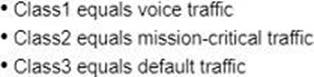
How must the solution prioritize the management traffic over the WAN?
- A . Mark the traffic with DSCP CS1 and map into Class2 with a minimum bandwidth assigned by reducing the bandwidth available to CIass3.
- B . Mark the traffic with DSCP CS6 and map into Class1 with a minimum bandwidth assigned by reducing the bandwidth available to Class2
- C . Mark the traffic with DSCP EF and map into Class1 with a minimum bandwidth assigned by reducing the bandwidth available to Class2.
- D . Mark the traffic with DSCP CS2 and map into Class2 with a minimum bandwidth assigned by reducing the bandwidth available to Class3
Which nonproprietary mechanism can be used to automate rendezvous point distribution in a large PIM domain?
- A . Embedded RP
- B . BSR
- C . Auto-RP
- D . Static RP
Which control-plane technology allows the same subnet to exist across multiple network locations?
- A . LISP
- B . VXLAN
- C . FabricPath
- D . ISE mobility services
A customer is discussing QoS requirements with a network consultant. The customer has specified that end-to-end path verification is a requirement.
Which QoS solution meets this requirement?
- A . IntServ model with RSVP to support the traffic flows
- B . DiffServ model with PHB to support the traffic flows
- C . marking traffic at the access layer with DSCP to support the traffic flows
- D . marking traffic at the access layer with CoS to support the traffic flows
An engineer is looking for a standards-driven YANG model to manage a multivendor network environment.
Which model must the engineer choose?
- A . Native
- B . OpenConfig
- C . IETF
- D . IEEE NETCONF
What is the purpose of a Cisco SD-Access underlay network?
- A . to abstract IP-based connectivity from physical connectivity
- B . to emulate LAN segments to transport Layer 2 frames over a Layer 3 network
- C . to establish physical connectivity between switches and routers
- D . to provide virtualization by encapsulating network traffic over IP tunnels
Which consideration must be taken into account when using the DHCP relay feature in a Cisco SD-Access Architecture?
- A . DHCP-relay must be enabled on fabric edge nodes to provide the correct mapping of DHCP scope to the local anycast gateway.
- B . A DHCP server must be enabled on the border nodes to allow subnets to span multiple fabric edges.
- C . DHCP servers must support Cisco SD-Access extensions to correctly assign IPs to endpoints in an SD-Access fabric with anycast gateway.
- D . DHCP Option-82 must be enabled to map the circuit IP option to the access fabric node where the DHCP discover originated.
What is the role of a control-plane node in a Cisco SD-Access architecture?
- A . fabric device that connects wired endpoints to the SD-Access fabric
- B . map system that manages endpoint to device relationships
- C . fabric device that connects APs and wireless endpoints to the SD-Access fabric
- D . map system that manages External Layer 3 networks
An engineer must propose a QoS architecture model that allows an application to inform the network of its traffic profile and to request a particular type of service to support its bandwidth and delay requirements. The application requires consistent and dedicated bandwidth end to end.
Which QoS architecture model meets these requirements?
- A . DiffServ
- B . LLQ
- C . WRED
- D . IntServ
Refer to the exhibit.
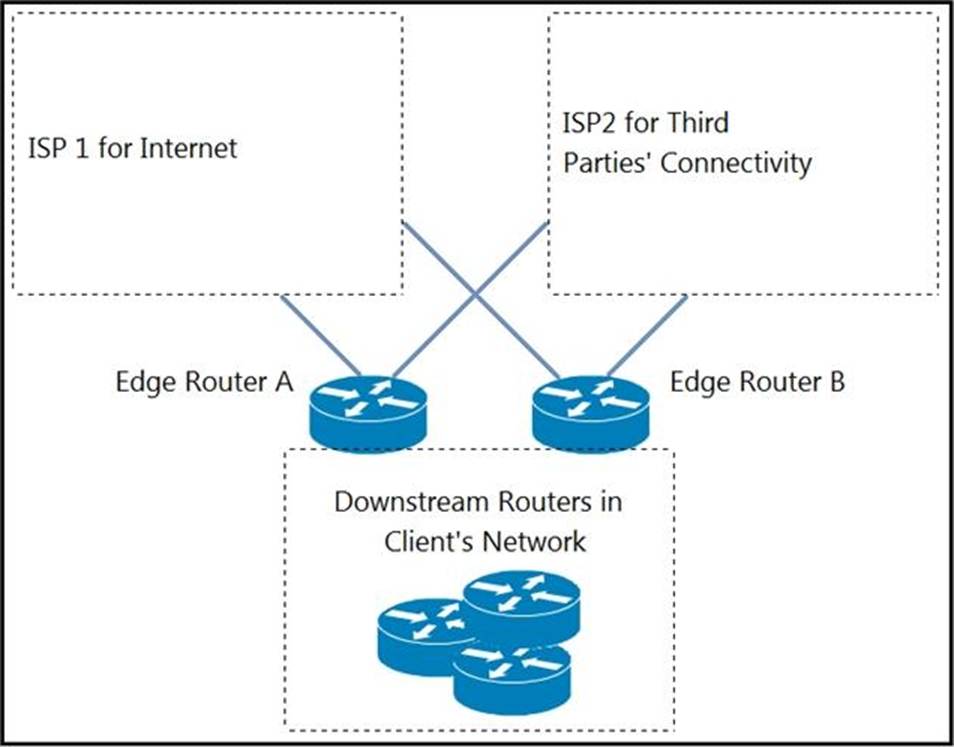
An engineer is designing a BGP solution for a client that peers with ISP1 for full Internet connectivity and with ISP2 for direct exchange of routes for several third parties.
Which action, when implemented on the edge routers, enables the client network to reach the Internet through ISP1?
- A . Run an eBGP session within different VRFs for each ISP.
- B . Advertise a default route for downstream routers within the client network.
- C . Apply the AS-path prepend feature for ISP2.
- D . Apply route filtering such that the client advertises only routes originated from its own AS.