
Cisco 300-410 Practice Exams
Last updated on Nov 16,2026- Exam Code: 300-410
- Exam Name: Implementing Cisco Enterprise Advanced Routing and Services (ENARSI)
- Certification Provider: Cisco
- Latest update: Nov 16,2026
IPv6 is enabled in the infrastructure to support customers with an IPv6 network over WAN and to connect the head office to branch offices in the local network. One of the customers is already running IPv6 and wants to enable IPv6 over the DMVPN network infrastructure between the headend and branch sites.
Which configuration command must be applied to establish an mGRE IPv6 tunnel neighborship?
- A . tunnel protection mode ipv6
- B . ipv6 unicast-routing
- C . ipv6 nhrp holdtime 30
- D . tunnel mode gre multipoint ipv6
D
Explanation:
The command “tunnel mode gre multipoint ipv ” sets the encapsulation mode of the tunnel to mGRE IPv6.
Refer to the exhibit.
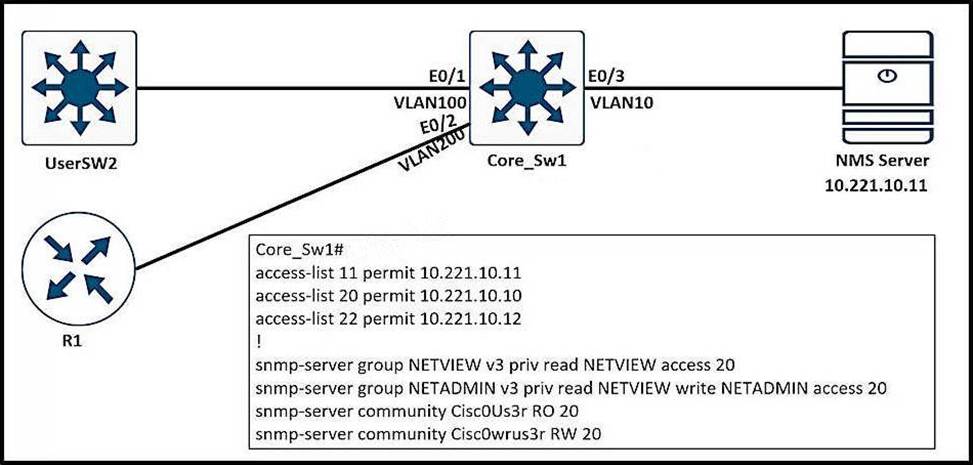
An engineer configured SNMP communities on the Core_SW1, but the SNMP server cannot obtain information from Core_SW1.
Which configuration resolves this issue?
- A . snmp-server group NETVIEW v2c priv read NETVIEW access 20
- B . access-list 20 permit 10.221.10.11
- C . access-list 20 permit 10.221.10.12
- D . snmp-server group NETADMIN v3 priv read NETVIEW write NETADMIN access 22
How does an MPLS Layer 3 VPN differentiate the IP address space used between each VPN?
- A . by RD
- B . by address family
- C . by MP-BGP
- D . byRT
Refer to the exhibit.
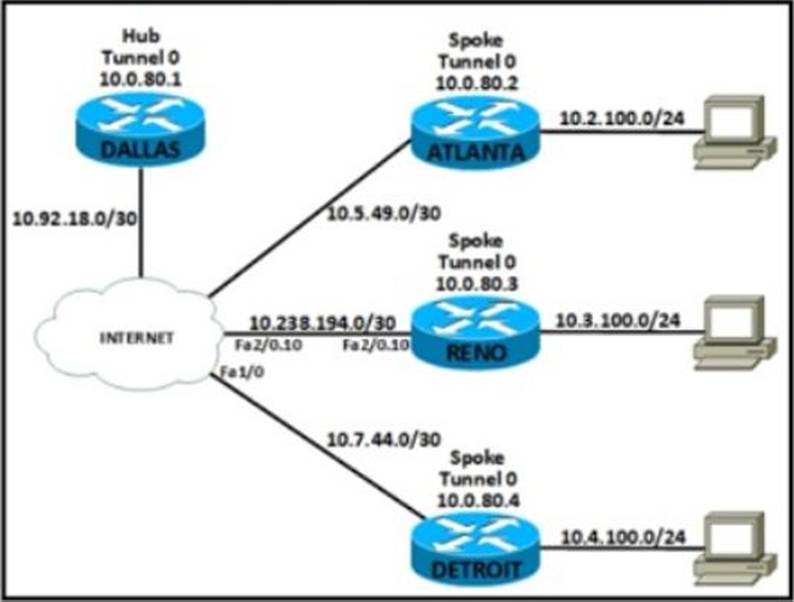
An engineer must connect the Reno and Detroit spokes using DMVPN phase 2 Hub tunnel configuration is
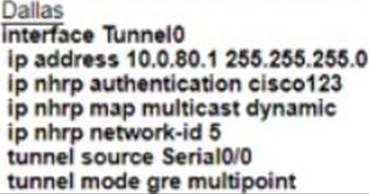
Which configuration accomplishes the task?
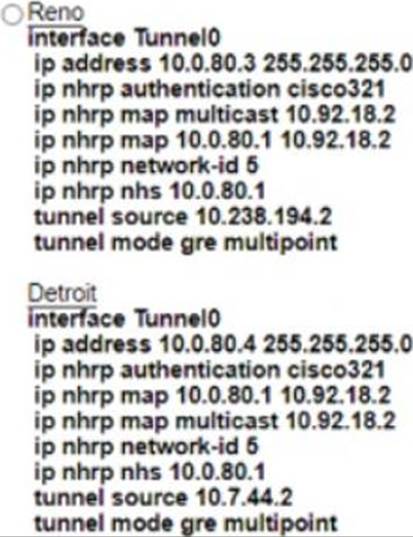
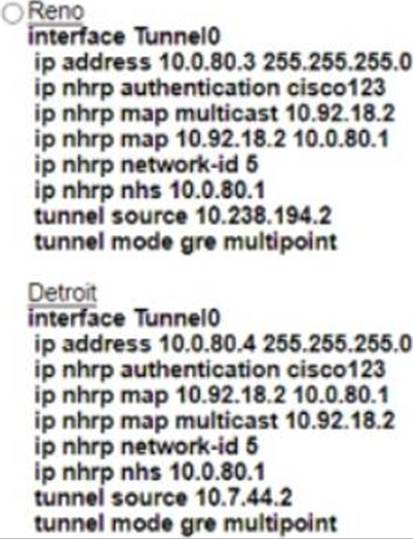
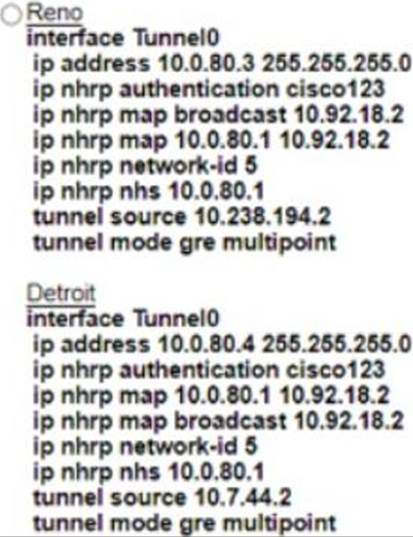
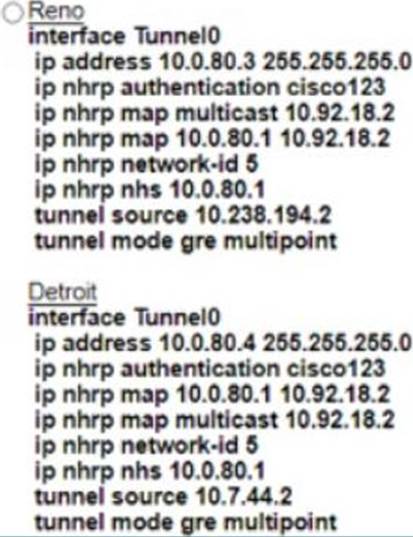
- A . Option A
- B . Option B
- C . Option C
- D . Option D
The network administrator configured R1 for Control Plane Policing so that the inbound Telnet traffic is policed to 100 kbps. This policy must not apply to traffic coming in from 10.1.1.1/32 and 172.16.1.1/32.
The administrator has configured this:
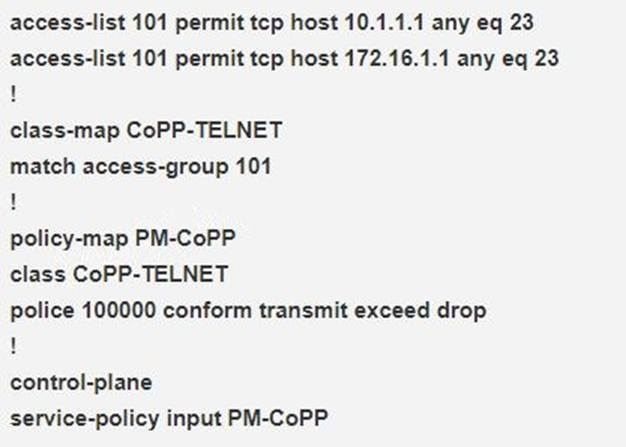
The network administrator is not getting the desired results.
Which set of configurations resolves this issue?
- A . control-plane
no service-policy input PM-CoPP
!
interface Ethernet 0/0
service-policy input PM-CoPP - B . control-plane
no service-policy input PM-CoPP
service-policy input PM-CoPP - C . no access-list 101
access-list 101 deny tcp host 10,1,1.1 any eq 23
access-list 101 deny tcp host 172,16.1.1 any eq 23
access-list 101 permit ip any any - D . no access-list 101
access-list 101 deny tcp host 10,1.1.1 any eq 23
access-list 101 deny tcp host 172.16.1.1 any eq 23
access-list 101 permit ip any any
!
interface E0/0
service-policy input PM-CoPP
C
Explanation:
Packets that match a deny rule are excluded from that class and cascade to the next class (if one exists) for classification. Therefore if we don’t want to CoPP traffic from 10.1.1.1/32 and 172.16.1.1/32, we must “deny” them in the ACL.
Refer to the exhibits.
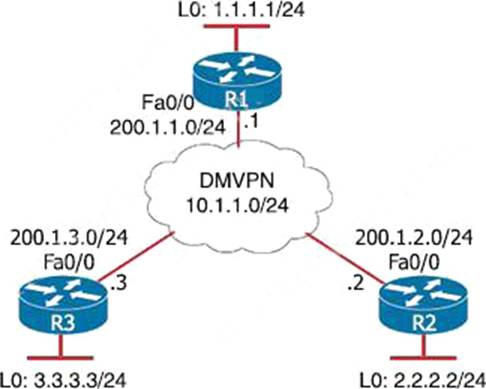
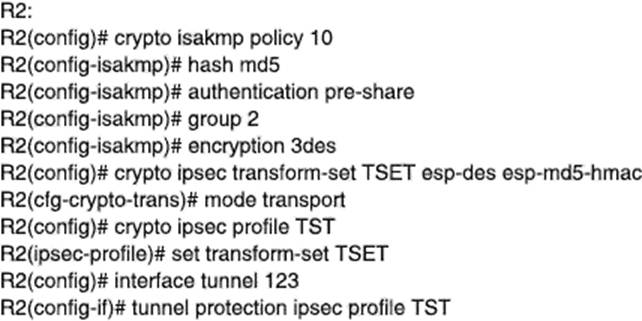
When DMVPN is configured, which configuration allows spoke-to-spoke communication using loopback as a tunnel source?
- A . Configure crypto isakmp key cisco address 0.0.0.0 on the hub.
- B . Configure crypto isakmp key Cisco address 200.1.0.0 255.255.0.0 on the hub.
- C . Configure crypto isakmp key cisco address 200.1.0.0 255.255.0.0 on the spokes.
- D . Configure crypto isakmp key cisco address 0.0.0.0 on the spokes.
D
Explanation:
https://www.cisco.com/en/US/technologies/tk583/tk372/technologies_white_paper0900aecd802b8f3c.html
An engineer is creating a policy that overrides normal routing behavior.
If the route to a destination of 10.100.100.0/24 is withdrawn from the routing Table, the policy must direct traffic to a next hop of 10.1 1.1. if the route is present in the routing table, then normal forwarding must occur.
Which configuration meets the requirements?
- A . access-list 100 permit ip any any
!
route-map POLICY permit 10
match ip address 100
set ip next-hop recursive 10.1.1.1 - B . access-list 100 permit ip any 10.100.100.0 0.0.0.255
!
Route-map POLICY permit 10
match ip address 100
set ip default next-hop 10.1.1.1 - C . access-list 100 permit ip any 10.100.100.0 0.0.0.255
!
route-map POLICY permit 10
match ip address 100
set ip next-hop 10.1.1.1
!
route map POLICY permit 20 - D . access-list 100 permit ip any 10.100.100.0 0.0.0.255
!
route map POLICY permit 10
match ip address 100
Set ip next-hop recursive 10.1.1.1
!
route-map POLICY permit 20
Refer to the exhibit.
A network engineer receives a fault ticket about traffic drops from BANK SITE to BANK
Users can reach BANK SITE Y from router RA as a source.
Routers RB and RD are acting as route reflectors.
Which configuration resolves the issue?
- A . RC(config)#router bgp 65201
RC(config-router)#neighbor 10.10.10.4 route-reflector-client - B . RF(config)#router bgp 65201
RF(config-router)#neighbor 10.10.10.6 route-reflector-client - C . RC(config)#router bgp 65201
RC(config-router)#neighbor 10.10.10.2 route-reflector-client - D . RB(config)router bgp 65201
RB(config-router)#neighbor 10.10.10.3 route-reflector-client
A network administrator is troubleshooting a high utilization issue on the route processor of a router that was reported by NMS The administrator logged into the router to check the control plane policing and observed that the BGP process is dropping a high number of routing packets and causing thousands of routes to recalculate frequently.
Which solution resolves this issue?
- A . Police the cir for BGP, conform-action transmit, and exceed action transmit.
- B . Shape the pir for BGP, conform-action set-prec-transmit, and exceed action set-frde-transmit.
- C . Shape the cir for BGP. conform-action transmit, and exceed action transmit.
- D . Police the pir for BGP, conform-action set-prec-transmit, and exceed action set-clp-transmit.
D
Explanation:
CIR (Committed Information Rate) is the minimum guaranteed traffic delivered in the network.
PIR (Peak Information Rate) is the top bandwidth point of allowed traffic in a non busy times without any guarantee.
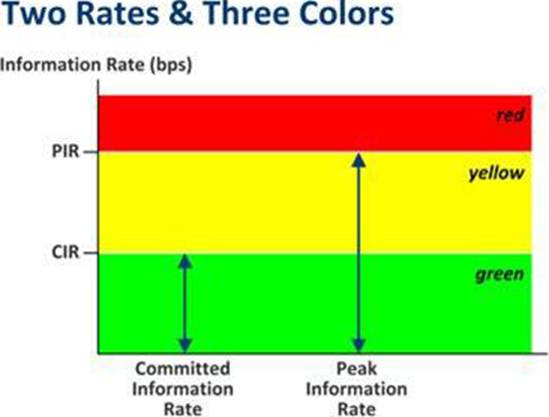
+ Policing: is used to control the rate of traffic flowing across an interface. During a bandwidth exceed (crossed the maximum configured rate), the excess traffic is generally dropped or remarked. The result of traffic policing is an output rate that appears as a saw-tooth with crests and troughs. Traffic policing can be applied to inbound and outbound interfaces. Unlike traffic shaping, QoS policing avoids delays due to queuing. Policing is configured in bytes.
+ Shaping: retains excess packets in a queue and then schedules the excess for later transmission over increments of time. When traffic reaches the maximum configured rate, additional packets are queued instead of being dropped to proceed later. Traffic shaping is applicable only on outbound interfaces as buffering and queuing happens only on outbound interfaces. Shaping is configured in bits per second.
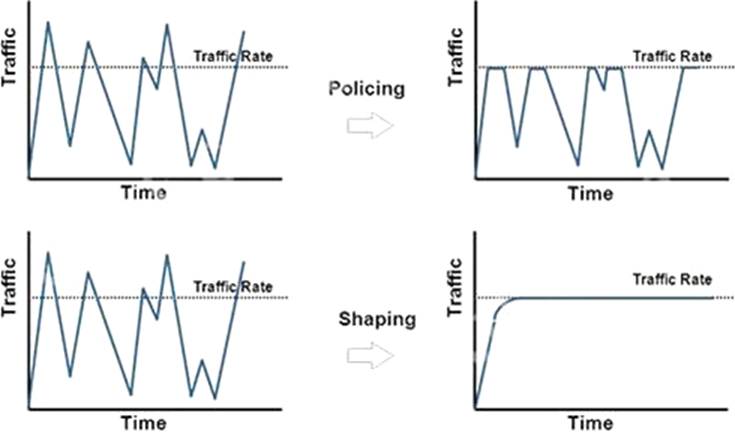
Therefore in this case we can only policing, not shaping as traffic shaping is applicable only on outbound interfaces as buffering and queuing happens only on outbound interfaces. Moreover, BGP traffic is not important so we can drop the excess packets without any problems.
And we only policing the PIR traffic so that the route processor is not overwhelmed by BGP calculation.
Note: The “set-prec-transmit” is the same as “transmit” command except it sets the IP Precedence level as well. The “set-clp-transmit” sets the ATM Cell Loss Priority (CLP) bit from 0 to 1 on the ATM cell and transmits the packet.
Refer to the exhibit.
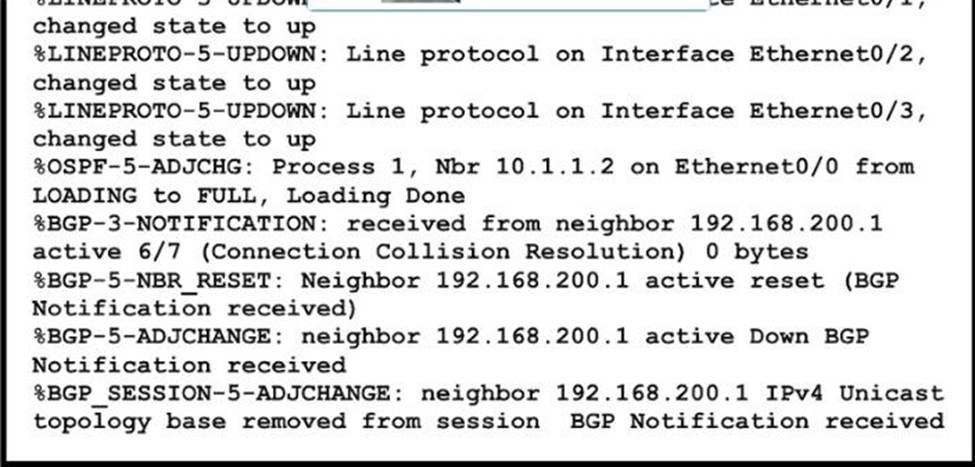
An engineer noticed that the router log messages do not have any information about when the event occurred.
Which action should the engineer take when enabling service time stamps to improve the logging functionality at a granular level?
- A . Configure the debug uptime option
- B . Configure the msec option
- C . Configure the time zone option
- D . Configure the tog uptime option