
CIPS L6M9 Practice Exams
Last updated on Oct 22,2026- Exam Code: L6M9
- Exam Name: Supply Network Design
- Certification Provider: CIPS
- Latest update: Oct 22,2026
Gill runs the operations department of a manufacturing organisation in Wales. The department emulates best practices from competitors through benchmarking and has recently introduced Six Sigma to prevent operational problems.
Which of the following best describes Gill’s approach to operations function?
- A . Internally neutral
- B . Externally neutral
- C . Internally supportive
- D . Externally supportive
Which of the following is a difference between a supply chain and a supply network? Select ALL that apply.
- A . Profit made
- B . Dimension difference
- C . Complexity
- D . Number of players involved
- E . Location of the players
DRAG DROP
Scenario:
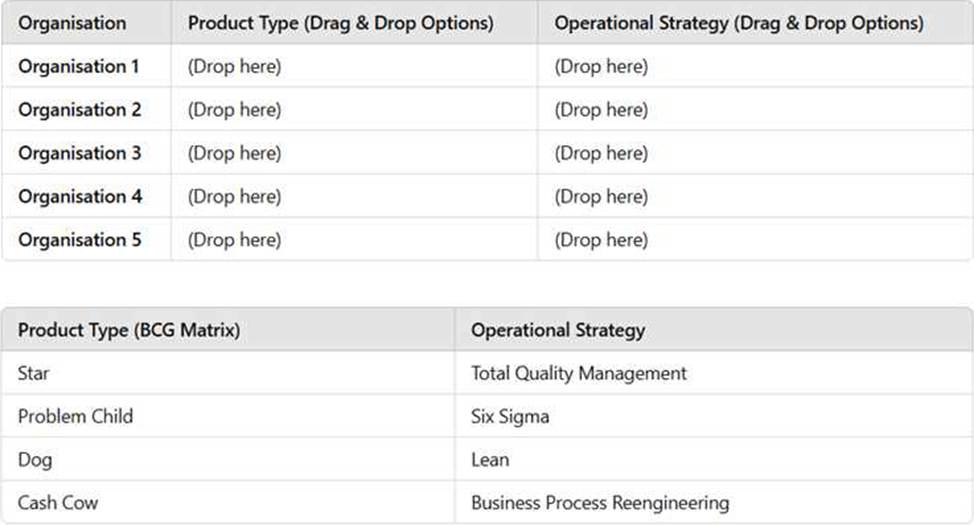
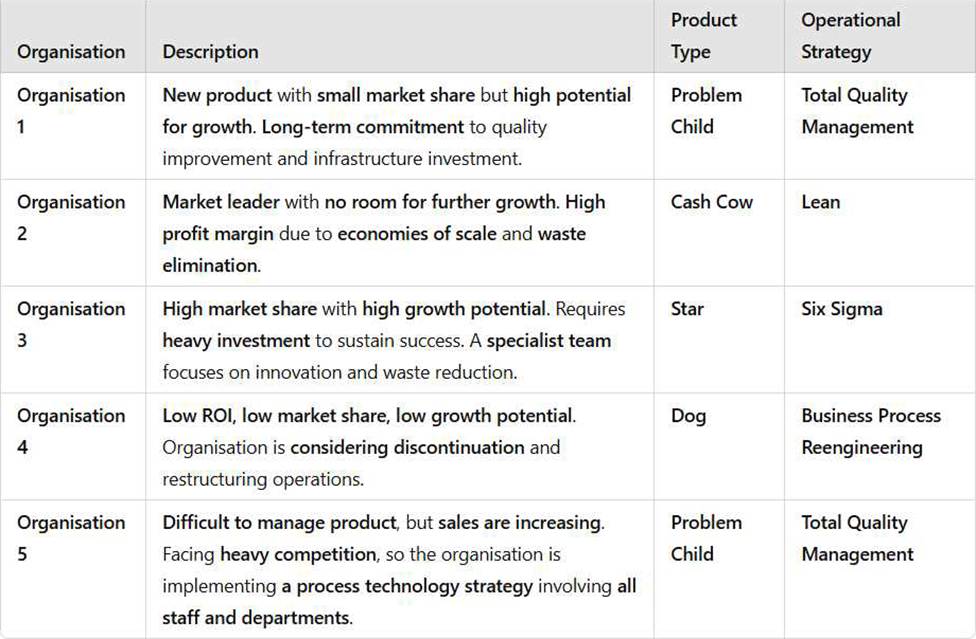
Five manufacturing organisations are working with different products and using various operational strategies. Each product aligns with a category from the Boston Consultancy Group (BCG) Matrix, and each organisation is implementing a specific operational strategy.
For each organisation, select the correct Product Type and Operational Strategy.
When designing a supply network, which of the following stages should be completed first?
- A . Analyse potential risks
- B . Confirm the network scope
- C . Determine the approach for managing material flow
- D . Track information flow
Paul is the Operations Manager at a button factory. Buttons are incorporated into many different fashion garments, and as they are currently ‘on trend,’ there is a high demand for more buttons. Paul is concerned that the factory cannot produce the number of buttons that is being demanded in the marketplace. He has calculated that each team within the factory only has the capacity to create 1,000 buttons per day, and he will decline any requests for buttons that exceed this amount.
In terms of Capacity Loading, what is this called?
- A . Maximum loading
- B . Finite loading
- C . Complete loading
- D . Process loading
Which of the following describes a Proprietary Network?
- A . A privately owned and controlled group
- B . The sharing of materials in an informal setting
- C . A network that has both horizontal and vertical structures
- D . A relationship that is one-sided
DRAG DROP
Scenario:
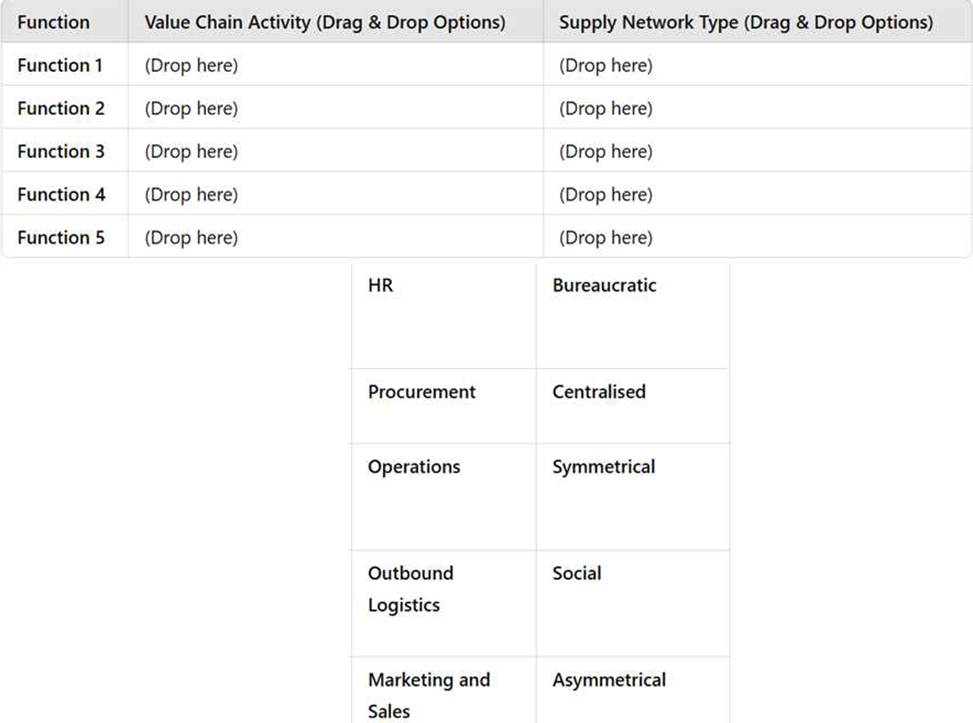
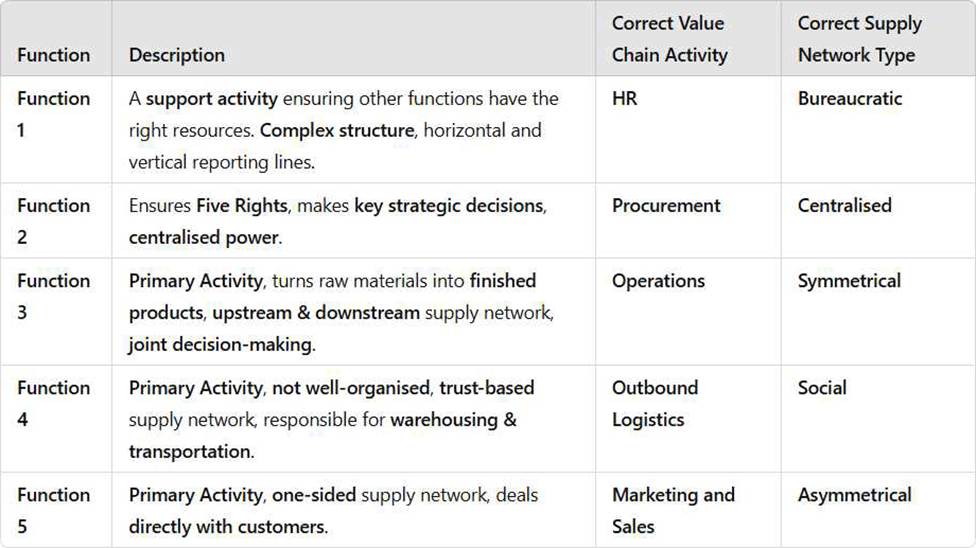
Blue Bear Ltd is a multifunctional manufacturing organisation with a global supply chain and customers in over 30 different countries. Each function within the company has different supply networks and relationships.
For each function, select the correct Value Chain Activity and Supply Network Type from the given options.
Linear Programming (LP) can be adopted by many business functions.
Who out of the following could use LP modelling? Select ALL that apply.
- A . An operations director who needs to choose between two products to manufacture
- B . A financial assistant who needs to create a budget for the manufacturing department
- C . The marketing manager who is deciding how many social media posts to create
- D . The HR manager who needs to plan work schedules for the staff
- E . The logistics coordinator who is planning delivery routes
An organisation may have several different business-level strategies. Is this TRUE?
- A . No―an organisation should only have one strategy, which can be likened to a ‘master plan’ with high-level ambitions
- B . No―effective vertical alignment between operations strategy and corporate strategy means there must only be one organisation-wide operations strategy
- C . Yes―different parts of the business may operate in different marketplaces or have different services/portfolios
- D . Yes―the different business-level strategies will contradict each other
According to Hays and Wheelwright, there are four stages of operations functions, reflecting how an organisation approaches its operational system.
Which of the following is Stage 4, the stage that organisations should aspire to achieve?
- A . Internally Supportive
- B . Externally Supportive
- C . Internally Neutral
- D . Externally Neutral