
CIPS L4M2 Practice Exams
Last updated on Oct 22,2026- Exam Code: L4M2
- Exam Name: Defining Business Needs
- Certification Provider: CIPS
- Latest update: Oct 22,2026
Which of the following factors are likely to be direct barriers to a new entrant in a supply market?
- A . Threat of forward integration
- B . Value to price
- C . Brand identity
- D . Availability of substitutes
- E . Cost advantages
C, E
Explanation:
There are many types of barriers to entry into a market. Some of these include:
– Economies of Scale: When manufacturing or selling at a large scale, companies are able to avail cost advantages because per unit costs of the product fall. So the more the company produces in quantity the more the benefit. When existing companies have this advantage, it can act as a barrier to entry because a new entrant will have to try to match the scale to achieve the same cost ad-vantage as the existing company. This may not be possible at the initial stage.
– A Differentiated Product: If the product being sold by the existing company or companies is highly differentiated or enjoys strong brand loyalty, then this can act as a strong barrier to entry. The new entrant will have to invest in creating a product with newer and unique features and bene-fits that surpass those offered by the old company. In addition, there will need to be strong efforts to break existing brand loyalties and shift them to a new untested company.
– High Capital Costs: If an industry requires huge capital investments at the onset, then this will act as a barrier to entry for many of the potential entrants. Only those will attempt to enter the competitive fray who have the resources to make this high initial investment.
– Other Cost Advantages: Apart from those cost benefits that come from economies of scale, there are other advantages that an existing firm may enjoy. These include access to the best suppliers, an understanding of existing materials and knowledge of their quality, possession of any necessary and important patents, and proprietary information and technological knowledge. There are also learning advantages, achieved over years of business and experience.
– Cost of Switching: The cost associated with a consumer’s move from one company or product or another is called the switching cost. If there are significant switching costs, then a new entrant may not be able to create means of removing these. Or, they may have to offer significant advantage to counter these switching costs at their own expense.
– Distribution Network: Often, distribution relationships are well established and may prove to be a strong barrier to entry for a new company. A new entrant will obviously need access to these distribution channels but will need to invest extra in order to engage distributors who have established relations with existing competitors.
– Suppliers: As with distributors, suppliers may be vital to the operations of a new business. Existing suppliers may have contracts or loyalties with existing companies and may prove to be difficult to form relationships with.
– Legal and Government Created Barriers: Government and regulatory requirements such as permits and licenses may be a strong barrier to entry. There may also be laws governing ways to conduct business that may conflict with a company’s practices in other countries.
– Barriers to Exit: Interestingly, barriers to exit may act as a deterrent to entry by new companies. If a company is unable to easily leave a competitive environment in case business does not work out, then it will have to stay and compete even if that is a detrimental business practice. In this case, the company may choose to not enter the market in the first place.
Reference: CIPS study guide page 96 LO 2, AC 2.2
Which of the following are typical environmental considerations throughout the contract life cycle? Select the TWO that apply.
- A . Modern slavery
- B . Health and safety
- C . Inequality
- D . Waste management
- E . Pollution control
D, E
Explanation:
All procurement has some level of impact on the environment that needs to be minimised to ensure sustainable procurement practices.
The greatest opportunity to influence environmental outcomes is by selecting products and services with the least ongoing environmental impacts, such as use of water, electricity and fuel, waste/disposal management, and impact on human health over the life of the product or service. Lifecycle stages that impact on the environment:
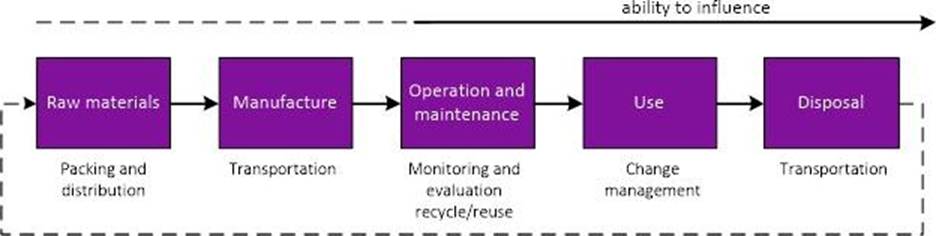
Most goods and services will have an element of environment impact in a number of areas. The five main impact areas are listed in the following table.
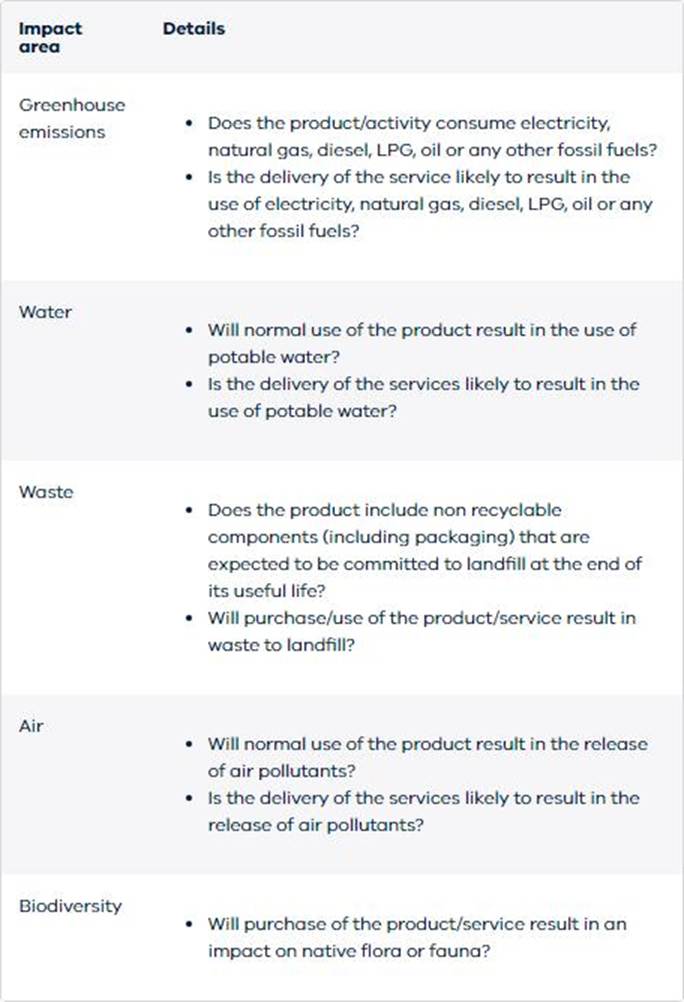
Source: Buying for Victoria
Reference: CIPS study guide page 137-139
LO 3, AC 3.2
A CPO is analyzing whole life cycle costing of a machinery. He realises that cost elements are not specific but come from a range of values.
Which whole-life costing model should the CPO use to get the most accurate total cost of ownership?
- A . Simulation models
- B . Optimisation models
- C . Decision support models
- D . Kraljic’s preferencing model
A
Explanation:
There are three basic groups of WLC (whole life-cycle costing) models:
– Decision support models
– Simulation models: Life cycle cost is an essential approach to decide on alternative rehabilitation strategies for infrastructure systems. Monte Carlo simulation approach is used to develop a stochastic life cycle cost (SLCC) model and methodology in order to compare different rehabilitation scenarios/alternatives for infrastructures, such as water mains. This method assumes that some inputs are randomly variable in a range of values.
– Optimisation models
Reference: CIPS study guide page 38-39
LO 1, AC 1.2
A buyer in Housing Authority is considering using performance specification in upcoming social housing project.
What should buyer be aware when using this type of specification?
- A . In performance specification, specific brands and preferred suppliers must be appointed to avoid the competition
- B . Using performance specification means that the buyer will bear all the risks regarding the fitness for purpose of the facility.
- C . The buyer must be able to clearly define the performance metrics to ensure that the offered solution will achieve the desired outcome
- D . The buyer must be able to define the materials to be used, the execution and installation methods required and the specific design of the building
C
Explanation:
In construction, specifications are written documents that describe the materials and workmanship required for a development. They do not include cost, quantity or drawn information but need to be read alongside other contract documentation such as quantities, schedules and drawings.
Specifications vary considerably depending on the stage to which the design has been developed, ranging from performance (open) specifications that require further design by a contractor or sup-plier, to prescriptive (closed) specifications where the design is already complete when the project is tendered.
Prescriptive specifications give the client more certainty about the end product when they make their final investment decision (i.e. when they appoint the contractor), whereas a performance specification gives the contractor and suppliers more scope to innovate and adopt cost effective methods of work, potentially offering better value for money.
Typically, performance specifications are written on projects that are straight-forward, standard building types, whereas prescriptive specifications are written for more complex buildings, or buildings where the client has requirements that might not be familiar to contractors and where certainty regarding the exact nature of the completed development is more important to the client. Performance specification has some disadvantages:
– Well-defined performance metrics are needed to ensure that the specified performance will achieve the desired outcome
– Require reliable, practical, economical tests of performance
– Evaluations are subjective and require additional time and effort to complete
Therefore, if a performance specification is used, the buying organisation will have to ensure that
they are able to define and conduct tests on whether supplier’s solution can deliver the desired out-
come.
Reference: – CIPS study guide page 118-121
– Performance specification – Designing Buildings Wiki
– Partnership for Public Procurement (cips.org)
LO 3, AC 3.1
A procurement manager is writing a conformance specification for a non-core component. She thinks that if the requirements in specification are higher than ISO standards, her company can achieve greater cost-savings.
Is the procurement manager’s opinion correct?
- A . No, because higher specification may incur additional costs for the buyer
- B . No, because higher requirements in specification, the greater bargaining power of buying organisation
- C . Yes, because optimising the specification is the only method to achieve value for money
- D . Yes, because higher requirements will help buying organisation find the best supplier
A
Explanation:
The specification that is produced too detailed will incur unnecessary cost because it does not allow suppliers to use their expertise in finding the most efficient way to produce it.
‘No, because higher requirements in specification, the greater bargaining power of buying organi-sation’: more detailed specifications could tighten the supplier base and potentially leave buying organisation with fewer potential supplier. This may reduce buyer’s bargaining power in negotiation. ‘Yes, because higher requirements will help buying organisation find the best supplier’: in some circumstances, higher requirements will lead to smaller supplier base. In the worst scenario, there is no supplier who has capability to carry out those requirements
‘Yes, because optimising the specification is the only method to achieve value for money’: There are other methods to achieve cost saving and value for money, inter alia, volume concentration, relationship restructuring, etc.
Reference: CIPS study guide page 118-119
LO 3, AC 3.1
A buyer can use sources of information to review indirect costs associated with the manufacture of goods to support supplier negotiations.
Is this statement true?
- A . Yes, because indirect costs are always variable
- B . No, because the only information available is for direct costs
- C . No, because the supplier’s quotation is the only source of information
- D . Yes, because the buyer can understand the cost build-up of the goods
D
Explanation:
Analyzing both direct and indirect costs helps buyers understand cost structures and negotiate effectively. Indirect costs, like overheads, can be identified through supplier data and market benchmarks, aiding in cost transparency.
Reference: CIPS Level 4, Cost Management and Negotiation.
A company is building a new two-storey office block and will need to purchase new desks and chairs. There will not be much space available.
What should be included in the specification for these desks and chairs?
- A . Technical drawings
- B . A brand name
- C . A list of inputs
- D . Key performance indicators