
CIPS L4M2 Practice Exams
Last updated on Oct 22,2026- Exam Code: L4M2
- Exam Name: Defining Business Needs
- Certification Provider: CIPS
- Latest update: Oct 22,2026
Which of the following are fixed costs? Select TWO that apply.
- A . Sales commission
- B . Utilities costs
- C . Materials costs
- D . Staff overtime
- E . Premises costs
Aldar Properties is a property developer in UAE. In last month, it spent $2,160 for 10 tons of steel. In this month, it had planned 10% increment in budget for steel comparing to last month. But the number of orders boosted and total spend on steel reached $1,992.1 while Aldar has imported 11 tons.
What is the main cost driver of steel budget?
- A . Both price and quantity variances
- B . Inflation
- C . Quantity variance
- D . Price variance
D
Explanation:
In this question, you have to calculate price variance and quantity variance.
Last month, 1 tonne of steel costed $216. This month, the price decreases to $181.1. Price variance = (P1 – P2)*Q2 = ($216-$181.1)*11 = $383.9
Quantity variance = (Q1-Q2)*P1 = -$216
Price variance is greater than quantity variance, therefore, price variance is the main cost driver. LO 1, AC 1.4
Which of the following would a buyer include when issuing an output specification to suppliers?
- A . A requirements brief
- B . The characteristics of the components
- C . The manufacturing processes required
- D . A product sample
A
Explanation:
An output specification defines the desired outcome or result of the procurement rather than specifying how the result should be achieved. A requirements brief outlines the goals, leaving flexibility for the supplier to propose solutions.
Reference: CIPS Level 4, Output Specifications in Procurement.
Which of the following positively affects a buyer’s company cash flow? Select TWO that apply:
- A . A customer agrees to pay the buyer’s company upon purchase
- B . Buyer’s company offers sales discounts and promotions
- C . A supplier reduces its payment terms to payment on receipt
- D . The bank grants a loan to the buyer’s company
- E . Payment of dividends to the buyer company shareholders
A, D
Explanation:
A (Customer payment upon purchase): Immediate payments improve cash flow.
D (Loan): Loans provide cash inflow, though they may increase liabilities.
Options like supplier payment on receipt (C) negatively impact cash flow, and sales promotions (B) may increase expenses.
Reference: CIPS Level 4, Financial Management in Procurement.
According to Porter’s value chain, which of the following activities is categorised as support activity?
- A . Product warranties and special services
- B . Storage of raw materials
- C . Distribution of products from factory to retailer
- D . Supervising the production line
- E . Develop digital SRM technology to manage suppliers better
E
Explanation:
Primary activities consist of inbound logistics, operations, outbound logistics, sales & marketing, service.
Second activities consist of firm infrastructure, human resource management, technology development and procurement
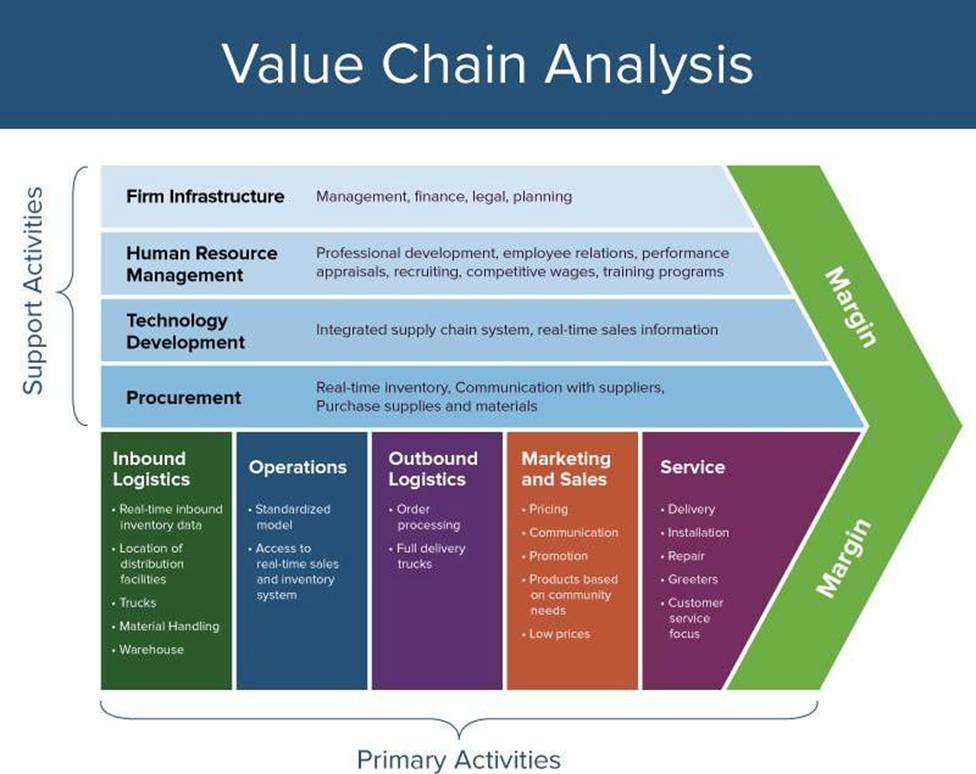
Support activities (also known as secondary activities) include Firm infrastructure, Human resource management, Technology development and Procurement. Developing digital SRM technology to manage suppliers better is Technology development. LO 1, AC 1.2
Halfords is a major bicycle and car parts retailer with long history in the market. Its suppliers are plentiful and there is no threat of forward integration. Some other smaller retailers are applying 3D-printing technology to make personalized bicycle parts but their market share is relatively low. 3D-printing technology is an example of which competitive force?
- A . Bargaining power of buyer
- B . Threat of substitute
- C . Rivalry within the industry
- D . New entrants may enter the market
B
Explanation:
3D-printed parts can replace traditional metal parts. They are also more easily customised to fit customer’s needs. This technology is an example of threat of substitute in Porter’s Five Forces model. Substitute goods or services that can be used in place of a company’s products or services pose a threat. Companies that produce goods or services for which there are no close substitutes will have more power to increase prices and lock in favorable terms. When close substitutes are available, customers will have the option to forgo buying a company’s product, and a company’s power can be weakened.
Reference: – CIPS study guide page 85-96
– Porter’s 5 Forces Definition: Analyzing Businesses (investopedia.com) LO 2, AC 2.2
When analyzing direct and indirect costs of potential suppliers for negotiations and planning purchasing budget, the procurement manager collects reports from specialist organisations like Mintel, Gartner and Forrester.
Which kind of information source is used by the procurement manager?
- A . Company annual report
- B . Technical data
- C . Market data
- D . RFI
C
Explanation:
Using Porter’s value chain helps procurement professionals know what are direct and indirect costs of supplier. Information on direct and indirect costs will have been collected as part of the market analysis.
Information sources that may help include the following:
– Company annual reports
– Market data
– Technical data
– Request for information
– Plan visits
– Discount lists
Market data is the information that is collected and analysed by specialist organisations like Mintel, Gartner, Forrester,…
Reference: CIPS study guide page 98-105
LO 2, AC 2.3