
CIPS L4M2 Practice Exams
Last updated on Oct 24,2026- Exam Code: L4M2
- Exam Name: Defining Business Needs
- Certification Provider: CIPS
- Latest update: Oct 24,2026
Buyers can ascertain the prices by examining information provided by primary and secondary sources of market data.
Which of the following is a secondary source of market data?
- A . Supplier prices provided on price comparison websites
- B . Historical records of supplier prices on the buyer’s database
- C . Price brochures provided by the supplier’s sales team
- D . Suppliers’ prices provided on the buyer’s request for quotation
A
Explanation:
Price comparison websites are secondary sources as they aggregate data collected from multiple suppliers. Primary sources (like RFQs and brochures) come directly from the supplier.
Reference: CIPS Level 4, Market Data Analysis.
Honda of America Manufacturing is a well established automobile manufacturer. It purchases tens of thousands of materials and parts from suppliers, however, only few of them are strategic. To these suppliers, Honda’s procurement manager requires them to send details of labour, materials, overhead cost and profit. However, the suppliers are reluctant to submit such confidential information.
Is the procurement manager’s action appropriate?
- A . Yes, because the procurement manager can get a good insight from the market
- B . No, because no suppliers are willing to show sensitive information on their costs and profit.
- C . Yes, because strategies can be introduced for reducing cost and improving the supplier relationships.
- D . No, because procurement manager should conduct life-cycle analysis
C
Explanation:
With strategic suppliers, the aim should be to work co-operatively with them to find ways of reducing costs to achieve a target cost. It is necessary to work with the suppliers in carrying out open book costing by having first persuaded them of the need to do it. Open book can be used to establish a Target Cost, a Compensation Event value and can eventually be used to ensure the payment of actual costs to an organization. A number of forms of contract cater for this functionality of which only the NEC goes to into any great depth of methodology.
If the suppliers worry about leak of confidential information, procurement team can suggest them to sign a non-disclosure agreement. The buying organisation should also comply with data protection regulations. The Employer / individual responsible for a project’s costs should ultimately take a pragmatic and sensible approach with regard to commercially or personally sensitive data provided by the contractor. The primary goal of all open book cost management is to provide Employer comfort and security in the accuracy of commercial data; this effectively means striking a balance between undertaking full audits and blind faith.
Reference: CIPS study guide page 32
LO 1, AC 1.2
A garment manufacturer supplies global retailers with t-shirts, shirts, and linen trousers. Because of currency fluctuations, the manufacturer is aware that they must control their direct costs in order to ensure profits.
Which of the following is a direct cost for the garment manufacturer?
- A . Facilities rent
- B . Cotton fabric
- C . Utilities cost
- D . Office staff payroll
B
Explanation:
Cotton fabric is a direct cost because it is directly attributable to the production of the garments.
Costs like rent, utilities, and payroll are indirect costs associated with running the business.
Reference: CIPS Level 4, Cost Categorization in Procurement.
British Steel needs to source a set of instruments that will improve quality of steel. Without these instruments British Steel will loss control of the temperature. The bucket may freeze up, or if it is too hot it leaks out of the casting process, damaging the machine. There is limited supply on the market and quality varies greatly.
Which of the following will be the most appropriate managing approach to procure these items?
- A . Bundle these instruments into larger contract
- B . Leverage market competition to drive down cost
- C . Seek continuity of supply
- D . Form partnership with supplier
D
Explanation:
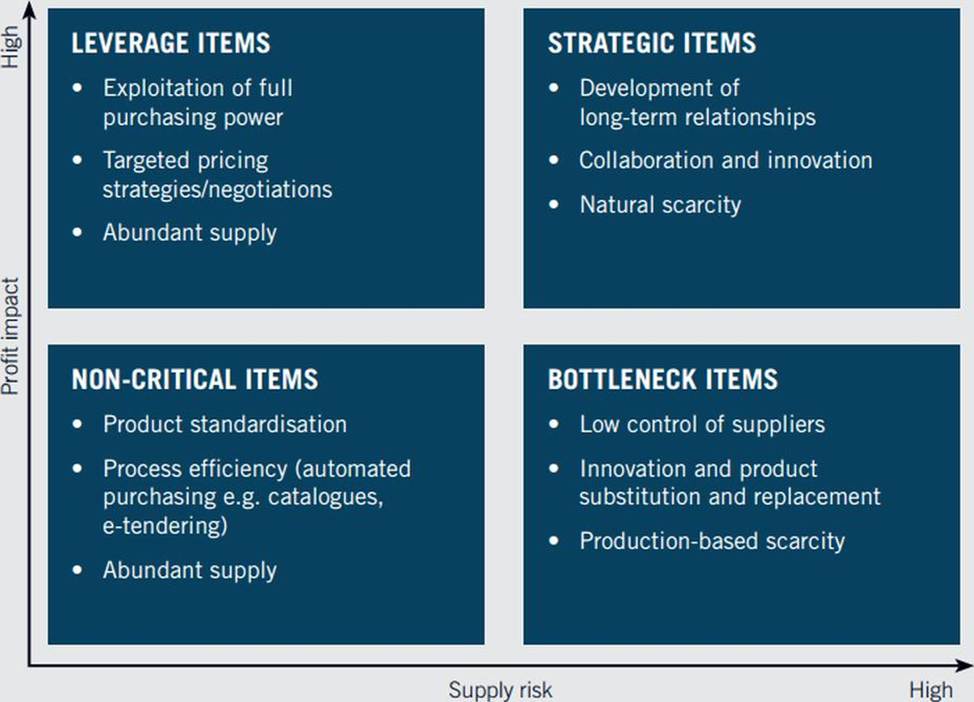
The instrument plays a crucial role in steel manufacturing because it presents in the majority of products, in which case lacking this instrument would have significant impact on the organisation’s output (production lines stop or damaging other machine). Otherwise, the risk of supply is high because there is limitation in supply. Therefore, it is considered as a strategic item in term of Kraljic’s portfolio matrix. Procurement manager should form partnership with suppliers to maximise the value.
The following graph illustrates Kraljic’s portfolio matrix:
Reference: CIPS Study guide page 84.
LO 2, AC 2.1
British Steel needs to source a set of instruments that will improve quality of steel. Without these instruments British Steel will loss control of the temperature. The bucket may freeze up, or if it is too hot it leaks out of the casting process, damaging the machine. There is limited supply on the market and quality varies greatly.
Which of the following will be the most appropriate managing approach to procure these items?
- A . Bundle these instruments into larger contract
- B . Leverage market competition to drive down cost
- C . Seek continuity of supply
- D . Form partnership with supplier
D
Explanation:
The instrument plays a crucial role in steel manufacturing because it presents in the majority of products, in which case lacking this instrument would have significant impact on the organisation’s output (production lines stop or damaging other machine). Otherwise, the risk of supply is high because there is limitation in supply. Therefore, it is considered as a strategic item in term of Kraljic’s portfolio matrix. Procurement manager should form partnership with suppliers to maximise the value.
The following graph illustrates Kraljic’s portfolio matrix:
Reference: CIPS Study guide page 84.
LO 2, AC 2.1
Department for Transport (DfT) needs to buy new locomotives to expand the capacity of trains fleet. In 2009, they were criticized for beginning the procurement “without any clear idea of how many trains would be needed, which routes they would run on and what form of power would be required”.
What should procurement manager of DfT do first to manage risk in making the specification?
- A . Identify the possible risks
- B . Monitor the potential risks
- C . Implement mitigating actions
- D . Assess the potential risks
A
Explanation:
There are 4 steps to risk managing process:
Step 1: Identify hazards
Step 2: Assess the risk
Once a risk has been identified, a risk assessment should be conducted.
You should carry out a risk assessment for any manual tasks identified as being hazardous, unless the risk is well known and you know how to control it. A risk assessment can help you determine, which postures, movements and forces of the task pose a risk, where during the task they pose a risk, why they are occurring and what needs to be fixed.
Step 3: Control the risk
The ways of controlling risks are ranked from the highest level of protection and reliability to the lowest, which is known as the hierarchy of control. You must always aim to eliminate the hazard, which is the most effective control.
Step 4: Review risk control
Control measures that have been implemented must be reviewed, and, if necessary, revised to make sure they work as planned and to maintain a work environment that is without risks to health and safety.
Source: WorkCover Queensland
Reference: CIPS study guide page 142-146
LO 3, AC 3.3
A consulting firm in London had previously had static budgets. They were set once and locked in for the year. This resulted in departments meeting their budgets early and doing virtually nothing the rest of the accounting period. To address this imbalance, the company tossed out the static budget and developed a new one for each department of the next 18 months. And each month, real sales figures are analyzed against the plan and the budget is adjusted accordingly. Then the company adds another month into the budgeting plan.
What type of budget this company is using?
- A . Activity-based budget
- B . Rolling budget
- C . Incremental budget
- D . Zero-based budget
B
Explanation:
A rolling budget is continually updated to add a new budget period as the most recent budget period is completed. Thus, the rolling budget involves the incremental extension of the existing budget model. By doing so, a business always has a budget that extends one year into the future.
Think of continuous (rolling) budgets as waves rolling ashore on the beach. A new wave comes in each time, replacing the one that was there before. From a financial perspective, the wave is your budget, and the time between waves is longer! These reporting time frames can be monthly, quarterly, yearly, etc.
An incremental budget is a budget prepared using a previous period’s budget or actual performance as a basis with incremental amounts added for the new budget period.
Zero-based budgeting (ZBB) is a method of budgeting in which all expenses must be justified for each new period. The process of zero-based budgeting starts from a "zero base," and every function within an organization is analyzed for its needs and costs. Budgets are then built around what is needed for the upcoming period, regardless of whether each budget is higher or lower than the previous one. Activity-based budgeting (ABB) is a system that records, researches, and analyzes activities that lead to costs for a company. Every activity in an organization that incurs a cost is scrutinized for potential ways to create efficiencies. Budgets are then developed based on these results.
Reference: CIPS study guide page 52-59
LO 1, AC 1.4
Which of these are advantages of using a conformance specification? Select TWO that apply.
- A . It enables supplier flexibility and product innovation
- B . It enables value-for-money solutions
- C . It forces consideration of actual product needs
- D . It provides evidence of requirements if there is a dispute
- E . There is a smaller supplier base to select from