
CIPS L4M2 Practice Exams
Last updated on Oct 24,2026- Exam Code: L4M2
- Exam Name: Defining Business Needs
- Certification Provider: CIPS
- Latest update: Oct 24,2026
Why should procurement professionals develop business case before seeking approval to purchase capital equipment?
- A . Using business case will prevent new entrants from entering the supply market
- B . A business case can be used as a replacement of purchase order
- C . Business case is a tool that eliminates all risks associated with the project
- D . Devising business case may prompt the procurement to consider different options
D
Explanation:
A business case is developed during the early stages of a project and outlines the why, what, how, and who necessary to decide if it is worthwhile continuing a project. One of the first things you need to know when starting a new project are the benefits of the proposed business change and how to communicate those benefits to the business.
Preparing the business case involves an assessment of:
– Business problem or opportunity
– Benefits
– Risk
– Costs including investment appraisal
– Technical solutions
– Timescale
– Impact on operations
– Organizational capability to deliver the project outcomes
These project issues are an important part of the business case. They express the problems with the current situation and demonstrate the benefits of the new business vision. Making business case with multiple options and choices also prompts the procurement and senior management to consider alternatives. As a result, the organisation may opt out the best option.
The business case brings together the benefits, disadvantages, costs, and risks of the current situation and future vision so that executive management can decide if the project should go ahead.
Reference: – CIPS study guide page 19-21
– How to Write a Business Case – Template & Examples | Adobe Workfront LO 1, AC 1.1
Which of the following are typically included in a conformance specification? Select TWO that apply.
- A . Product functions
- B . Product dimensions
- C . Brand name
- D . List of outcome
- E . Packaging requirements
B, E
Explanation:
A conformance specification is a specification that defines the technical and physical characteristics and/or measurements of a product, such as physical aspects (e.g. dimensions, colour, and surface finish), design details, material properties, energy requirements, processes, maintenance requirements and operational requirements.
On the other hand, performance specification typically includes list of output or outcome or functional requirements. Brand name can be a part of performance specification because brand is a re-minder of quality that customers remember. For example, when talking about Roll Royce, people will think about an elegant car.
Reference: CIPS study guide page 118-124
LO 3, AC 3.1
XYZ Ltd operates in the plumbing and heating industry. The company has developed and patented a new range of alternative products, using a different material from conventional brass that offers substantial cost savings. XYZ Ltd plans to launch the full range of new products.
Will this change the impact on competitive forces in the market?
- A . Yes, this development has created substitute products
- B . Yes, this development has created the threat of new entrants
- C . No, this development does not impact supplier bargaining power
- D . No, this development does not impact buyer bargaining power
Lider Ltd is a leading bathroom furniture manufacturer in India. The company has more than 30 years experience in the market with extended knowledge of engineering and customers’ taste. Lider is planning to launch a new type of bath fitting next year which offers Bluetooth connectivity and thermostat display. The company gathers a team of multi-disciplines, including engineering, procurement, sales and marketing. At the first team meeting, the project leader tells the team to discuss which functions will be valued by the customers, and how to deliver those functions with the lowest costs possible.
Which of the following describes the process that the project team is undertaking?
- A . Cost analysis
- B . Standardisation
- C . Value engineering
- D . Just in time
C
Explanation:
From the scenario, you can see that the project team is developing a new product. They start with analysing the functions, and the costs of delivering those functions. This is a typical process of value engineering. You may read more on value engineering from the reference paper.
Reference: – CIPS study guide page 171-173
– Value Analysis – Norwood Whittle (cimaglobal.com)
– A CASE STUDY ANALYSIS THROUGH THE IMPLEMENTATION OF VALUE ENGI-NEERING (researchgate.net)
LO 3, AC 3.4
At which stage of product life cycle, price competition between sellers will be the most intense?
- A . Growth stage
- B . Introductory stage
- C . Maturity stage
- D . Decline stage
D
Explanation:
The term product life cycle refers to the length of time a product is introduced to consumers into the market until it’s removed from the shelves. The life cycle of a product is broken into four stages― introduction, growth, maturity, and decline.
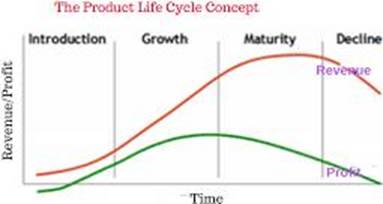
Source: https://blueoceanoutsource.co.ke/the-product-life-cycle-concept/
At maturity stage, price competition sets in as more and more supply capacity has been added by new entrants, then the competition will be the most intense.
Reference: CIPS study guide page 90-91
LO 2, AC 2.2
Which of the following problems may be identified as closed problems? Select TWO that apply:
- A . A cyber attack takes down whole company’s IT system
- B . Shortage of key medicines in healthcare industry
- C . There are not enough data for procurement analytics
- D . Logistics costs incur a large portion in wholesale prices
- E . The suppliers don’t comply with the company’s policy on underage labour.
A, B
Explanation:
Closed problem is something happens that should not have happened. To solve this type of problem, procurement professional should find a way to correct the situation or try to adapt to it. On the other hand, open ended problem is a obstacle to your short-term objective. You will need to overcome this obstacle.
Shortage of key medicines is a situation in which procurement must find a substitution or try to save the current stock.
In case of cyber attack, procurement should find a way to recover the IT system as soon as possible. Otherwise, ‘There are not enough data for procurement analytics’ is an open-ended problem because it prevents company to conduct procurement analytics (an objective).
‘Logistics costs incur a large portion in wholesale prices’: In this situation, logistics costs are hurdles that prevent companies to reach lower wholesale.
‘The suppliers don’t comply with the company’s policy on underage labour’: In this situation, procurement should seek ways to help supplier comply with the company’s labour policy. LO 1, AC 1.1