
CIPS L4M2 Practice Exams
Last updated on Oct 23,2026- Exam Code: L4M2
- Exam Name: Defining Business Needs
- Certification Provider: CIPS
- Latest update: Oct 23,2026
The procurement team of an IT hardware manufacturer has been set a target by senior management to reduce the rates paid to the sole supplier of a new and innovative power-saving battery.
Which action should the procurement team first consider?
- A . Offering a framework agreement
- B . Agreeing rebate thresholds
- C . Dual or multiple sourcing
- D . Offering economies of scale
C
Explanation:
Dual or multiple sourcing introduces competition, reducing the sole supplier’s bargaining power and leading to cost reductions. Framework agreements (A) or economies of scale (D) may not address the immediate need to reduce rates.
Reference: CIPS Level 4, Sourcing Strategies.
Which type of specification is less time-consuming to develop?
- A . Outcome-based specification
- B . Design specification
- C . Conformance specification
- D . Technical drawings
A
Explanation:
There are two major types of specification: conformance and performance specifications. They have the following characteristics:
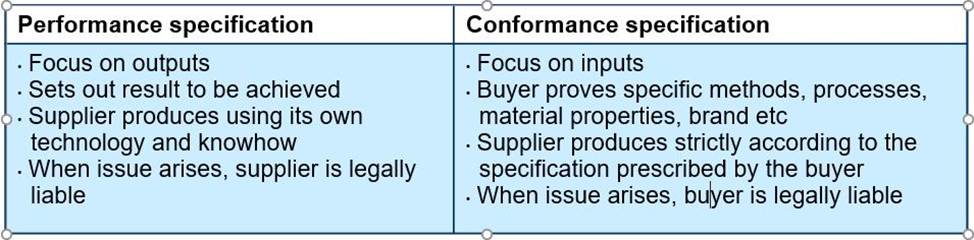
Since performance specification is often a list of outputs or outcomes, it usually takes less time to
develop than conformance specification.
Reference: CIPS study guide page 116-124
Dana is an automobile manufacturer. It has a new electrification strategy that aims at making eco-friendly electric pick-up trucks. To implement this strategy, the procurement department must source new categories of parts that make motors, sensors, solenoids and stators. He starts to analyse the market by identifying specific supply market segments for those parts and finding suppliers who have the best capabilities in those segment. He intends to segment the market based on specific features of the products.
Which variable is used by Dana procurement manager to shape and manage supply market?
- A . Buyer segments
- B . Channel segments
- C . Geographical segments
- D . Product segments
D
Explanation:
In sales and marketing, market segmentation is the process of trying to understand clusters of customers in terms of their buying behavior and their buying characteristics. There are some traditional segmentation approaches: geography, demography, types of industry and the benefits. Then there are newer segmentation approaches: behavioral, situational, and psychographic.
Procurement professionals can learn market segmentation from sales and marketing. Segmenting the market can help them to shape and manage the supply market effectively. According to Michael Porter, a market can be segment with array of products and buyers.
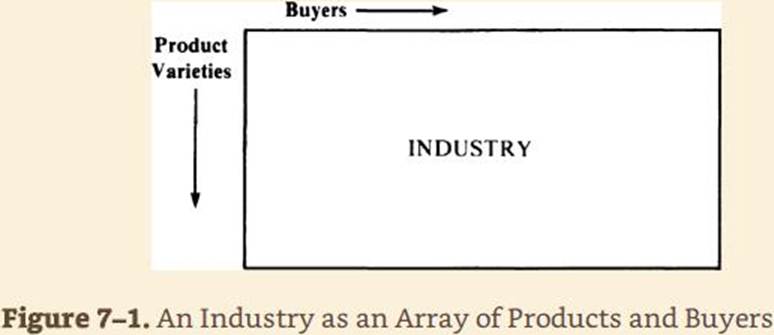
Source: Porter, Michael E.. Competitive Advantage: Creating and Sustaining Superior Performance (p. 234). Free Press. Kindle Edition.
In the scenario, the products that Dana needs to source is distinct in their features. The best way is to
segment the market by product varieties.
Reference: CIPS study guide page 65
LO 2, AC 2.1
When devising a business case for purchasing a new copier, Maria analyses its whole-life costs as following:
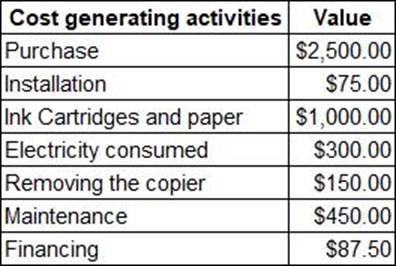
Though cost generating activities are identified, she has not categorised the costs.
What is the total value of copier’s end of life costs?
- A . $450
- B . $75
- C . $150
- D . $300
C
Explanation:
Life cycle costing is a key asset management tool that takes into account the whole of life implications of planning, acquiring, operating, maintaining and disposing of an asset.
The process is an evaluation method that considers all ownership and management costs. These include;
– Concept and definition;
– Design and development;
– Manufacturing and installation;
– Maintenance;
– Support services; and
– Retirement, remediation and disposal costs.
End of life costs often comprise of decommissioning, removing and disposal costs. In the copier scenario, the end of life costs equal to removal cost, which is $150.
Reference: – Life Cycle Cost Guidelines (dlgsc.wa.gov.au)
– CIPS study guide page 36-40
LO 1, AC 1.2
When devising a business case for purchasing a new copier, Maria analyses its whole-life costs as following:
Though cost generating activities are identified, she has not categorised the costs.
What is the total value of copier’s end of life costs?
- A . $450
- B . $75
- C . $150
- D . $300
C
Explanation:
Life cycle costing is a key asset management tool that takes into account the whole of life implications of planning, acquiring, operating, maintaining and disposing of an asset.
The process is an evaluation method that considers all ownership and management costs. These include;
– Concept and definition;
– Design and development;
– Manufacturing and installation;
– Maintenance;
– Support services; and
– Retirement, remediation and disposal costs.
End of life costs often comprise of decommissioning, removing and disposal costs. In the copier scenario, the end of life costs equal to removal cost, which is $150.
Reference: – Life Cycle Cost Guidelines (dlgsc.wa.gov.au)
– CIPS study guide page 36-40
LO 1, AC 1.2
A buying organisation may not have technical capability to produce a highly complex specification.
Which of the following are sources of information that can be used to create the specification? Select
TWO that apply
- A . Standard terms and conditions
- B . Name cards
- C . Industry standards
- D . Suppliers’ know-how
- E . Constitution
C, D
Explanation:
If an organisation doesn’t have capability to produce a technical specification, they can draft one
based on standards or consulting the suppliers.
Reference: CIPS study guide page 125-130
LO 3, AC 3.1
A procurement manager is requested to source a major component. She needs information on sup-pliers’ direct and indirect cost, fixed and variable costs to prepare for negotiations. Therefore, she collects 17 annual reports from potential suppliers who are competing in the same industry.
In order to estimate an approximate value of fixed and variable costs in that industry, which of the following technique should be adopted by the procurement manager?
- A . Line of best fit
- B . Variance calculation
- C . Total cost of ownership
- D . Open-book costing
A
Explanation:
Public annual reports can be a source of information that helps the procurement professional to analyse an industry’s cost and revenue using the line of best fit. Line of best fit is one of the most important outputs of regression analysis. Regression refers to a quantitative measure of the relationship between one or more independent variables and a resulting dependent variable. Regression is of use to professionals in a wide range of fields from science and public service to financial analysis.
In this case, by collecting and analysing 17 annual reports, the procurement manager can find the line of best fit which goes approximately through the middle of the data points with an equal number of data points above and below it.
The slope of the line of best fit is the approximate variable costs the industry. The easiest way to calculate it is to take a point at the right-hand end of the line of best fit and note its cost and output levels. Divide the cost by the output and this gives and approximate figure for the cost per unit of output or variable cost. This gives an approximate value for the industry fixed and variable costs.
Reference: CIPS study guide page 99-100
LO 2, AC 2.3
Which of the following is the technology that disrupts traditional retail?
- A . Self-Driving Cars
- B . Blockchain
- C . E-commerce
- D . Robotics
C
Explanation:
One of the biggest disruptors in retail has been e-commerce. According to a report by IDC, in the month of December 2018, which is also the holiday season in the west, the e-commerce sector globally, has grown by 20 percent.
LO 2, AC 2.2
This is the information on an organisation’s activities over the past year
• Sale were $5,000,000. The value of accounts receivable was $450,000 at the start of the year and $525,000 at the end of the year
• The value of direct costs was $2,500,000 and 75% of this was bought on credit
• Indirect costs were $3,000,000 and 25% of this was bought on credit
• During the year the organization spent $1,500,000 on new assets and sold $150,000 of old assets. $1,000,000 of the spend on assets was funded by a bank loan
• The organization declared a dividend of $200,000 at the end of the year but this was not paid for another two months
• Opening balance was $175,000
Which of the following is the bank balance of that organization at the end of the year?
- A . $1,675,000
- B . $1,875,000
- C . $1,700,000
- D . $2,025,000
B
Explanation:
In this question, you should understand the concept of cash flow and formula of cash flow. Cash flow calculates the physical money moving in and out a company’s bank balance.
The cash flow from sale activity is:
cash flow from sale = account receivable at beginning of the year + revenue – account receivable at the end of the year = $450,000 + $5,000,000 – $525,000 = $4,925,000
75% of direct costs was bought by credit, therefore, the company spent 25% on direct cost: – $2,500,000*25/100 = -$625,000
25% of indirect costs was bought on credit. Cash flow out on indirect costs is: -$3,000,000*75/100 = – $2,250,000
Company spent $1,500,000 on new assets funded by a loan of $1,000,000. Cash flow out from this activity is -$500,000
Company received $150,000 from selling old assets
Dividends have not been paid for another 2 months, thus, they are not accounted as cash flow out. The bank balance at the end of the year is: $175,000 + $4,925,000 – $625,000 – $2,250,000 – $500,000
+ $150,000 = $1,875,000 LO 1, AC 1.4
Which of the following is the disadvantage of embedding standards in a specification?
- A . Standards do not improving buyer’s bargaining power
- B . Embedding standards into specification requires enormous time and effort
- C . Standards are too static and discourage innovation
- D . Standards are too flexible and may cause ambiguity in the specification
C
Explanation:
"Standards are often produced by professional bodies (maybe national or international bodies). Standards tend to be stable for a period of time, therefore, they are likely to be static and discourage innovation."
Reference: CIPS L4M3 study guide page 125
LO 3, AC 3.1