
CertNexus AIP-210 Practice Exams
Last updated on Oct 22,2026- Exam Code: AIP-210
- Exam Name: CertNexus Certified Artificial Intelligence Practitioner (CAIP)
- Certification Provider: CertNexus
- Latest update: Oct 22,2026
You are developing a prediction model. Your team indicates they need an algorithm that is fast and requires low memory and low processing power.
Assuming the following algorithms have similar accuracy on your data, which is most likely to be an ideal choice for the job?
- A . Deep learning neural network
- B . Random forest
- C . Ridge regression
- D . Support-vector machine
C
Explanation:
Ridge regression is a type of linear regression that adds a regularization term to the loss function to reduce overfitting and improve generalization. Ridge regression is fast and requires low memory and low processing power, as it only involves solving a system of linear equations. Ridge regression can also handle multicollinearity (high correlation among predictors) by shrinking the coefficients of correlated predictors.
Which of the following is a privacy-focused law that an AI practitioner should adhere to while designing and adapting an AI system that utilizes personal data?
- A . General Data Protection Regulation (GDPR)
- B . ISO/IEC 27001
- C . PCIDSS
- D . Sarbanes Oxley (SOX)
A
Explanation:
The General Data Protection Regulation (GDPR) is a privacy-focused law that an AI practitioner should adhere to while designing and adapting an AI system that utilizes personal data. The GDPR applies to any organization that processes personal data of individuals in the European Union (EU), regardless of where the organization is located. The GDPR grants individuals rights over their personal data, such as the right to access, rectify, erase, restrict, or object to its processing. The GDPR also imposes obligations on organizations that process personal data, such as the duty to obtain consent, conduct data protection impact assessments, implement data protection by design and by default, and ensure accountability and transparency. The GDPR also addresses some specific issues related to AI, such as automated decision-making, profiling, and data portability.
Which of the following best describes distributed artificial intelligence?
- A . It does not require hyperparemeter tuning because the distributed nature accounts for the bias.
- B . It intelligently pre-distributes the weight of starting a neural network.
- C . It relies on a distributed system that performs robust computations across a network of unreliable nodes.
- D . It uses a centralized system to speak to decentralized nodes.
C
Explanation:
Distributed artificial intelligence (DAI) is a subfield of artificial intelligence that studies how multiple intelligent agents can coordinate and cooperate to achieve a common goal or solve a complex problem. DAI relies on a distributed system that performs robust computations across a network of unreliable nodes, such as sensors, robots, or humans. DAI can handle large-scale, dynamic, and uncertain environments that are beyond the capabilities of a single agent.
Reference: [Distributed artificial intelligence – Wikipedia], [Distributed Artificial Intelligence: An Overview]
Which database is designed to better anticipate and avoid risks of AI systems causing safety, fairness, or other ethical problems?
- A . Asset
- B . Code Repository
- C . Configuration Management
- D . Incident
D
Explanation:
An incident database is a database that is designed to better anticipate and avoid risks of AI systems causing safety, fairness, or other ethical problems. An incident database collects and stores information about incidents or events where AI systems have caused or contributed to negative outcomes or harms, such as accidents, errors, biases, discriminations, or violations. An incident database can help identify patterns, trends, causes, impacts, and solutions for AI-related incidents, as well as provide guidance and best practices for preventing or mitigating future incidents.
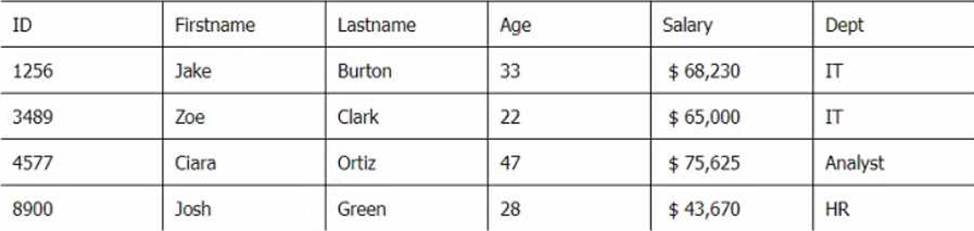
Below are three tables: Employees, Departments, and Directors.
Employee_Table
Department_Table
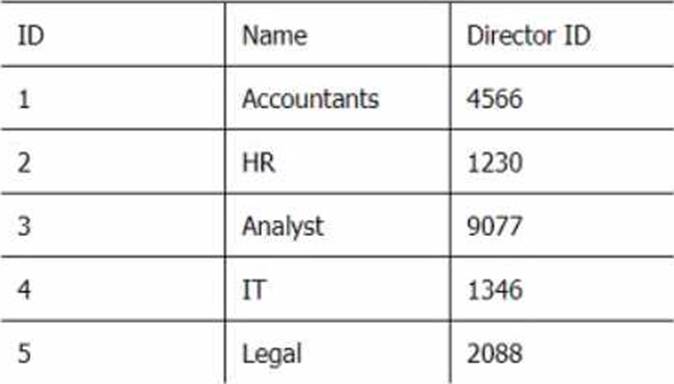
Director_Table
ID Firstname Lastname Age Salary
4566 Joey Morin 62 $ 122,000
1230 Sam Clarck 43 $ 95,670
9077 Lola Russell 54 $ 165,700
1346 Lily Cotton 46 $ 156,000
2088 Beckett Good 52 $ 165,000
Which SQL query provides the Directors’ Firstname, Lastname, the name of their departments, and the average employee’s salary?
- A . SELECT m.Firstname, m.Lastname, d.Name, AVG(e.Saiary) as Dept_avg_Saiary FROM Employee_Table as e
LEFT JOIN Department_Table as d on e.Dept = d.Name LEFT JOIN Directorjable as m on d.ID = m.DeptJD GROUP BY m.Firstname, m.Lastname, d.Name - B . SELECT m.Firstname, m.Lastname, d.Name, AVG(e.Salary) as Dept_avg_Salary FROM Employee_Table as e
RIGHT JOIN Departmentjable as d on e.Dept = d.Name INNER JOIN Directorjable as m on d.ID = m.DeptJD GROUP BY d.Name - C . SELECT m.Firstname, m.Lastname, d.Name, AVG(e.Salary) as Dept_avg_Salary FROM Employee_Table as e
RIGHT JOIN Department_Table as d on e.Dept = d.Name INNER JOIN Directorjable as m on d.ID = m.DeptJD GROUP BY e.Salary - D . SELECT m.Firstname, m.Lastname, d.Name, AVG(e.Salary) as Dept_avg_Salary FROM Employee_Table as e
RIGHT JOIN Department_Table as d on e.Dept = d.Name INNER JOIN Directorjable as m on d.ID = m.DeptID GROUP BY m.Firstname, m.Lastname, d.Name
D
Explanation:
This SQL query provides the Directors’ Firstname, Lastname, the name of their departments, and the average employee’s salary by joining the three tables using the appropriate join types and conditions. The RIGHT JOIN between Employee_Table and Department_Table ensures that all departments are included in the result, even if they have no employees. The INNER JOIN between Department_Table and Directorjable ensures that only departments with directors are included in the result. The GROUP BY clause groups the result by the directors’ names and departments’ names, and calculates the average salary for each group using the AVG function.
Reference: SQL Joins – W3Schools, SQL GROUP BY Statement – W3Schools
For each of the last 10 years, your team has been collecting data from a group of subjects, including their age and numerous biomarkers collected from blood samples. You are tasked with creating a prediction model of age using the biomarkers as input. You start by performing a linear regression using all of the data over the 10-year period, with age as the dependent variable and the biomarkers as predictors.
Which assumption of linear regression is being violated?
- A . Equality of variance (Homoscedastidty)
- B . Independence
- C . Linearity
- D . Normality
B
Explanation:
Independence is an assumption of linear regression that states that the errors (residuals) of the model are independent of each other, meaning that they are not correlated or influenced by previous or subsequent errors. Independence can be violated when the data has serial correlation or autocorrelation, which means that the value of a variable at a given time depends on its previous or future values. This can happen when the data is collected over time (time series) or over space (spatial data). In this case, the data is collected over time from a group of subjects, which may introduce serial correlation among the errors.
In which of the following scenarios is lasso regression preferable over ridge regression?
- A . The number of features is much larger than the sample size.
- B . There are many features with no association with the dependent variable.
- C . There is high collinearity among some of the features associated with the dependent variable.
- D . The sample size is much larger than the number of features.
B
Explanation:
Lasso regression is a type of linear regression that adds a regularization term to the loss function to reduce overfitting and improve generalization. Lasso regression uses an L1 norm as the regularization term, which is the sum of the absolute values of the coefficients. Lasso regression can shrink some of the coefficients to zero, which effectively eliminates some of the features from the model. Lasso regression is preferable over ridge regression when there are many features with no association with the dependent variable, as it can perform feature selection and reduce the complexity and noise of the model.
What is the open framework designed to help detect, respond to, and remediate threats in ML systems?
- A . Adversarial ML Threat Matrix
- B . MITRE ATT&CK® Matrix
- C . OWASP Threat and Safeguard Matrix
- D . Threat Susceptibility Matrix
A
Explanation:
The Adversarial ML Threat Matrix is an open framework designed to help detect, respond to, and remediate threats in ML systems. The Adversarial ML Threat Matrix is inspired by the MITRE ATT&CK® Matrix1, which is a framework for describing cyberattacks across various stages of an attack lifecycle. The Adversarial ML Threat Matrix adapts this framework to address specific threats and vulnerabilities in ML systems, such as data poisoning, model stealing, model evasion, or model inversion2. The Adversarial ML Threat Matrix provides a structured way to organize and classify adversarial techniques, tactics, procedures, examples, and mitigations for ML systems2.
Which type of regression represents the following formula: y = c + b*x, where y = estimated dependent variable score, c = constant, b = regression coefficient, and x = score on the independent variable?
- A . Lasso regression
- B . Linear regression
- C . Polynomial regression
- D . Ridge regression
Workflow design patterns for the machine learning pipelines:
- A . Aim to explain how the machine learning model works.
- B . Represent a pipeline with directed acyclic graph (DAG).
- C . Seek to simplify the management of machine learning features.
- D . Separate inputs from features.
B
Explanation:
Workflow design patterns for machine learning pipelines are common solutions to recurring problems in building and managing machine learning workflows. One of these patterns is to represent a pipeline with a directed acyclic graph (DAG), which is a graph that consists of nodes and edges, where each node represents a step or task in the pipeline, and each edge represents a dependency or order between the tasks. A DAG has no cycles, meaning there is no way to start at one node and return to it by following the edges. A DAG can help visualize and organize the pipeline, as well as facilitate parallel execution, fault tolerance, and reproducibility.