
Amazon SAP-C02 Practice Exams
Last updated on Oct 22,2026- Exam Code: SAP-C02
- Exam Name: AWS Certified Solutions Architect - Professional
- Certification Provider: Amazon
- Latest update: Oct 22,2026
A company is planning to migrate its business-critical applications from an on-premises data center to AWS. The company has an on-premises installation of a
Microsoft SQL Server Always On cluster. The company wants to migrate to an AWS managed database service. A solutions architect must design a heterogeneous database migration on AWS.
Which solution will meet these requirements?
- A . Migrate the SQL Server databases to Amazon RDS for MySQL by using backup and restore utilities.
- B . Use an AWS Snowball Edge Storage Optimized device to transfer data to Amazon S3. Set up Amazon RDS for MySQL. Use S3 integration with SQL Server features, such as BULK INSERT.
- C . Use the AWS Schema Conversion Tool to translate the database schema to Amazon RDS for MeSQL. Then use AWS Database Migration Service (AWS DMS) to migrate the data from on-premises databases to Amazon RDS.
- D . Use AWS DataSync to migrate data over the network between on-premises storage and Amazon S3. Set up Amazon RDS for MySQL. Use S3 integration with SQL Server features, such as BULK INSERT.
A company wants to host a new global website that consists of static content. A solutions architect is working on a solution that uses Amazon CloudFront with an origin access identity <OAI) to access website content that is stored in a private Amazon S3 bucket.
During testing, the solutions architect receives 404 errors from the S3 bucket. Error messages appear only for attempts to access paths that end with a forward slash. such as example.com/path/. These requests should return the existing S3 object path/index.html. Any potential solution must not prevent CloudFront from caching the content.
What should the solutions architect do to resolve this problem?
- A . Change the CloudFront origin to an Amazon API Gateway proxy endpoint. Rewrite the S3 request URL by using an AWS Lambda function.
- B . Change the CloudFront origin to an Amazon API Gateway endpoint. Rewrite the S3 request URL in an AWS service integration.
- C . Change the CloudFront configuration to use an AWS Lambda@Edge function that is invoked by a viewer request event to rewrite the S3 request URL.
- D . Change the CloudFront configuration to use an AWS Lambda@Edge function that is invoked by an origin request event to rewrite the S3 request URL.
A company runs many workloads on AWS and uses AWS Organizations to manage its accounts. The workloads are hosted on Amazon EC2, AWS Fargate, and AWS Lambda. Some of the workloads have unpredictable demand. Accounts record high usage in some months and low usage in other months.
The company wants to optimize its compute costs over the next 3 years. A solutions architect obtains a 6-month average for each of the accounts across the organization to calculate usage.
Which solution will provide the MOST cost savings for all the organization’s compute usage?
- A . Purchase Reserved Instances for the organization to match the size and number of the most common EC2 instances from the member accounts.
- B . Purchase a Compute Savings Plan for the organization from the management account by using the recommendation at the management account level.
- C . Purchase Reserved Instances for each member account that had high EC2 usage according to the data from the last 6 months.
- D . Purchase an EC2 Instance Savings Plan for each member account from the management account based on EC2 usage data from the last 6 months.
A company maintains a restaurant review website. The website is a single-page application where files are stored in Amazon S3 and delivered using Amazon CloudFront. The company receives several fake postings every day that are manually removed.
The security team has identified that most of the fake posts are from bots with IP addresses that have a bad reputation within the same global region. The team needs to create a solution to help restrict the bots from accessing the website.
Which strategy should a solutions architect use?
- A . Use AWS Firewall Manager to control the CloudFront distribution security settings.
Create a geographical block rule and associate it with Firewall Manager. - B . Associate an AWS WAF web ACL with the CloudFront distribution. Select the managed Amazon IP reputation rule group for the web ACL with a deny action.
- C . Use AWS Firewall Manager to control the CloudFront distribution security settings. Select the managed Amazon IP reputation rule group and associate it with Firewall Manager with a deny action.
- D . Associate an AWS WAF web ACL with the CloudFront distribution. Create a rule group for the web ACL with a geographical match statement with a deny action.
A company needs to build a disaster recovery (DR) solution for its ecommerce website. The web application is hosted on a fleet of t3.Iarge Amazon EC2 instances and uses an Amazon RDS for MySQL DB instance. The EC2 instances are in an Auto Scaling group that extends across multiple Availability Zones.
In the event of a disaster, the web application must fail over to the secondary environment with an RPO of 30 seconds and an R TO of 10 minutes.
Which solution will meet these requirements MOST cost-effectively?
- A . Use infrastructure as code (IaC) to provision the new infrastructure in the DR Region. Create a cross-Region read replica for the DB instance. Set up a backup plan in AWS Backup to create cross-Region backups for the EC2 instances and the DB instance. Create a cron expression to back up the EC2 instances and the DB instance every 30 seconds to the DR Region. Recover the EC2 instances from the latest EC2 backup. Use an Amazon Route 53 geolocation routing policy to automatically fail over to the DR Region in the event of a disaster.
- B . Use infrastructure as code (laC) to provision the new infrastructure in the DR Region. Create a cross-Region read replica for the DB instance. Set up AWS Elastic Disaster Recovery to continuously replicate the EC2 instances to the DR Region. Run the EC2 instances at the minimum capacity in the DR Region Use an Amazon Route 53 failover routing policy to automatically fail over to the DR Region in the event of a disaster. Increase the desired capacity of the Auto Scaling group.
- C . Set up a backup plan in AWS Backup to create cross-Region backups for the EC2 instances and the DB instance. Create a cron expression to back up the EC2 instances and the DB instance every 30 seconds to the DR Region. Use infrastructure as code (IaC) to provision the new infrastructure in the DR Region. Manually restore the backed-up data on new instances. Use an Amazon Route 53 simple routing policy to automatically fail over to the DR Region in the event of a disaster.
- D . Use infrastructure as code (IaC) to provision the new infrastructure in the DR Region. Create an Amazon Aurora global database. Set up AWS Elastic Disaster Recovery to continuously replicate the EC2 instances to the DR Region. Run the Auto Scaling group of EC2 instances at full capacity in the DR
Region. Use an Amazon Route 53 failover routing policy to automatically fail over to the DR Region in the event of a disaster.
A solutions architect needs to provide AWS Cost and Usage Report data from a company’s AWS Organizations management account. The company already has an Amazon S3 bucket to store the reports. The reports must be automatically ingested into a database that can be visualized with other toots.
Which combination of steps should the solutions architect take to meet these requirements? (Select THREE)
- A . Create an Amazon EventBridge (Amazon CloudWatch Events) rule that a new object creation in the S3 bucket will trigger
- B . Create an AWS Cost and Usage Report configuration to deliver the data into the S3 bucket
- C . Configure an AWS Glue crawler that a new object creation in the S3 bucket will trigger.
- D . Create an AWS Lambda function that a new object creation in the S3 bucket will trigger
- E . Create an AWS Glue crawler that me AWS Lambda function will trigger to crawl objects in me S3 bucket
- F . Create an AWS Glue crawler that the Amazon EventBridge (Amazon CloudWatCh Events) rule will trigger to crawl objects m the S3 bucket
A company has separate AWS accounts for each of its departments. The accounts are in OUs that are in an organization in AWS Organizations. The IT department manages a private certificate authority (CA) by using AWS Private Certificate Authority in its account.
The company needs a solution to allow developer teams in the other departmental accounts to access the private CA to issue certificates for their applications. The solution must maintain appropriate security boundaries between accounts.
Which solution will meet these requirements?
- A . Create an AWS Lambda function in the IT account. Program the Lambda function to use theAWS Private CA API to export and import a private CA certificate to each department account. Use Amazon EventBridge to invoke the Lambda function on a schedule.
- B . Create an 1AM identity-based policy that allows cross-account access to AWS Private CA. In the IT account, attach this policy to the private CA. Grant access to AWS Private CA by using the AWS Private CA API.
- C . In the organization’s management account, create an AWS CloudFormation stack to set up a resource-based delegation policy. Update the policy to allow the organizations: EnableAWSServiceAccess action. Add the ARN of the private CA from the IT account as the principal in the policy statement.
- D . Use AWS Resource Access Manager (AWS RAM) in the IT account to enable sharing in the organization. Create a resource share. Add the private CA resource to the resource share. Grant the department OUs access to the shared CA.
A company is planning on hosting its ecommerce platform on AWS using a multi-tier web application designed for a NoSQL database. The company plans to use the us-west-2 Region as its primary Region. The company want to ensure that copies of the application and data are available in a second Region, us-west-1, for disaster recovery. The company wants to keep the time to fail over as low as possible. Failing back to the primary Region should be possible without administrative interaction after the primary service is restored.
Which design should the solutions architect use?
- A . Use AWS Cloud Formation StackSets lo create the stacks in both Regions with Auto Scaling groups for the web and application tiers. Asynchronously replicate static content between Regions using Amazon S3 cross-Region replication. Use an Amazon Route 53 DNS failover routing policy to direct users to the secondary site in us-west-1 in the event of an outage. Use Amazon DynamoDB global tables for the database tier.
- B . Use AWS Cloud Formation StackSets to create the stacks in both Regions with Auto Scaling groups for the web and application tiers. Asynchronously replicate static content between Regions using Amazon S3 cross-Region replication. Use an Amazon Route 53 DNS failover routing policy to direct users to the secondary site in us-west-1 in the event of an outage. Deploy an Amazon Aurora global database for the database tier.
- C . Use AWS Service Catalog to deploy the web and application servers in both Regions. Asynchronously replicate static content between the two Regions using Amazon S3 cross-Region replication. Use Amazon Route 53 health checks to identify a primary Region failure and update the public DNS entry listing to the secondary Region in the event of an outage. Use Amazon RDS for MySQL with cross-Region replication for the database tier.
- D . Use AWS CloudFormation StackSets to create the stacks in both Regions using Auto
Scaling groups for the web and application tiers. Asynchronously replicate static content between Regions using Amazon S3 cross-Region replication. Use Amazon CloudFront with static files in Amazon S3, and multi-Region origins for the front-end web tier. Use Amazon DynamoD8 tables in each Region with scheduled backups to Amazon S3.
A company is hosting a monolithic REST-based API for a mobile app on five Amazon EC2 instances in public subnets of a VPC. Mobile clients connect to the API by using a domain
name that is hosted on Amazon Route 53. The company has created a Route 53 multivalue answer routing policy with the IP addresses of all the EC2 instances. Recently, the app has been overwhelmed by large and sudden increases to traffic. The app has not been able to keep up with the traffic.
A solutions architect needs to implement a solution so that the app can handle the new and varying load.
Which solution will meet these requirements with the LEAST operational overhead?
- A . Separate the API into individual AWS Lambda functions. Configure an Amazon API Gateway REST API with Lambda integration for the backend. Update the Route 53 record to point to the API Gateway API.
- B . Containerize the API logic. Create an Amazon Elastic Kubernetes Service (Amazon EKS) cluster. Run the containers in the cluster by using Amazon EC2. Create a Kubernetes ingress. Update the Route 53 record to point to the Kubernetes ingress.
- C . Create an Auto Scaling group. Place all the EC2 instances in the Auto Scaling group. Configure the Auto Scaling group to perform scaling actions that are based on CPU utilization. Create an AWS Lambda function that reacts to Auto Scaling group changes and updates the Route 53 record.
- D . Create an Application Load Balancer (ALB) in front of the API. Move the EC2 instances to private subnets in the VPC. Add the EC2 instances as targets for the ALB. Update the Route 53 record to point to the ALB.
A solutions architect needs to implement a client-side encryption mechanism for objects that will be stored in a new Amazon S3 bucket. The solutions architect created a CMK that is stored in AWS Key Management Service (AWS KMS) for this purpose.
The solutions architect created the following IAM policy and attached it to an IAM role:
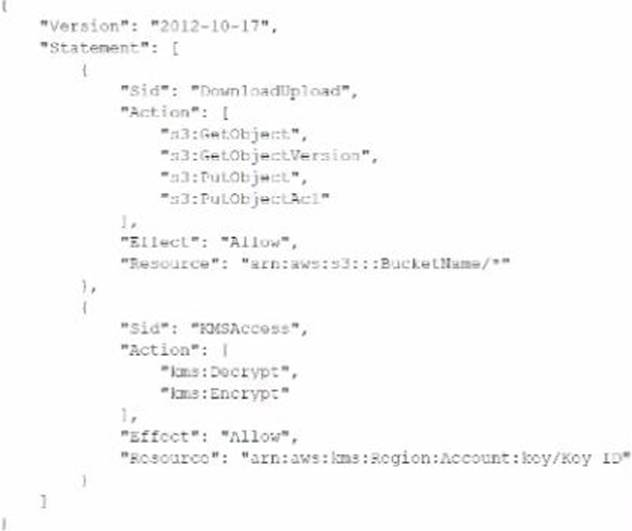
During tests, me solutions architect was able to successfully get existing test objects m the S3 bucket However, attempts to upload a new object resulted in an error message. The error message stated that me action was forbidden.
Which action must me solutions architect add to the IAM policy to meet all the requirements?
- A . Kms:GenerateDataKey
- B . KmsGetKeyPolpcy
- C . kmsGetPubKKey
- D . kms:SKjn