
Amazon SAP-C02 Practice Exams
Last updated on Oct 22,2026- Exam Code: SAP-C02
- Exam Name: AWS Certified Solutions Architect - Professional
- Certification Provider: Amazon
- Latest update: Oct 22,2026
A solutions architect needs to assess a newly acquired company’s portfolio of applications and databases. The solutions architect must create a business case to migrate the portfolio to AWS. The newly acquired company runs applications in an on-premises data center. The data center is not well documented. The solutions architect cannot immediately determine how many applications and databases exist. Traffic for the applications is variable. Some applications are batch processes that run at the end of each month.
The solutions architect must gain a better understanding of the portfolio before a migration to AWS can begin.
Which solution will meet these requirements?
- A . Use AWS Server Migration Service (AWS SMS) and AWS Database Migration Service (AWS DMS) to evaluate migration. Use AWS Service Catalog to understand application and database dependencies.
- B . Use AWS Application Migration Service. Run agents on the on-premises infrastructure. Manage the agents by using AWS Migration Hub. Use AWS Storage Gateway to assess local storage needs and database dependencies.
- C . Use Migration Evaluator to generate a list of servers. Build a report for a business case. Use AWS Migration Hub to view the portfolio. Use AWS Application Discovery Service to gain an understanding of application dependencies.
- D . Use AWS Control Tower in the destination account to generate an application portfolio. Use AWS Server Migration Service (AWS SMS) to generate deeper reports and a business case. Use a landing zone for core accounts and resources.
A company is migrating an application from on-premises infrastructure to the AWS Cloud. During migration design meetings, the company expressed concerns about the availability and recovery options for its legacy Windows file server. The file server contains sensitive business-critical data that cannot be recreated in the event of data corruption or data loss. According to compliance requirements, the data must not travel across the public internet. The company wants to move to AWS managed services where possible.
The company decides to store the data in an Amazon FSx for Windows File Server file system. A solutions architect must design a solution that copies the data to another AWS Region for disaster recovery (DR) purposes.
Which solution will meet these requirements?
- A . Create a destination Amazon S3 bucket in the DR Region. Establish connectivity between the FSx for Windows File Server file system in the primary Region and the S3 bucket in the DR Region by using Amazon FSx File Gateway. Configure the S3 bucket as a continuous backup source in FSx File Gateway.
- B . Create an FSx for Windows File Server file system in the DR Region. Establish connectivity between the VPC in the primary Region and the VPC in the DR Region by using AWS Site-to-Site VPN. Configure AWS DataSync to communicate by using VPN endpoints.
- C . Create an FSx for Windows File Server file system in the DR Region. Establish connectivity between the VPC in the primary Region and the VPC in the DR Region by using VPC peering. Configure AWS DataSync to communicate by using interface VPC endpoints with AWS PrivateLink.
- D . Create an FSx for Windows File Server file system in the DR Region. Establish connectivity between the VPC in the primary Region and the VPC in the DR Region by using AWS Transit Gateway in each Region. Use AWS Transfer Family to copy files between the FSx for Windows File Server file system in the primary Region and the FSx for Windows File Server file system in the DR Region over the private AWS backbone network.
A company uses a service to collect metadata from applications that the company hosts on premises. Consumer devices such as TVs and internet radios access the applications. Many older devices do not support certain HTTP headers and exhibit errors when these headers are present in responses. The company has configured an on-premises load balancer to remove the unsupported headers from responses sent to older devices, which the company identified by the User-Agent headers.
The company wants to migrate the service to AWS, adopt serverless technologies, and retain the ability to support the older devices. The company has already migrated the applications into a set of AWS Lambda functions.
Which solution will meet these requirements?
- A . Create an Amazon CloudFront distribution for the metadata service. Create an Application Load Balancer (ALB). Configure the CloudFront distribution to forward requests to the ALB. Configure the ALB to invoke the correct Lambda function for each type of request. Create a CloudFront function to remove the problematic headers based on the value of the User-Agent header.
- B . Create an Amazon API Gateway REST API for the metadata service. Configure API Gateway to invoke the correct Lambda function for each type of request. Modify the default gateway responses to remove the problematic headers based on the value of the User-Agent header.
- C . Create an Amazon API Gateway HTTP API for the metadata service. Configure API Gateway to invoke the correct Lambda function for each type of request. Create a response mapping template to remove the problematic headers based on the value of the User-Agent. Associate the response data mapping with the HTTP API.
- D . Create an Amazon CloudFront distribution for the metadata service. Create an
Application Load Balancer (ALB). Configure the CloudFront distribution to forward requests to the ALB. Configure the ALB to invoke the correct Lambda function for each type of request. Create a Lambda@Edge function that will remove the problematic headers in response to viewer requests based on the value of the User-Agent header.
A company is launching a new web application on Amazon EC2 instances. Development and production workloads exist in separate AWS accounts.
According to the company’s security requirements, only automated configuration tools are allowed to access the production account. The company’s security team wants to receive immediate notification if any manual access to the production AWS account or EC2 instances occurs
Which combination of actions should a solutions architect take in the production account to meet these requirements? (Select THREE.)
- A . Turn on AWS CloudTrail logs in the application’s primary AWS Region Use Amazon Athena to queiy the logs for AwsConsoleSignln events.
- B . Configure Amazon Simple Email Service (Amazon SES) to send email to the security team when an alarm is activated.
- C . Deploy EC2 instances in an Auto Scaling group Configure the launch template to deploy instances without key pairs Configure Amazon CloudWatch Logs to capture system access logs Create an Amazon CloudWatch alarm that is based on the logs to detect when a user logs in to an EC2 instance
- D . Configure an Amazon Simple Notification Service (Amazon SNS) topic to send a message to the security team when an alarm is activated
- E . Turn on AWS CloudTrail logs for all AWS Regions. Configure Amazon CloudWatch alarms to provide an alert when an AwsConsoleSignin event is detected.
- F . Deploy EC2 instances in an Auto Scaling group. Configure the launch template to delete the key pair after launch. Configure Amazon CloudWatch Logs for the system access logs Create an Amazon CloudWatch dashboard to show user logins over time.
An online magazine will launch Its latest edition this month. This edition will be the first to be distributed globally. The magazine’s dynamic website currently uses an Application Load Balancer in front of the web tier a fleet of Amazon EC2 instances for web and application servers, and Amazon Aurora MySQL. Portions of the website include static content and almost all traffic is read-only
The magazine is expecting a significant spike m internet traffic when the new edition is launched Optimal performance is a top priority for the week following the launch
Which combination of steps should a solutions architect take to reduce system response antes for a global audience? (Select TWO)
- A . Use logical cross-Region replication to replicate the Aurora MySQL database to a secondary Region Replace the web servers with Amazon S3 Deploy S3 buckets in cross-Region replication mode
- B . Ensure the web and application tiers are each m Auto Scaling groups. Introduce an AWS Direct Connect connection Deploy the web and application tiers in Regions across the world
- C . Migrate the database from Amazon Aurora to Amazon RDS for MySQL. Ensure all three of the application tiers―web. application, and database―are in private subnets.
- D . Use an Aurora global database for physical cross-Region replication. Use Amazon S3 with cross-Region replication for static content and resources. Deploy the web and application tiers in Regions across the world
- E . Introduce Amazon Route 53 with latency-based routing and Amazon CloudFront distributions. Ensure me web and application tiers are each in Auto Scaling groups
A solution architect needs to deploy an application on a fleet of Amazon EC2 instances. The EC2 instances run in private subnets in An Auto Scaling group. The application is expected to generate logs at a rate of 100 MB each second on each of the EC2 instances.
The logs must be stored in an Amazon S3 bucket so that an Amazon EMR cluster can consume them for further processing. The logs must be quickly accessible for the first 90 days and should be retrievable within 48 hours thereafter.
What is the MOST cost-effective solution that meets these requirements?
- A . Set up an S3 copy job to write logs from each EC2 instance to the S3 bucket with S3 Standard storage Use a NAT instance within the private subnets to connect to Amazon S3. Create S3 Lifecycle policies to move logs that are older than 90 days to S3 Glacier.
- B . Set up an S3 sync job to copy logs from each EC2 instance to the S3 bucket with S3 Standard storage Use a gateway VPC endpoint for Amazon S3 to connect to Amazon S3. Create S3 Lifecycle policies to move logs that are older than 90 days to S3 Glacier Deep Archive
- C . Set up an S3 batch operation to copy logs from each EC2 instance to the S3 bucket with S3 Standard storage Use a NAT gateway with the private subnets to connect to Amazon S3 Create S3 Lifecycle policies to move logs that are older than 90 days to S3 Glacier Deep Archive
- D . Set up an S3 sync job to copy logs from each EC2 instance to the S3 bucket with S3 Standard storage Use a gateway VPC endpoint for Amazon S3 to connect to Amazon S3. Create S3 Lifecycle policies to move logs that are older than 90 days to S3 Glacier
A company needs to optimize the cost of backups for Amazon Elastic File System (Amazon EFS). A solutions architect has already configured a backup plan in AWS Backup for the EFS backups. The backup plan contains a rule with a lifecycle configuration to transition EFS backups to cold storage after 7 days and to keep the backups for an additional 90 days.
After I month, the company reviews its EFS storage costs and notices an increase in the EFS backup costs. The EFS backup cold storage produces almost double the cost of the EFS warm backup storage.
What should the solutions architect do to optimize the cost?
- A . Modify the backup rule’s lifecycle configuration to move the EFS backups to cold storage after 1 day. Set the backup retention period to 30 days.
- B . Modify the backup rule’s lifecycle configuration to move the EFS backups to cold storage after 8 days. Set the backup retention period to 30 days.
- C . Modify the backup rule’s lifecycle configuration to move the EFS backups to cold storage after 1 day. Set the backup retention period to 90 days.
- D . Modify the backup rule’s lifecycle configuration to move the EFS backups to cold storage after 8 days. Set the backup retention period to 98 days.
A company runs a web application on AWS. The web application delivers static content from an Amazon S3 bucket that is behind an Amazon CloudFront distribution. The application serves dynamic content by using an Application Load Balancer (ALB) that distributes requests to a fleet of Amazon EC2 instances in Auto Scaling groups. The application uses a domain name setup in Amazon Route 53.
Some users reported occasional issues when the users attempted to access the website during peak hours. An operations team found that the ALB sometimes returned HTTP 503 Service Unavailable errors. The company wants to display a custom error message page when these errors occur. The page should be displayed immediately for this error code.
Which solution will meet these requirements with the LEAST operational overhead?
- A . Set up a Route 53 failover routing policy. Configure a health check to determine the status of the ALB endpoint and to fail over to the failover S3 bucket endpoint.
- B . Create a second CloudFront distribution and an S3 static website to host the custom error page. Set up a Route 53 failover routing policy. Use an active-passive configuration between the two distributions.
- C . Create a CloudFront origin group that has two origins. Set the ALB endpoint as the primary origin. For the secondary origin, set an S3 bucket that is configured to host a static website Set up origin failover for the CloudFront distribution. Update the S3 static website to incorporate the custom error page.
- D . Create a CloudFront function that validates each HTTP response code that the ALB returns. Create an S3 static website in an S3 bucket. Upload the custom error page to the S3 bucket as a failover. Update the function to read the S3 bucket and to serve the error page to the end users.
A company is planning to migrate an on-premises data center to AWS. The company currently hosts the data center on Linux-based VMware VMs. A solutions architect must collect information about network dependencies between the VMs. The information must be in the form of a diagram that details host IP addresses, hostnames, and network connection information.
Which solution will meet these requirements?
- A . Use AWS Application Discovery Service. Select an AWS Migration Hub home AWS Region. Install the AWS Application Discovery Agent on the on-premises servers for data collection. Grant permissions to Application Discovery Service to use the Migration Hub network diagrams.
- B . Use the AWS Application Discovery Service Agentless Collector for server data collection. Export the network diagrams from the AWS Migration Hub in .png format.
- C . Install the AWS Application Migration Service agent on the on-premises servers for data collection.
Use AWS Migration Hub data in Workload Discovery on AWS to generate network diagrams. - D . Install the AWS Application Migration Service agent on the on-premises servers for data collection. Export data from AWS Migration Hub in .csv format into an Amazon CloudWatch dashboard to generate network diagrams.
A company is in the process of implementing AWS Organizations to constrain its developers to use only Amazon EC2. Amazon S3 and Amazon DynamoDB. The developers account resides In a dedicated organizational unit (OU).
The solutions architect has implemented the following SCP on the developers account:
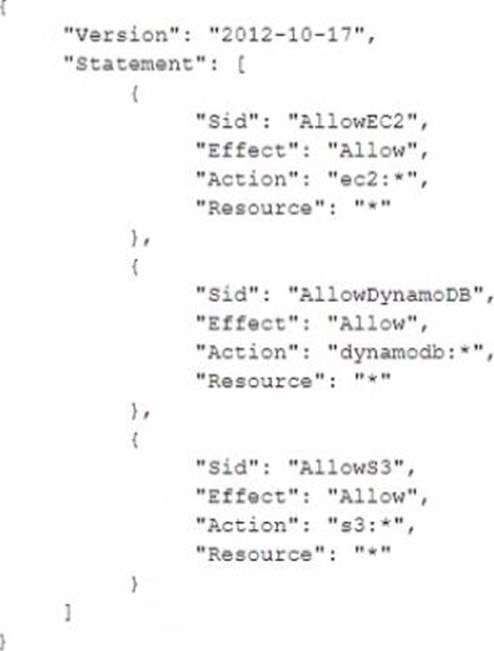
When this policy is deployed, IAM users in the developers account are still able to use AWS services that are not listed in the policy.
What should the solutions architect do to eliminate the developers’ ability to use services outside the scope of this policy?
- A . Create an explicit deny statement for each AWS service that should be constrained
- B . Remove the Full AWS Access SCP from the developer account’s OU
- C . Modify the Full AWS Access SCP to explicitly deny all services
- D . Add an explicit deny statement using a wildcard to the end of the SCP