
Amazon MLS-C01 Practice Exams
Last updated on Oct 23,2026- Exam Code: MLS-C01
- Exam Name: AWS Certified Machine Learning - Specialty
- Certification Provider: Amazon
- Latest update: Oct 23,2026
An ecommerce company has used Amazon SageMaker to deploy a factorization machines (FM) model to suggest products for customers. The company’s data science team has developed two new models by using the TensorFlow and PyTorch deep learning frameworks. The company needs to use A/B testing to evaluate the new models against the deployed model. …required A/B testing setup is as follows:
• Send 70% of traffic to the FM model, 15% of traffic to the TensorFlow model, and 15% of traffic to the Py Torch model.
• For customers who are from Europe, send all traffic to the TensorFlow model
..sh architecture can the company use to implement the required A/B testing setup?
- A . Create two new SageMaker endpoints for the TensorFlow and PyTorch models in addition to the existing SageMaker endpoint. Create an Application Load Balancer Create a target group for each endpoint. Configure listener rules and add weight to the target groups. To send traffic to the TensorFlow model for customers who are from Europe, create an additional listener rule to forward traffic to the TensorFlow target group.
- B . Create two production variants for the TensorFlow and PyTorch models. Create an auto scaling policy and configure the desired A/B weights to direct traffic to each production variant Update the existing SageMaker endpoint with the auto scaling policy. To send traffic to the TensorFlow model for customers who are from Europe, set the TargetVariant header in the request to point to the variant name of the TensorFlow model.
- C . Create two new SageMaker endpoints for the TensorFlow and PyTorch models in addition to the existing SageMaker endpoint. Create a Network Load Balancer. Create a target group for each endpoint. Configure listener rules and add weight to the target groups. To send traffic to the TensorFlow model for customers who are from Europe, create an additional listener rule to forward traffic to the TensorFlow target group.
- D . Create two production variants for the TensorFlow and PyTorch models. Specify the weight for each production variant in the SageMaker endpoint configuration. Update the existing SageMaker endpoint with the new configuration. To send traffic to the TensorFlow model for customers who are from Europe, set the TargetVariant header in the request to point to the variant name of the TensorFlow model.
D
Explanation:
The correct answer is D because it allows the company to use the existing SageMaker endpoint and leverage the built-in functionality of production variants for A/B testing. Production variants can be used to test ML models that have been trained using different training datasets, algorithms, and ML frameworks; test how they perform on different instance types; or a combination of all of the above1. By specifying the weight for each production variant in the endpoint configuration, the company can control how much traffic to send to each variant. By setting the TargetVariant header in the request, the company can invoke a specific variant directly for each request2. This enables the company to implement the required A/B testing setup without creating additional endpoints or load balancers.
References:
1: Production variants – Amazon SageMaker
2: A/B Testing ML models in production using Amazon SageMaker | AWS Machine Learning Blog
A trucking company is collecting live image data from its fleet of trucks across the globe. The data is growing rapidly and approximately 100 GB of new data is generated every day. The company wants to explore machine learning uses cases while ensuring the data is only accessible to specific IAM users.
Which storage option provides the most processing flexibility and will allow access control with IAM?
- A . Use a database, such as Amazon DynamoDB, to store the images, and set the IAM policies to restrict access to only the desired IAM users.
- B . Use an Amazon S3-backed data lake to store the raw images, and set up the permissions using bucket policies.
- C . Setup up Amazon EMR with Hadoop Distributed File System (HDFS) to store the files, and restrict access to the EMR instances using IAM policies.
- D . Configure Amazon EFS with IAM policies to make the data available to Amazon EC2 instances owned by the IAM users.
B
Explanation:
The best storage option for the trucking company is to use an Amazon S3-backed data lake to store the raw images, and set up the permissions using bucket policies. A data lake is a centralized repository that allows you to store all your structured and unstructured data at any scale. Amazon S3 is the ideal choice for building a data lake because it offers high durability, scalability, availability, and security. You can store any type of data in Amazon S3, such as images, videos, audio, text, etc. You can also use AWS services such as Amazon Rekognition, Amazon SageMaker, and Amazon EMR to analyze and process the data in the data lake. To ensure the data is only accessible to specific IAM users, you can use bucket policies to grant or deny access to the S3 buckets based on the IAM user’s identity or role. Bucket policies are JSON documents that specify the permissions for the bucket and the objects in it. You can use conditions to restrict access based on various factors, such as IP address, time, source, etc. By using bucket policies, you can control who can access the data in the data lake and what actions they can perform on it.
References:
AWS Machine Learning Specialty Exam Guide
AWS Machine Learning Training – Build a Data Lake Foundation with Amazon S3 AWS Machine Learning Training – Using Bucket Policies and User Policies
Each morning, a data scientist at a rental car company creates insights about the previous day’s rental car reservation demands. The company needs to automate this process by streaming the data to Amazon S3 in near real time. The solution must detect high-demand rental cars at each of the company’s locations. The solution also must create a visualization dashboard that automatically refreshes with the most recent data.
Which solution will meet these requirements with the LEAST development time?
- A . Use Amazon Kinesis Data Firehose to stream the reservation data directly to Amazon S3. Detect high-demand outliers by using Amazon QuickSight ML Insights. Visualize the data in QuickSight.
- B . Use Amazon Kinesis Data Streams to stream the reservation data directly to Amazon S3. Detect high-demand outliers by using the Random Cut Forest (RCF) trained model in Amazon SageMaker. Visualize the data in Amazon QuickSight.
- C . Use Amazon Kinesis Data Firehose to stream the reservation data directly to Amazon S3. Detect high-demand outliers by using the Random Cut Forest (RCF) trained model in Amazon SageMaker. Visualize the data in Amazon QuickSight.
- D . Use Amazon Kinesis Data Streams to stream the reservation data directly to Amazon S3. Detect high-demand outliers by using Amazon QuickSight ML Insights. Visualize the data in QuickSight.
A
Explanation:
The solution that will meet the requirements with the least development time is to use Amazon Kinesis Data Firehose to stream the reservation data directly to Amazon S3, detect high-demand outliers by using Amazon QuickSight ML Insights, and visualize the data in QuickSight. This solution does not require any custom development or ML domain expertise, as it leverages the built-in features of QuickSight ML Insights to automatically run anomaly detection and generate insights on the streaming data. QuickSight ML Insights can also create a visualization dashboard that automatically refreshes with the most recent data, and allows the data scientist to explore the outliers and their key drivers.
References:
1: Simplify and automate anomaly detection in streaming data with Amazon Lookout for Metrics | AWS Machine Learning Blog
2: Detecting outliers with ML-powered anomaly detection – Amazon QuickSight
3: Real-time Outlier Detection Over Streaming Data – IEEE Xplore
4: Towards a deep learning-based outlier detection … – Journal of Big Data
A Machine Learning Specialist is assigned to a Fraud Detection team and must tune an XGBoost model, which is working appropriately for test data.
However, with unknown data, it is not working as expected. The existing parameters are provided as follows.
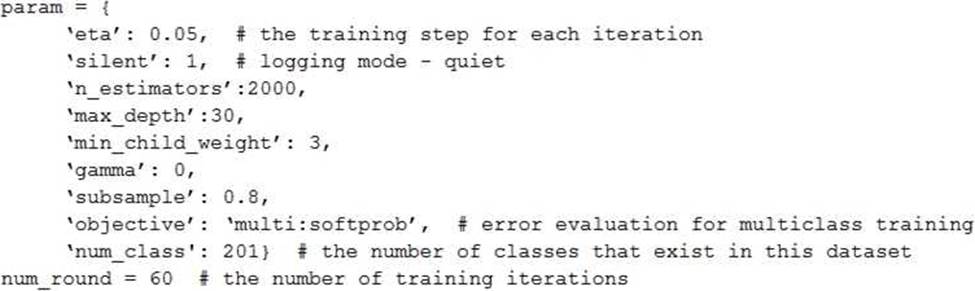
Which parameter tuning guidelines should the Specialist follow to avoid overfitting?
- A . Increase the max_depth parameter value.
- B . Lower the max_depth parameter value.
- C . Update the objective to binary:logistic.
- D . Lower the min_child_weight parameter value.
B
Explanation:
Overfitting occurs when a model performs well on the training data but poorly on the test data. This is often because the model has learned the training data too well and is not able to generalize to new data. To avoid overfitting, the Machine Learning Specialist should lower the max_depth parameter value. This will reduce the complexity of the model and make it less likely to overfit. According to the XGBoost documentation1, the max_depth parameter controls the maximum depth of a tree and lower values can help prevent overfitting. The documentation also suggests other ways to control overfitting, such as adding randomness, using regularization, and using early stopping1.
References: XGBoost Parameters
A library is developing an automatic book-borrowing system that uses Amazon Rekognition. Images of library members’ faces are stored in an Amazon S3 bucket. When members borrow books, the Amazon Rekognition CompareFaces API operation compares real faces against the stored faces in Amazon S3.
The library needs to improve security by making sure that images are encrypted at rest. Also, when the images are used with Amazon Rekognition. they need to be encrypted in transit. The library also must ensure that the images are not used to improve Amazon Rekognition as a service.
How should a machine learning specialist architect the solution to satisfy these requirements?
- A . Enable server-side encryption on the S3 bucket. Submit an AWS Support ticket to opt out of allowing images to be used for improving the service, and follow the process provided by AWS Support.
- B . Switch to using an Amazon Rekognition collection to store the images. Use the IndexFaces and SearchFacesByImage API operations instead of the CompareFaces API operation.
- C . Switch to using the AWS GovCloud (US) Region for Amazon S3 to store images and for Amazon Rekognition to compare faces. Set up a VPN connection and only call the Amazon Rekognition API operations through the VPN.
- D . Enable client-side encryption on the S3 bucket. Set up a VPN connection and only call the Amazon Rekognition API operations through the VPN.
A
Explanation:
The best solution for encrypting images at rest and in transit, and opting out of data usage for service improvement, is to use the following steps:
Enable server-side encryption on the S3 bucket. This will encrypt the images stored in the bucket using AWS Key Management Service (AWS KMS) customer master keys (CMKs). This will protect the data at rest from unauthorized access1
Submit an AWS Support ticket to opt out of allowing images to be used for improving the service, and follow the process provided by AWS Support. This will prevent AWS from storing or using the images processed by Amazon Rekognition for service development or enhancement purposes. This will protect the data privacy and ownership2
Use HTTPS to call the Amazon Rekognition CompareFaces API operation. This will encrypt the data in transit between the client and the server using SSL/TLS protocols. This will protect the data from interception or tampering3
The other options are incorrect because they either do not encrypt the images at rest or in transit, or do not opt out of data usage for service improvement.
For example:
Option B switches to using an Amazon Rekognition collection to store the images. A collection is a container for storing face vectors that are calculated by Amazon Rekognition. It does not encrypt the images at rest or in transit, and it does not opt out of data usage for service improvement. It also requires changing the API operations from CompareFaces to IndexFaces and SearchFacesByImage, which may not have the same functionality or performance4
Option C switches to using the AWS GovCloud (US) Region for Amazon S3 and Amazon Rekognition.
The AWS GovCloud (US) Region is an isolated AWS Region designed to host sensitive data and regulated workloads in the cloud. It does not automatically encrypt the images at rest or in transit, and it does not opt out of data usage for service improvement. It also requires migrating the data and the application to a different Region, which may incur additional costs and complexity5
Option D enables client-side encryption on the S3 bucket. This means that the client is responsible for encrypting and decrypting the images before uploading or downloading them from the bucket.
This adds extra overhead and complexity to the client application, and it does not encrypt the data in transit when calling the Amazon Rekognition API. It also does not opt out of data usage for service improvement.
Reference:
1: Protecting Data Using Server-Side Encryption with AWS KMSCManaged Keys (SSE-KMS) – Amazon Simple Storage Service
2: Opting Out of Content Storage and Use for Service Improvements – Amazon Rekognition
3: HTTPS – Wikipedia
4: Working with Stored Faces – Amazon Rekognition
5: AWS GovCloud (US) – Amazon Web Services
: Protecting Data Using Client-Side Encryption – Amazon Simple Storage Service
A manufacturer is operating a large number of factories with a complex supply chain relationship where unexpected downtime of a machine can cause production to stop at several factories. A data scientist wants to analyze sensor data from the factories to identify equipment in need of preemptive maintenance and then dispatch a service team to prevent unplanned downtime. The sensor readings from a single machine can include up to 200 data points including temperatures, voltages, vibrations, RPMs, and pressure readings.
To collect this sensor data, the manufacturer deployed Wi-Fi and LANs across the factories. Even though many factory locations do not have reliable or high-speed internet connectivity, the manufacturer would like to maintain near-real-time inference capabilities.
Which deployment architecture for the model will address these business requirements?
- A . Deploy the model in Amazon SageMaker. Run sensor data through this model to predict which machines need maintenance.
- B . Deploy the model on AWS IoT Greengrass in each factory. Run sensor data through this model to infer which machines need maintenance.
- C . Deploy the model to an Amazon SageMaker batch transformation job. Generate inferences in a daily batch report to identify machines that need maintenance.
- D . Deploy the model in Amazon SageMaker and use an IoT rule to write data to an Amazon DynamoDB table. Consume a DynamoDB stream from the table with an AWS Lambda function to invoke the endpoint.
B
Explanation:
AWS IoT Greengrass is a service that extends AWS to edge devices, such as sensors and machines, so they can act locally on the data they generate, while still using the cloud for management, analytics, and durable storage. AWS IoT Greengrass enables local device messaging, secure data transfer, and local computing using AWS Lambda functions and machine learning models. AWS IoT Greengrass can run machine learning inference locally on devices using models that are created and trained in the cloud. This allows devices to respond quickly to local events, even when they are offline or have intermittent connectivity. Therefore, option B is the best deployment architecture for the model to address the business requirements of the manufacturer.
Option A is incorrect because deploying the model in Amazon SageMaker would require sending the sensor data to the cloud for inference, which would not work well for factory locations that do not have reliable or high-speed internet connectivity. Moreover, this option would not provide near-real-time inference capabilities, as there would be latency and bandwidth issues involved in transferring the data to and from the cloud.
Option C is incorrect because deploying the model to an Amazon SageMaker batch transformation job would not provide near-real-time inference capabilities, as batch transformation is an asynchronous process that operates on large datasets. Batch transformation is not suitable for streaming data that requires low-latency responses.
Option D is incorrect because deploying the model in Amazon SageMaker and using an IoT rule to write data to an Amazon DynamoDB table would also require sending the sensor data to the cloud for inference, which would have the same drawbacks as option A. Moreover, this option would introduce additional complexity and cost by involving multiple services, such as IoT Core, DynamoDB, and Lambda.
References:
AWS Greengrass Machine Learning Inference – Amazon Web Services Machine learning components – AWS IoT Greengrass.
What is AWS Greengrass? | AWS IoT Core | Onica
GitHub – aws-samples/aws-greengrass-ml-deployment-sample
AWS IoT Greengrass Architecture and Its Benefits | Quick Guide – XenonStack
An aircraft engine manufacturing company is measuring 200 performance metrics in a time-series. Engineers want to detect critical manufacturing defects in near-real time during testing. All of the data needs to be stored for offline analysis.
What approach would be the MOST effective to perform near-real time defect detection?
- A . Use AWS IoT Analytics for ingestion, storage, and further analysis. Use Jupyter notebooks from within AWS IoT Analytics to carry out analysis for anomalies.
- B . Use Amazon S3 for ingestion, storage, and further analysis. Use an Amazon EMR cluster to carry out Apache Spark ML k-means clustering to determine anomalies.
- C . Use Amazon S3 for ingestion, storage, and further analysis. Use the Amazon SageMaker Random Cut Forest (RCF) algorithm to determine anomalies.
- D . Use Amazon Kinesis Data Firehose for ingestion and Amazon Kinesis Data Analytics Random Cut Forest (RCF) to perform anomaly detection. Use Kinesis Data Firehose to store data in Amazon S3 for further analysis.
D
Explanation:
The company wants to perform near-real time defect detection on a time-series of 200 performance metrics, and store all the data for offline analysis. The best approach for this scenario is to use Amazon Kinesis Data Firehose for ingestion and Amazon Kinesis Data Analytics Random Cut Forest (RCF) to perform anomaly detection. Use Kinesis Data Firehose to store data in Amazon S3 for further analysis.
Amazon Kinesis Data Firehose is a service that can capture, transform, and deliver streaming data to destinations such as Amazon S3, Amazon Redshift, Amazon OpenSearch Service, and Splunk. Kinesis Data Firehose can handle any amount and frequency of data, and automatically scale to match the throughput. Kinesis Data Firehose can also compress, encrypt, and batch the data before delivering it to the destination, reducing the storage cost and enhancing the security.
Amazon Kinesis Data Analytics is a service that can analyze streaming data in real time using SQL or Apache Flink applications. Kinesis Data Analytics can use built-in functions and algorithms to perform various analytics tasks, such as aggregations, joins, filters, windows, and anomaly detection. One of the built-in algorithms that Kinesis Data Analytics supports is Random Cut Forest (RCF), which is a supervised learning algorithm for forecasting scalar time series using recurrent neural networks. RCF can detect anomalies in streaming data by assigning an anomaly score to each data point, based on how distant it is from the rest of the data. RCF can handle multiple related time series, such as the performance metrics of the aircraft engine, and learn a global model that captures the common patterns and trends across the time series.
Therefore, the company can use the following architecture to build the near-real time defect detection solution:
Use Amazon Kinesis Data Firehose for ingestion: The company can use Kinesis Data Firehose to capture the streaming data from the aircraft engine testing, and deliver it to two destinations: Amazon S3 and Amazon Kinesis Data Analytics. The company can configure the Kinesis Data Firehose delivery stream to specify the source, the buffer size and interval, the compression and encryption options, the error handling and retry logic, and the destination details.
Use Amazon Kinesis Data Analytics Random Cut Forest (RCF) to perform anomaly detection: The company can use Kinesis Data Analytics to create a SQL application that can read the streaming data from the Kinesis Data Firehose delivery stream, and apply the RCF algorithm to detect anomalies. The company can use the RANDOM_CUT_FOREST or RANDOM_CUT_FOREST_WITH_EXPLANATION functions to compute the anomaly scores and attributions for each data point, and use the WHERE clause to filter out the normal data points. The company can also use the CURSOR function to specify the input stream, and the PUMP function to write the output stream to another destination, such as Amazon Kinesis Data Streams or AWS Lambda.
Use Kinesis Data Firehose to store data in Amazon S3 for further analysis: The company can use Kinesis Data Firehose to store the raw and processed data in Amazon S3 for offline analysis. The company can use the S3 destination of the Kinesis Data Firehose delivery stream to store the raw data, and use another Kinesis Data Firehose delivery stream to store the output of the Kinesis Data Analytics application. The company can also use AWS Glue or Amazon Athena to catalog, query, and analyze the data in Amazon S3.
References:
What Is Amazon Kinesis Data Firehose?
What Is Amazon Kinesis Data Analytics for SQL Applications?
DeepAR Forecasting Algorithm – Amazon SageMaker
A bank’s Machine Learning team is developing an approach for credit card fraud detection. The company has a large dataset of historical data labeled as fraudulent. The goal is to build a model to take the information from new transactions and predict whether each transaction is fraudulent or not
Which built-in Amazon SageMaker machine learning algorithm should be used for modeling this problem?
- A . Seq2seq
- B . XGBoost
- C . K-means
- D . Random Cut Forest (RCF)
B
Explanation:
XGBoost is a built-in Amazon SageMaker machine learning algorithm that should be used for modeling the credit card fraud detection problem. XGBoost is an algorithm that implements a scalable and distributed gradient boosting framework, which is a popular and effective technique for supervised learning problems. Gradient boosting is a method of combining multiple weak learners, such as decision trees, into a strong learner, by iteratively fitting new models to the residual errors of the previous models and adding them to the ensemble. XGBoost can handle various types of data, such as numerical, categorical, or text, and can perform both regression and classification tasks. XGBoost also supports various features and optimizations, such as regularization, missing value handling, parallelization, and cross-validation, that can improve the performance and efficiency of the algorithm.
XGBoost is suitable for the credit card fraud detection problem for the following reasons:
The problem is a binary classification problem, where the goal is to predict whether a transaction is fraudulent or not, based on the information from new transactions. XGBoost can perform binary classification by using a logistic regression objective function and outputting the probability of the positive class (fraudulent) for each transaction.
The problem involves a large and imbalanced dataset of historical data labeled as fraudulent. XGBoost can handle large-scale and imbalanced data by using distributed and parallel computing, as well as techniques such as weighted sampling, class weighting, or stratified sampling, to balance the classes and reduce the bias towards the majority class (non-fraudulent).
The problem requires a high accuracy and precision for detecting fraudulent transactions, as well as a low false positive rate for avoiding false alarms. XGBoost can achieve high accuracy and precision by using gradient boosting, which can learn complex and non-linear patterns from the data and reduce the variance and overfitting of the model. XGBoost can also achieve a low false positive rate by using regularization, which can reduce the complexity and noise of the model and prevent it from fitting spurious signals in the data.
The other options are not as suitable as XGBoost for the credit card fraud detection problem for the following reasons:
Seq2seq: Seq2seq is an algorithm that implements a sequence-to-sequence model, which is a type of neural network model that can map an input sequence to an output sequence. Seq2seq is mainly used for natural language processing tasks, such as machine translation, text summarization, or dialogue generation. Seq2seq is not suitable for the credit card fraud detection problem, because the problem is not a sequence-to-sequence task, but a binary classification task. The input and output of the problem are not sequences of words or tokens, but vectors of features and labels.
K-means: K-means is an algorithm that implements a clustering technique, which is a type of unsupervised learning method that can group similar data points into clusters. K-means is mainly used for exploratory data analysis, dimensionality reduction, or anomaly detection. K-means is not suitable for the credit card fraud detection problem, because the problem is not a clustering task, but a classification task. The problem requires using the labeled data to train a model that can predict the labels of new data, not finding the optimal number of clusters or the cluster memberships of the data.
Random Cut Forest (RCF): RCF is an algorithm that implements an anomaly detection technique, which is a type of unsupervised learning method that can identify data points that deviate from the normal behavior or distribution of the data. RCF is mainly used for detecting outliers, frauds, or faults in the data. RCF is not suitable for the credit card fraud detection problem, because the problem is not an anomaly detection task, but a classification task. The problem requires using the labeled data to train a model that can predict the labels of new data, not finding the anomaly scores or the anomalous data points in the data.
References:
XGBoost Algorithm
Use XGBoost for Binary Classification with Amazon SageMaker
Seq2seq Algorithm
K-means Algorithm
[Random Cut Forest Algorithm]
A data scientist has developed a machine learning translation model for English to Japanese by using Amazon SageMaker’s built-in seq2seq algorithm with 500,000 aligned sentence pairs. While testing with sample sentences, the data scientist finds that the translation quality is reasonable for an example as short as five words. However, the quality becomes unacceptable if the sentence is 100 words long.
Which action will resolve the problem?
- A . Change preprocessing to use n-grams.
- B . Add more nodes to the recurrent neural network (RNN) than the largest sentence’s word count.
- C . Adjust hyperparameters related to the attention mechanism.
- D . Choose a different weight initialization type.
C
Explanation:
The data scientist should adjust hyperparameters related to the attention mechanism to resolve the problem. The attention mechanism is a technique that allows the decoder to focus on different parts of the input sequence when generating the output sequence. It helps the model cope with long input sequences and improve the translation quality. The Amazon SageMaker seq2seq algorithm supports different types of attention mechanisms, such as dot, general, concat, and mlp. The data scientist can use the hyperparameter attention_type to choose the type of attention mechanism. The data scientist can also use the hyperparameter attention_coverage_type to enable coverage, which is a mechanism that penalizes the model for attending to the same input positions repeatedly. By adjusting these hyperparameters, the data scientist can fine-tune the attention mechanism and reduce the number of false negative predictions by the model.
References:
Sequence-to-Sequence Algorithm – Amazon SageMaker
Attention Mechanism – Sockeye Documentation