
Amazon MLA-C01 Practice Exams
Last updated on Oct 22,2026- Exam Code: MLA-C01
- Exam Name: AWS Certified Machine Learning Engineer - Associate
- Certification Provider: Amazon
- Latest update: Oct 22,2026
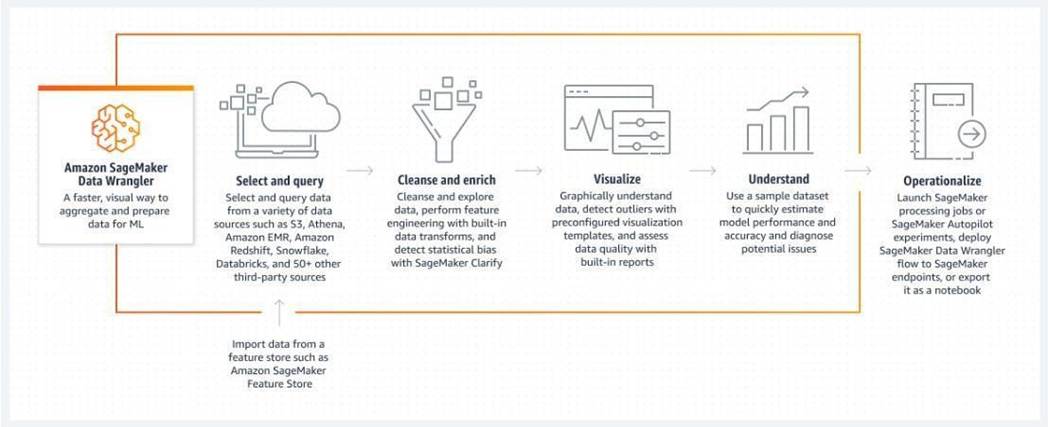
A company stores its training datasets on Amazon S3 in the form of tabular data running into millions of rows. The company needs to prepare this data for Machine Learning jobs. The data preparation involves data selection, cleansing, exploration, and visualization using a single visual interface.
Which Amazon SageMaker service is the best fit for this requirement?
- A . Amazon SageMaker Feature Store
- B . Amazon SageMaker Data Wrangler
- C . SageMaker Model Dashboard
- D . Amazon SageMaker Clarify
You are a machine learning engineer at a fintech company that has developed several models for various use cases, including fraud detection, credit scoring, and personalized marketing. Each model has different performance and deployment requirements. The fraud detection model requires real-time predictions with low latency and needs to scale quickly based on incoming transaction volumes. The credit scoring model is computationally intensive but can tolerate batch processing with slightly higher latency. The personalized marketing model needs to be triggered by events and doesn’t require constant availability.
Given these varying requirements, which deployment target is the MOST SUITABLE for each model?
- A . Deploy the fraud detection model using AWS Lambda for serverless, on-demand execution, deploy the credit scoring model on Amazon EKS for scalable batch processing, and deploy the personalized marketing model on SageMaker endpoints to handle event-driven inference
- B . Deploy the fraud detection model using SageMaker endpoints for low-latency, real-time predictions, deploy the credit scoring model on Amazon ECS for batch processing, and deploy the personalized marketing model using AWS Lambda for event-driven execution
- C . Deploy all three models on a single Amazon EKS cluster to take advantage of Kubernetes orchestration, ensuring consistent management and scaling across different use cases
- D . Deploy the fraud detection model on Amazon ECS for auto-scaling based on demand, deploy the credit scoring model using SageMaker endpoints for real-time scoring, and deploy the personalized marketing model on Amazon EKS for event-driven processing
You are a machine learning engineer responsible for managing a fraud detection model deployed on Amazon SageMaker. The model needs to be retrained periodically as new transaction data becomes available and as data distribution shifts over time. To ensure compliance and traceability, the company requires that all re-training activities, including data access and model updates, be logged and monitored. Additionally, the security team wants to be notified of any unauthorized attempts to retrain the model.
How can you use AWS CloudTrail to meet these guidelines?
- A . Enable detailed monitoring in Amazon CloudWatch to track all SageMaker activities, and use CloudWatch Logs to store and analyze the logs for any suspicious activity related to re-training
- B . Enable AWS CloudTrail to log all API calls related to SageMaker, including CreateTrainingJob and UpdateEndpoint, and configure CloudWatch Alarms to notify the security team if unauthorized API calls are detected
- C . Configure AWS CloudTrail to log only the data access events that trigger re-training, and manually trigger model re-training when changes in the data are detected through these logs
- D . Enable AWS CloudWatch to log all API calls related to SageMaker, including CreateTrainingJob and UpdateEndpoint, and configure CloudWatch Alarms to notify the security team if unauthorized API calls are detected
Your company is starting a new machine learning project, and the data preparation tasks are being handled by a team of business analysts. These analysts are more comfortable working with visual tools rather than writing code, and they need to combine, transform, and clean large datasets efficiently. The goal is to use a SageMaker tool that allows them to perform these tasks using a visual, point-and-click interface.
Which SageMaker tool(s) would best suit the team’s requirements for preparing and analyzing data without writing code?
- A . Prepare data using Amazon EMR in Studio
- B . Use Amazon SageMaker Data Wrangler within Amazon SageMaker Canvas
- C . Prepare data with SQL in Amazon SageMaker Studio. The SQL extension connections to Amazon Athena for working with datasets
- D . Use Amazon SageMaker Data Wrangler within Amazon SageMaker JumpStart
You are a machine learning engineer responsible for maintaining an ML pipeline that processes customer transaction data to detect fraudulent activity. The pipeline includes several stages: data ingestion, data preprocessing, model inference, and result storage. The pipeline runs continuously, processing large volumes of data in near real-time. Recently, you’ve noticed that some transactions are being incorrectly classified as non-fraudulent, raising concerns about potential anomalies or errors in the data processing or model inference stages.
Given the critical nature of the pipeline, which approach is the MOST EFFECTIVE for addressing these issues?
- A . Schedule periodic manual reviews of a random sample of processed transactions to check for anomalies or errors, documenting any issues for further investigation
- B . Use AWS Lambda functions to log and audit every transaction processed by the pipeline, storing detailed logs in Amazon S3 for manual analysis when anomalies are suspected
- C . Implement Amazon SageMaker Model Monitor to track the distribution of input data features and model predictions over time, alerting you when deviations from expected patterns occur
- D . Set up Amazon CloudWatch alarms to monitor CPU and memory usage across the pipeline’s compute resources, and trigger notifications if these metrics exceed predefined thresholds
A company has recently migrated to AWS Cloud and it wants to optimize the hardware used for its AI workflows.
Which of the following would you suggest?
- A . Leverage either AWS Trainium or AWS Inferentia for the deep learning (DL) and generative AI inference applications
- B . Leverage AWS Trainium for high-performance, cost-effective Deep Learning training. Leverage AWS Inferentia for the deep learning (DL) and generative AI inference applications
- C . Leverage either AWS Trainium or AWS Inferentia for high-performance, cost-effective Deep Learning training
- D . Leverage AWS Inferentia for high-performance, cost-effective Deep Learning training. Leverage AWS Trainium for the deep learning (DL) and generative AI inference applications
You are a data scientist working for an e-commerce company that wants to implement personalized product recommendations for its users. The company has a large dataset of user interactions, including clicks, purchases, and reviews. The goal is to create a recommendation system that can scale to millions of users while providing real-time recommendations based on user behavior. You need to choose the most appropriate built-in algorithm in Amazon SageMaker to achieve this goal.
Given the requirements, which of the following Amazon SageMaker built-in algorithms is the MOST SUITABLE for this use case?
- A . XGBoost Algorithm to rank the products based on user behavior and demographic features
- B . K-Means Algorithm to cluster users into segments and recommend products based on these segments
- C . Factorization Machines Algorithm to model user-item interactions for collaborative filtering
- D . BlazingText Algorithm to analyze the text in user reviews and identify product similarities
What is a key difference in feature engineering tasks for structured data compared to unstructured data in the context of machine learning?
- A . Feature engineering for structured data is not necessary as the data is already in a usable format, whereas for unstructured data, extensive preprocessing is always required
- B . Feature engineering for structured data often involves tasks such as normalization and handling missing values, while for unstructured data, it involves tasks such as tokenization and vectorization
- C . Feature engineering tasks for structured data and unstructured data are identical and do not vary based on data type
- D . Feature engineering for structured data focuses on image recognition, whereas for unstructured
data, it focuses on numerical data analysis