Amazon MLA-C01 Practice Exams
Last updated on Oct 22,2026- Exam Code: MLA-C01
- Exam Name: AWS Certified Machine Learning Engineer - Associate
- Certification Provider: Amazon
- Latest update: Oct 22,2026
You are a machine learning engineer tasked with deploying a machine learning model to a mobile device for real-time object detection. The model currently performs well but is too large to fit within the device’s memory and computational constraints. To ensure the model can run efficiently on the device without sacrificing too much accuracy, you need to reduce its size.
Given these constraints, which combination of techniques is the MOST LIKELY to effectively reduce the model’s size while maintaining acceptable performance?
- A . Reduce the size of the training dataset, use dropout to decrease model complexity, thereby shrinking the deployed model size
- B . Prune the model by removing less important neurons and layers, and apply quantization to reduce the precision of the model’s weights from 32-bit to 8-bit
- C . Use feature selection to reduce the number of input features, compress the model by converting the model weights from floating-point to integer format
- D . Apply dimensionality reduction using PCA on the input data, and use model ensembling to combine smaller models, which collectively match the performance of the original model
You are a machine learning engineer at a financial services company responsible for maintaining a fraud detection model deployed on Amazon SageMaker. The model processes a high volume of real-time transactions and must respond with low latency to ensure a seamless customer experience. Recently, the model has experienced increased latency during peak traffic times, and there have been instances where requests were dropped due to insufficient capacity.
Which approach is the MOST EFFECTIVE for monitoring and resolving these latency and scaling issues in your ML solution?
- A . Configure Amazon CloudWatch to monitor key metrics such as invocation latency, model error rates, and CPU utilization. Set up CloudWatch Alarms to automatically trigger an increase in instance count when latency exceeds a predefined threshold, and enable auto-scaling on the SageMaker endpoint to handle traffic spikes
- B . Use Amazon SageMaker Model Monitor to track the performance of the model and identify data drift. Adjust the model’s hyperparameters based on the results to reduce latency and improve scalability during peak times
- C . Manually monitor the model’s performance using the SageMaker console, and manually increase the instance size whenever latency is detected, to ensure the model remains responsive during peak periods
- D . Implement a serverless architecture using AWS Lambda for model inference to eliminate latency
and scaling issues. Use Amazon CloudFront to cache inference results for faster response times
Which of the following is correct regarding the techniques used to improve the performance of a Foundation Model (FM)?
- A . Neither Fine-tuning nor Retrieval-augmented generation (RAG) changes the weights of the FM
- B . Both Fine-tuning and Retrieval-augmented generation (RAG) change the weights of the FM
- C . Fine-tuning does not change the weights of the FM whereas Retrieval-augmented generation (RAG) changes the weights of the FM
- D . Fine-tuning changes the weights of the FM whereas Retrieval-augmented generation (RAG) does
not change the weights of the FM
You are a DevOps engineer at a tech company that is building a scalable microservices-based application. The application is composed of several containerized services, each responsible for different parts of the application, such as user authentication, data processing, and recommendation systems. The company wants to standardize and automate the deployment and management of its infrastructure using Infrastructure as Code (IaC). You need to choose between AWS CloudFormation and AWS Cloud Development Kit (CDK) for defining the infrastructure. Additionally, you must decide on the appropriate AWS container service to manage and deploy these microservices efficiently.
Given the requirements, which combination of IaC option and container service is MOST SUITABLE for this scenario, and why?
- A . Use AWS CloudFormation with YAML templates for infrastructure automation and deploy the containerized microservices using Amazon Lightsail Containers to simplify management and reduce costs
- B . Use AWS CloudFormation to define and deploy the infrastructure as code, and Amazon ECR (Elastic Container Registry) with Fargate for running the containerized microservices without needing to manage the underlying servers
- C . Use AWS CDK for infrastructure as code, allowing you to define the infrastructure in a high-level programming language, and deploy the containerized microservices using Amazon EKS (Elastic Kubernetes Service) for advanced orchestration and scalability
- D . Use AWS CDK with Amazon ECS on EC2 instances to combine the flexibility of programming languages with direct control over the underlying server infrastructure for the microservices
A machine learning specialist is developing a proof of concept for government users whose primary concern is security. The specialist is using Amazon SageMaker to train a convolutional neural network (CNN) model for a photo classifier application. The specialist wants to protect the data so that it cannot be accessed and transferred to a remote host by malicious code accidentally installed on the training container.
Which action will provide the MOST secure protection?
- A . Encrypt the weights of the CNN model.
- B . Enable network isolation for training jobs.
- C . Remove Amazon S3 access permissions from the SageMaker execution role.
- D . Encrypt the training and validation dataset.
What is Feature Engineering in the context of machine learning?
- A . Feature Engineering involves selecting, modifying, or creating features from raw data to improve the performance of machine learning models, and it is important because it can significantly enhance model accuracy and efficiency
- B . Feature Engineering refers to the visualization of data to understand patterns, and it is important because it helps in identifying trends in the dataset
- C . Feature Engineering is the process of tuning hyperparameters in a machine learning model, and it is important because it optimizes the model’s performance
- D . Feature Engineering is the process of collecting raw data, and it is important because it ensures the availability of data for model training
You are a data scientist working on a binary classification model to predict whether customers will default on their loans. The dataset is highly imbalanced, with only 10% of the customers having defaulted in the past. After training the model, you need to evaluate its performance to ensure it effectively distinguishes between defaulters and non-defaulters. Given the class imbalance, accuracy alone is not sufficient to assess the model’s performance. Instead, you decide to use the Receiver Operating Characteristic (ROC) curve and the Area Under the ROC Curve (AUC) to evaluate the model.
Which of the following interpretations of the ROC and AUC metrics is MOST ACCURATE for assessing the model’s performance?
- A . A ROC curve that is closer to the top-left corner of the plot (AUC ~ 1) shows that the model is overfitting, and its predictions are too optimistic
- B . An AUC close to 0 indicates that the model is highly accurate, correctly classifying almost all instances of defaulters and non-defaulters
- C . An AUC close to 1.0 indicates that the model has excellent discriminatory power, effectively distinguishing between defaulters and non-defaulters
- D . A ROC curve that is close to the diagonal line (AUC ~ 0.5) indicates that the model performs well
across all thresholds
A Machine Learning Specialist is preparing data for training on Amazon SageMaker. The Specialist is using one of the SageMaker built-in algorithms for the training. The dataset is stored in .CSV format and is transformed into a numpy.array, which appears to be negatively affecting the speed of the training.
What should the Specialist do to optimize the data for training on SageMaker?
- A . Use AWS Glue to compress the data into the Apache Parquet format.
- B . Use the SageMaker hyperparameter optimization feature to automatically optimize the data.
- C . Transform the dataset into the RecordIO protobuf format.
- D . Use the SageMaker batch transform feature to transform the training data into a DataFrame.
You are working as a data scientist at a financial services company tasked with developing a credit risk prediction model. After experimenting with several models, including logistic regression, decision trees, and support vector machines, you find that none of the models individually achieves the desired level of accuracy and robustness. Your goal is to improve overall model performance by combining these models in a way that leverages their strengths while minimizing their weaknesses.
Given the scenario, which of the following approaches is the MOST LIKELY to improve the model’s performance?
- A . Apply stacking, where the predictions from logistic regression, decision trees, and support vector machines are used as inputs to a meta-model, such as a random forest, to make the final prediction
- B . Implement boosting by training sequentially different types of models – logistic regression, decision trees, and support vector machines – where each new model corrects the errors of the previous ones
- C . Use a simple voting ensemble, where the final prediction is based on the majority vote from the logistic regression, decision tree, and support vector machine models
- D . Use bagging, where different types of models – logistic regression, decision trees, and support vector machines – are trained on different subsets of the data, and their predictions are averaged to
produce the final result
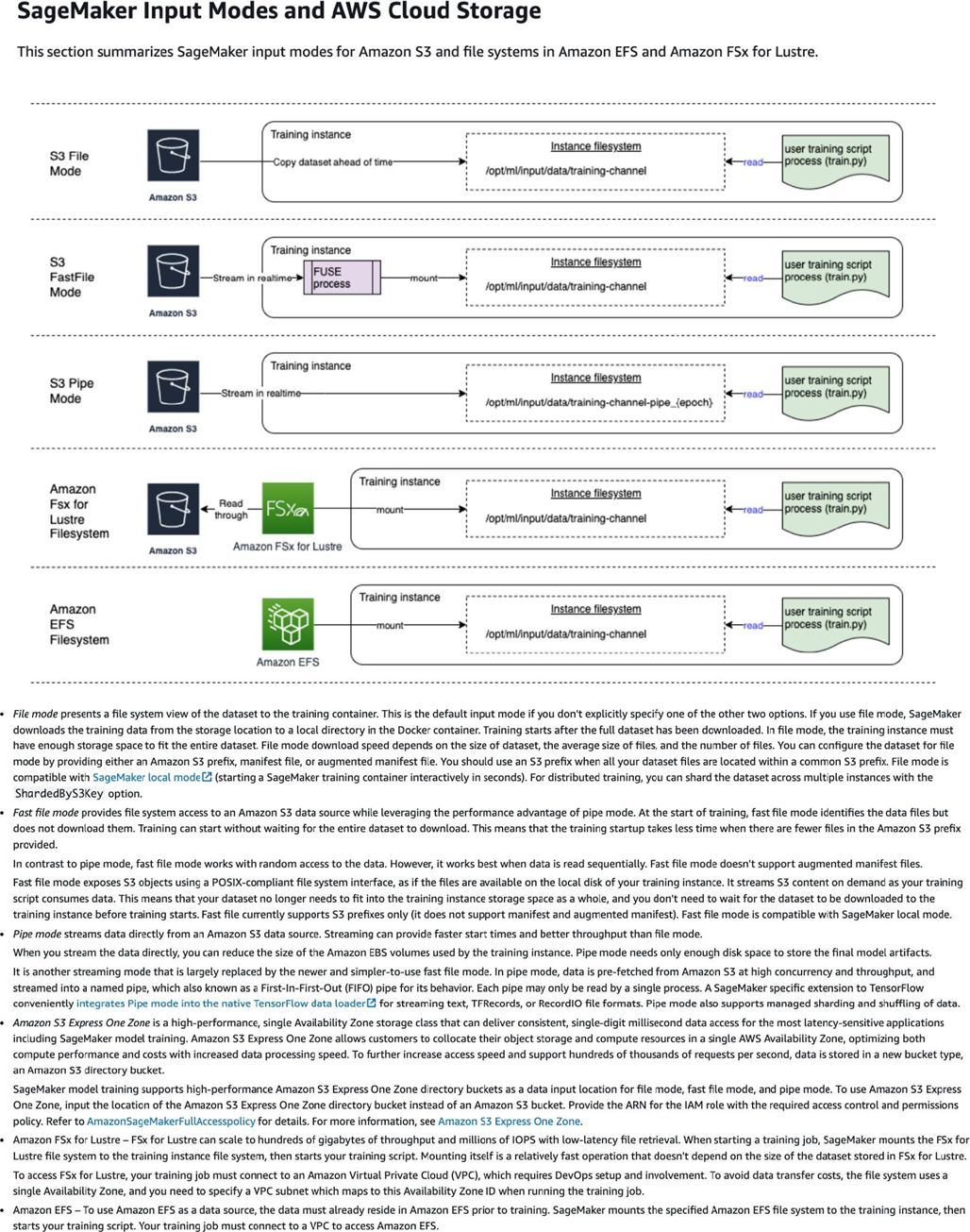
You are a data scientist at a healthcare company developing a machine learning model to analyze medical imaging data, such as X-rays and MRIs, for disease detection. The dataset consists of 10 million high-resolution images stored in Amazon S3, amounting to several terabytes of data. The training process requires processing these images efficiently to avoid delays due to I/O bottlenecks, and you must ensure that the chosen data access method aligns with the large dataset size and the high throughput requirements of the model.
Given the size and nature of the dataset, which SageMaker input mode and AWS Cloud Storage configuration is the MOST SUITABLE for this use case?
- A . Select the Pipe input mode to stream the data directly from Amazon S3 to the training instances, allowing the model to start processing data immediately without requiring local storage for the entire dataset
- B . Use the File input mode with EFS (Amazon Elastic File System) to mount the dataset across multiple instances, ensuring data is shared and accessible during distributed training
- C . Implement the FastFile input mode with FSx for Lustre, to enable on-demand streaming of data chunks from Amazon S3 with low latency and high throughput
- D . Use the File input mode to download the entire dataset from Amazon S3 to the training instances’
local storage before starting the training process, ensuring that all data is available locally during training