
Amazon MLA-C01 Practice Exams
Last updated on Oct 22,2026- Exam Code: MLA-C01
- Exam Name: AWS Certified Machine Learning Engineer - Associate
- Certification Provider: Amazon
- Latest update: Oct 22,2026
Which AWS services are specifically designed to aid in monitoring machine learning models and incorporating human review processes? (Select two)
- A . Amazon SageMaker Feature Store
- B . Amazon SageMaker Ground Truth
- C . Amazon Augmented AI (Amazon A2I)
- D . Amazon SageMaker Data Wrangler
- E . Amazon SageMaker Model Monitor
You are preparing a dataset for training a machine learning model using SageMaker Data Wrangler. The dataset has several missing values spread across different columns, and these columns contain numeric data. Before training the model, it is essential to handle these missing values to ensure the model performs optimally. The goal is to replace the missing values in each numeric column with the mean of that column.
Which transformation in SageMaker Data Wrangler should you apply to replace the missing values in numeric columns with the mean of those columns?
- A . Encode
- B . Impute
- C . Scale
- D . Drop
Why is it important to estimate the amount of uncertainty in an ML model?
- A . To improve the model’s computational efficiency
- B . To increase the speed of data processing
- C . To reduce the amount of training data needed
- D . To avoid potential misinterpretations of life and property
What characterizes a simple machine learning model?
- A . Low accuracy but high explainability
- B . High accuracy and high explainability
- C . Low accuracy and low explainability
- D . High accuracy but low explainability
You are a machine learning engineer at a healthcare startup that uses an Amazon SageMaker endpoint to deliver real-time diagnostics based on patient data. The model needs to handle a high volume of requests with low latency to ensure timely results. Recently, the startup has experienced rapid growth, leading to occasional periods of high traffic where users experience increased latency and, in some cases, request timeouts. You also need to be mindful of cost, as the startup operates on a tight budget.
Which approach is the MOST EFFECTIVE for troubleshooting and resolving the capacity concerns while balancing cost and performance?
- A . Request a service quota increase for the SageMaker endpoint to allow for more instances during peak traffic, and set up a CloudWatch Alarm to notify you when utilization exceeds 80% of the current quota
- B . Increase the instance size for the SageMaker endpoint to handle more requests per instance, and manually monitor performance and costs using Amazon CloudWatch metrics
- C . nable auto-scaling for the SageMaker endpoint to automatically adjust the number of instances based on request load, and set a budget alert in AWS Budgets to monitor cost increases as traffic scales
- D . Use AWS Lambda with provisioned concurrency to handle the requests, ensuring that the function is always ready to serve traffic. Configure Lambda to auto-scale based on traffic but limit the maximum concurrency to control costs
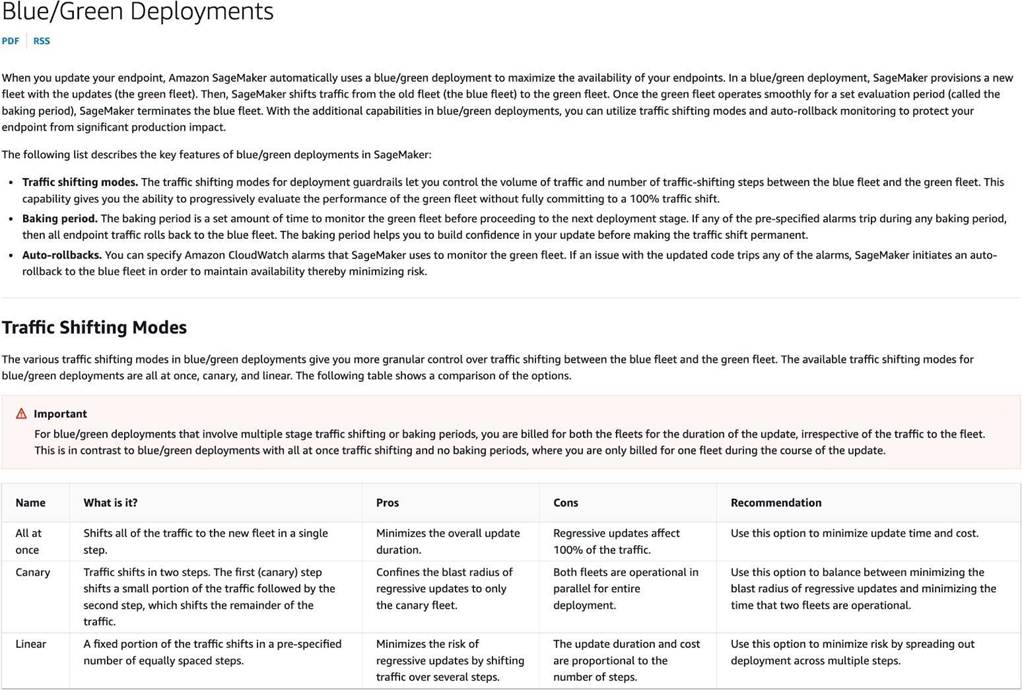
You are an ML Engineer working for a healthcare company that uses a machine learning model to recommend personalized treatment plans to patients. The model is deployed on Amazon SageMaker and is critical to the company’s operations, as any incorrect predictions could have significant consequences. A new version of the model has been developed, and you need to deploy it in production. However, you want to ensure that the deployment process is robust, allowing you to quickly roll back to the previous version if any issues arise. Additionally, you need to maintain version control for future updates and manage traffic between different model versions.
Which of the following strategies should you implement to ensure a smooth and reliable deployment of the new model version using Amazon SageMaker, considering best practices for versioning and rollback strategies? (Select two)
- A . Utilize Amazon SageMaker’s blue/green deployment strategy to shift traffic gradually from the old model to the new one, ensuring that you can monitor performance and quickly revert if needed
- B . Deploy the new model version immediately and redirect 100% of traffic to it, assuming it has been thoroughly tested and will not require a rollback
- C . Use Amazon SageMaker’s built-in versioning to manage different versions of the model, and deploy the new version in a canary release by redirecting a small percentage of traffic to it initially
- D . Create a backup of the current model, deploy the new version, and if any issues arise, manually roll back by redeploying the previous model version
- E . Deploy the new model version alongside the current one, and use Amazon SageMaker’s multi-
model endpoint to serve both models simultaneously, splitting traffic between them
What is the main goal of testing the model in ML?
- A . To prepare the data for training
- B . To generate predictions for new data
- C . To construct input representations from raw variables
- D . To evaluate the quality of the model on held-out data
A company is using a fleet of Amazon EC2 instances to ingest data from on-premises data sources. The data is in JSON format and ingestion rates can be as high as 1 MB/s. When an EC2 instance is rebooted, the data in flight is lost. The company’s data science team wants to query ingested data in near-real time.
Which solution provides near-real-time data querying that is scalable with minimal data loss?
- A . Store ingested data in an Amazon Elastic Block Store (Amazon EBS) volume. Write to Amazon S3 bucket and use Amazon Redshift Spectrum to query the data
- B . Store ingested data in an Amazon Elastic Block Store (Amazon EBS) volume. Publish data to Amazon ElastiCache for Redis. Subscribe to the Redis channel to query the data
- C . Publish data to Amazon Kinesis Data Streams, use Kinesis Data Analytics to query the data
- D . Store ingested data in an EC2 instance store. Publish data to Amazon Kinesis Data Firehose with
Amazon S3 as the destination. Use Amazon Athena to query the data
How does the Amazon flywheel model ensure continuous improvement and growth?
- A . By using feedback loops that integrate customer experience, selection, and pricing.
- B . By limiting the scope of operational improvements to cost reduction only.
- C . By avoiding changes to business practices.
- D . By maintaining a static approach to business operations.
You are a machine learning engineer at a biotechnology company working on a deep learning model to analyze genomic sequences. The model requires significant computational resources for training due to the complexity and size of the dataset, which consists of billions of nucleotide sequences. Additionally, once deployed, the model must provide real-time inferences for clinical applications, requiring low-latency predictions. Your task is to choose the appropriate compute environment for both training and inference.
Which of the following compute environment configurations is the MOST SUITABLE for meeting the training and inference requirements of this use case?
- A . Use Amazon SageMaker with p3 instances (NVIDIA V100 GPUs) for training, and deploy the model using ml.m5.large instances (Intel Skylake CPUs) for real-time inference to balance cost and performance
- B . Use Amazon EC2 with g4dn instances (NVIDIA T4 GPUs) for both training and inference, optimizing for cost-efficiency while maintaining moderate GPU performance
- C . Use Amazon SageMaker with ml.c5.large instances (Intel Cascade Lake CPUs) for training and inference, relying on the CPU’s high memory bandwidth for both tasks
- D . Use Amazon SageMaker with p4d instances (NVIDIA A100 GPUs) for training to handle large-scale deep learning workloads, and deploy the model using ml.inf1 instances (AWS Inferentia chips) for low-latency inference