Amazon MLA-C01 Practice Exams
Last updated on Oct 21,2026- Exam Code: MLA-C01
- Exam Name: AWS Certified Machine Learning Engineer - Associate
- Certification Provider: Amazon
- Latest update: Oct 21,2026
You are a data scientist working for a financial institution that uses a machine learning model to predict loan defaults. The model was trained on historical data from the past five years, but after being deployed for several months, its accuracy has gradually decreased. Upon investigation, you suspect that the underlying data distribution has changed due to economic shifts and changes in customer behavior. This phenomenon is known as model drift, and you need to address it to ensure the model continues to perform well.
Which of the following approaches would you combine for detecting and managing drift in your ML model? (Select two)
- A . Decrease the complexity of the model by removing features and layers, thereby turning it into a simpler model that can various types of data distributions
- B . Increase the complexity of the model by adding more features and deeper layers, ensuring it can adapt to changing data distributions over time
- C . Deploy a secondary model trained on different data and compare its predictions with the original model to detect any significant differences, indicating potential drift
- D . Retrain the model on the most recent data to ensure it captures current trends, and use model versioning to track performance improvements over time
- E . Implement continuous monitoring of input data features and model predictions using statistical tests
to detect shifts in data distribution or performance, triggering an alert when drift is detected
A Data Scientist is training a multilayer perception (MLP) on a dataset with multiple classes. The target class of interest is unique compared to the other classes within the dataset, but it does not achieve an acceptable recall metric. The Data Scientist has already tried varying the number and size of the MLP’s hidden layers, which has not significantly improved the results. A solution to improve recall must be implemented as quickly as possible.
Which techniques should be used to meet these requirements?
- A . Train an anomaly detection model instead of an MLP
- B . Train an XGBoost model instead of an MLP
- C . Gather more data using Amazon Mechanical Turk and then retrain
- D . Add class weights to the MLP’s loss function and then retrain
You are a data scientist at a financial technology company developing a fraud detection system. The system needs to identify fraudulent transactions in real-time based on patterns in transaction data, including amounts, locations, times, and account histories. The dataset is large and highly imbalanced, with only a small percentage of transactions labeled as fraudulent. Your team has access to Amazon SageMaker and is considering various built-in algorithms to build the model.
Given the need for both high accuracy and the ability to handle imbalanced data, which SageMaker built-in algorithm is the MOST SUITABLE for this use case?
- A . Implement the K-Nearest Neighbors (k-NN) algorithm to classify transactions based on similarity to known fraudulent cases
- B . Apply the XGBoost algorithm with a custom objective function to optimize for precision and recall
- C . Select the Random Cut Forest (RCF) algorithm for its ability to detect anomalies in transaction data
- D . Use the Linear Learner algorithm with weighted classification to address the class imbalance
What is the bias versus variance trade-off in machine learning?
- A . The bias versus variance trade-off refers to the balance between underfitting and overfitting, where high bias leads to overfitting and high variance leads to underfitting
- B . The bias versus variance trade-off is a technique used to improve model performance by increasing both bias and variance simultaneously to achieve better generalization
- C . The bias versus variance trade-off refers to the challenge of balancing the error due to the model’s complexity (variance) and the error due to incorrect assumptions in the model (bias), where high bias can cause underfitting and high variance can cause overfitting
- D . The bias versus variance trade-off involves choosing between a model with high complexity that may capture more noise (high bias) and a simpler model that may generalize better but miss important patterns (high variance)
A Machine Learning Specialist is developing a custom video recommendation model for an application.
The dataset used to train this model is very large with millions of data points and is hosted in an Amazon S3 bucket. The Specialist wants to avoid loading all of this data onto an Amazon SageMaker notebook instance because it would take hours to move and will exceed the attached 5 GB Amazon EBS volume on the notebook instance.
Which approach allows the Specialist to use all the data to train the model?
- A . Load a smaller subset of the data into the SageMaker notebook and train locally. Confirm that the training code is executing and the model parameters seem reasonable. Launch an Amazon EC2 instance with an AWS Deep Learning AMI and attach the S3 bucket to train the full dataset.
- B . Use AWS Glue to train a model using a small subset of the data to confirm that the data will be compatible with Amazon SageMaker. Initiate a SageMaker training job using the full dataset from the S3 bucket using Pipe input mode.
- C . Load a smaller subset of the data into the SageMaker notebook and train locally. Confirm that the training code is executing and the model parameters seem reasonable. Initiate a SageMaker training job using the full dataset from the S3 bucket using Pipe input mode.
- D . Launch an Amazon EC2 instance with an AWS Deep Learning AMI and attach the S3 bucket to the instance. Train on a small amount of the data to verify the training code and hyperparameters. Go back to Amazon SageMaker and train using the full dataset.
You are a machine learning engineer working for a telecommunications company that needs to develop a predictive maintenance model. The goal is to predict when network equipment is likely to fail based on historical sensor data. The data includes features such as temperature, pressure, usage, and error rates recorded over time. The company wants to avoid unplanned downtime and optimize maintenance schedules by predicting failures just in time.
Given the nature of the data and the business objective, which Amazon SageMaker built-in algorithm is the MOST SUITABLE for this use case?
- A . DeepAR Algorithm to forecast future equipment failures based on historical data
- B . Time Series K-Means Algorithm to cluster similar patterns in the sensor data and predict failures
- C . Random Cut Forest (RCF) Algorithm to detect anomalies in sensor data that may indicate impending failures
- D . Linear Learner Algorithm to classify equipment status as ‘healthy’ or ‘at risk’ based on sensor readings
What is the primary distinction between discriminative models and generative models in the context of generative AI?
- A . Discriminative models are only used for text classification, while generative models are only used for image classification
- B . Discriminative models are used to generate new data, while generative models are used only for classification
- C . Generative models are trained on labeled data, while discriminative models can be trained on both labeled and unlabeled data
- D . Generative models focus on generating new data from learned patterns, whereas discriminative models classify data by distinguishing between different classes
You are a data scientist working for a media company that processes large volumes of video and image data to generate personalized content recommendations. The dataset, which is stored in Amazon S3, contains tens of millions of small image files and several terabytes of high-resolution large video files. The training jobs you run on Amazon SageMaker require low-latency access to this data and need to be completed quickly to keep up with the dynamic content pipeline.
Given the characteristics of your data and the requirements for low-latency, high-throughput access, which approach is the MOST APPROPRIATE for this scenario?
- A . Use Fast File mode with Amazon S3 for the large video files, enabling on-demand streaming of data, and store the small image files locally on the training instances to reduce I/O latency
- B . Use Amazon FSx for Lustre to mount the entire dataset as a high-performance file system, providing consistently low-latency access to both the small image files and the large video files
- C . Create an FSx for Lustre file system linked with the Amazon S3 bucket folder having the training data for the small image files and apply Fast File mode for the video files in the relevant Amazon S3 bucket folder, thereby combining the strengths of both approaches
- D . Use Fast File mode with Amazon S3 to stream the small image files directly to the training instances on-demand, minimizing the time required to start training
Which benefits might persuade a developer to choose a transparent and explainable machine learning model? (Select two)
- A . They foster trust and confidence in model predictions
- B . They enhance security by concealing model logic
- C . They simplify the integration process with other systems
- D . They facilitate easier debugging and optimization
- E . They require less computational power and storage
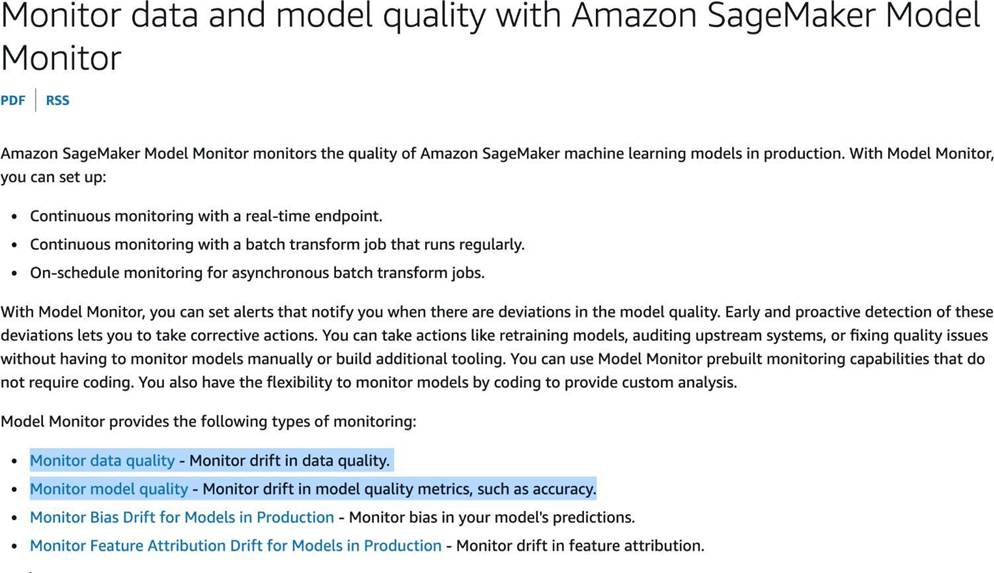
You are a machine learning engineer at an e-commerce company that uses a recommendation model to suggest products to customers. The model was trained on data from the past year, but after being in production for several months, you notice that the model’s recommendations are becoming less relevant. You suspect that either data drift or model drift could be causing the decline in performance. To investigate and resolve the issue, you need to understand the difference between these two types of drift and how to monitor them using Amazon SageMaker.
Which of the following statements BEST describes the difference between data drift and model drift, and how you would address them using Amazon SageMaker?
- A . Data drift occurs when the distribution of the input data changes over time, while model drift happens when the model’s underlying assumptions or parameters become outdated. To address data drift, you should use SageMaker Model Monitor to track changes in input data distribution. For model drift, you should periodically retrain the model using the latest data
- B . Data drift is a sudden change in the model’s accuracy, while model drift is a gradual degradation in model performance. You should use SageMaker Feature Store to manage both types of drift by standardizing input data
- C . Data drift occurs when the model’s predictions start to deviate from the expected outcomes, while model drift occurs when the model’s accuracy declines due to changes in the input data. SageMaker Pipelines should be used to automate retraining for both types of drift
- D . Data drift refers to changes in the model’s accuracy due to shifts in the data, while model drift refers to changes in the underlying data features over time. To address both, you should use SageMaker
Clarify to detect bias and retrain the model monthly